Yin Sha-Sha, Ma Feng-Lian, Gao Xing
Department of Pediatric Medicine, Linyi People's Hospital, Linyi, Shandong 276000, P.R. China.
Exp Ther Med. 2017 May;13(5):1813-1819. doi: 10.3892/etm.2017.4219. Epub 2017 Mar 10.
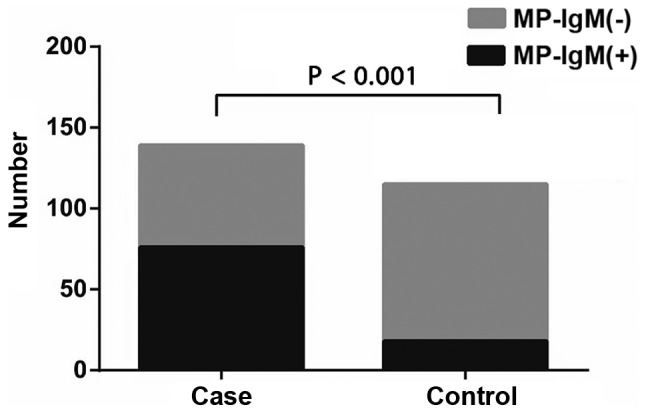
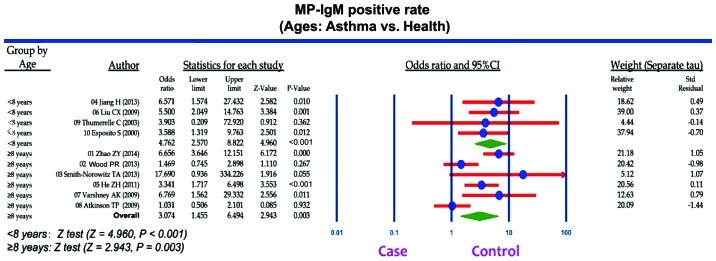
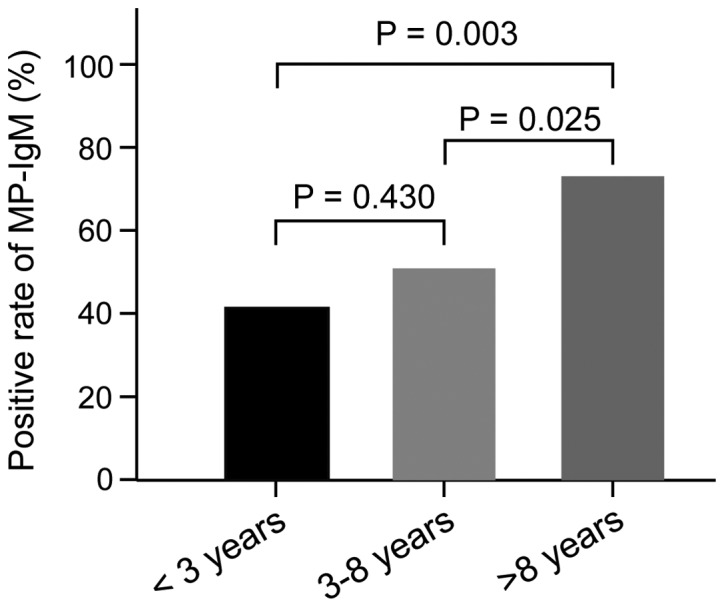
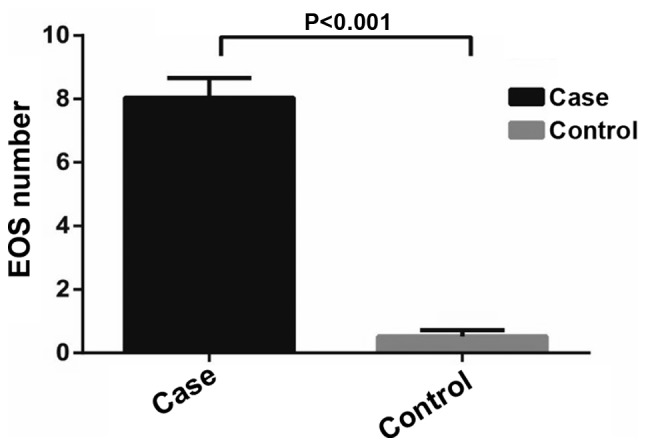
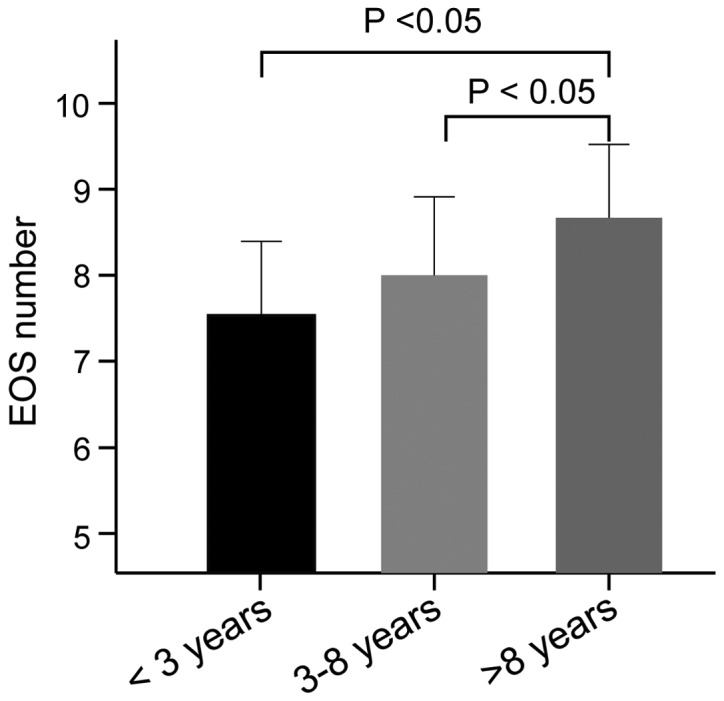
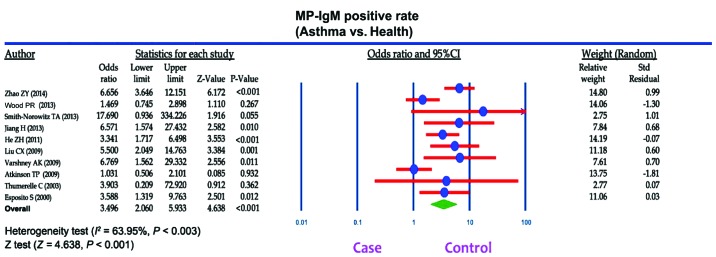
The present study was conducted to investigate the relationship between (MP) infection and the risk of asthma among children by detecting the rate of MP immunoglobulin M (MP-IgM) and the eosinophil (EOS) count. A total of 139 asthmatic children were enrolled as the case group and assigned into three groups: Group A (aged <3 years, n=42), group B (aged 3-8 years, n=45) and group C (aged >8 years, n=52). Additionally, 115 healthy children were enrolled in the control group. Enzyme-linked immunosorbent assay was used to measure the MP-IgM-positive rate. EOS count was detected in the experimental and control groups by using a hemocytometer analyzer. A meta-analysis was performed by using the Comprehensive Meta-Analysis version 2.0 software. The positive rates of the MP-IgM and EOS count in the experimental group were significantly higher than those in control group (both P<0.001). Furthermore, the asthmatic children in group C had a higher MP-IgM-positive rate and EOS count as compared to those in groups A and B, respectively (all P<0.05). Results from groups A and B were not statistically significant (all P>0.05). The meta-analysis further confirmed that asthmatic children had a higher MP-IgM-positive rate as compared to the healthy controls (P<0.001). Age-stratified analysis revealed that the MP-IgM-positive rate in asthmatic children aged ≥8 and <8 years was significantly higher than that in the healthy controls (P=0.003 and P<0.001). Asthmatic children had a higher MP-IgM-positive rate and EOS count as compared with controls, suggesting that the MP infection may be closely associated with the risk of asthma. Additionally, the positive rate of MP-IgM may indicate an important biological marker in predicting the development of asthma.
本研究旨在通过检测肺炎支原体免疫球蛋白M(MP-IgM)率和嗜酸性粒细胞(EOS)计数,探讨儿童肺炎支原体(MP)感染与哮喘风险之间的关系。共纳入139例哮喘儿童作为病例组,并分为三组:A组(年龄<3岁,n = 42)、B组(年龄3 - 8岁,n = 45)和C组(年龄>8岁,n = 52)。此外,纳入115例健康儿童作为对照组。采用酶联免疫吸附测定法检测MP-IgM阳性率。使用血细胞分析仪在实验组和对照组中检测EOS计数。使用Comprehensive Meta-Analysis 2.0软件进行荟萃分析。实验组中MP-IgM和EOS计数的阳性率显著高于对照组(均P<0.001)。此外,与A组和B组相比,C组哮喘儿童的MP-IgM阳性率和EOS计数分别更高(均P<0.05)。A组和B组的结果无统计学意义(均P>0.05)。荟萃分析进一步证实,与健康对照组相比,哮喘儿童的MP-IgM阳性率更高(P<0.001)。年龄分层分析显示,年龄≥8岁和<8岁的哮喘儿童的MP-IgM阳性率显著高于健康对照组(P = 0.003和P<0.001)。与对照组相比,哮喘儿童的MP-IgM阳性率和EOS计数更高,提示MP感染可能与哮喘风险密切相关。此外,MP-IgM阳性率可能是预测哮喘发展的重要生物学标志物。