Tzani-Tzanopoulou Panagiota, Skliros Dimitrios, Megremis Spyridon, Xepapadaki Paraskevi, Andreakos Evangelos, Chanishvili Nina, Flemetakis Emmanouil, Kaltsas Grigoris, Taka Styliani, Lebessi Evangelia, Doudoulakakis Anastassios, Papadopoulos Nikolaos G
Allergy and Clinical Immunology Unit, 2nd Pediatric Clinic, National and Kapodistrian University of Athens, Athens, Greece.
Laboratory of Molecular Biology, Department of Biotechnology, School of Food, Biotechnology and Development, Agricultural University of Athens, Athens, Greece.
Front Allergy. 2021 Jan 26;1:617240. doi: 10.3389/falgy.2020.617240. eCollection 2020.
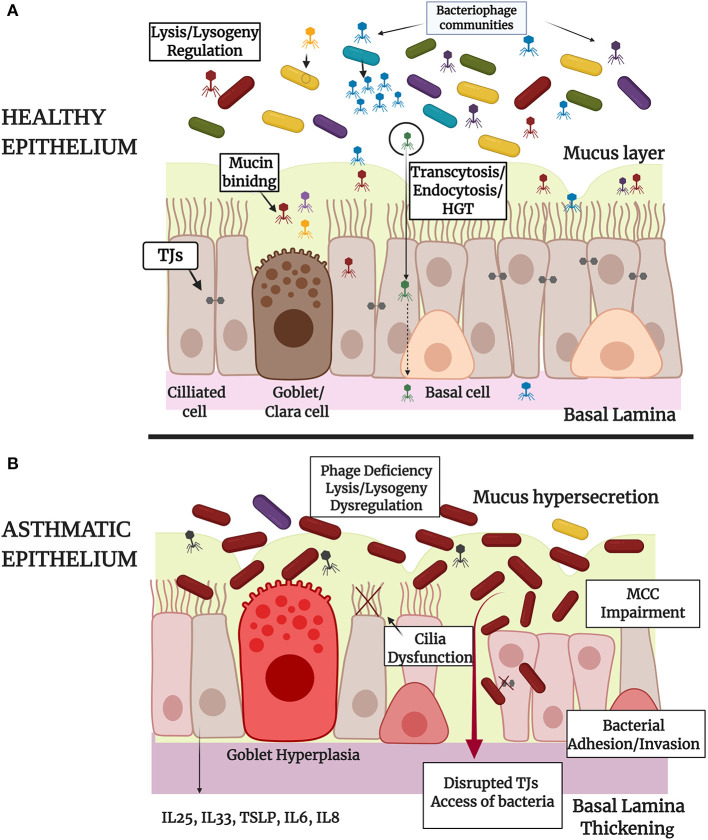
The airway epithelium is the primary site where inhaled and resident microbiota interacts between themselves and the host, potentially playing an important role on allergic asthma development and pathophysiology. With the advent of culture independent molecular techniques and high throughput technologies, the complex composition and diversity of bacterial communities of the airways has been well-documented and the notion of the lungs' sterility definitively rejected. Recent studies indicate that the microbial composition of the asthmatic airways across the spectrum of disease severity, differ significantly compared with healthy individuals. In parallel, a growing body of evidence suggests that bacterial viruses (bacteriophages or simply phages), regulating bacterial populations, are present in almost every niche of the human body and can also interact directly with the eukaryotic cells. The triptych of airway epithelial cells, bacterial symbionts and resident phages should be considered as a functional and interdependent unit with direct implications on the respiratory and overall homeostasis. While the role of epithelial cells in asthma pathophysiology is well-established, the tripartite interactions between epithelial cells, bacteria and phages should be scrutinized, both to better understand asthma as a system disorder and to explore potential interventions.
气道上皮是吸入性微生物群和常驻微生物群之间以及它们与宿主之间相互作用的主要部位,可能在过敏性哮喘的发展和病理生理学中发挥重要作用。随着非培养分子技术和高通量技术的出现,气道细菌群落的复杂组成和多样性已得到充分记录,肺部无菌的观念也被明确否定。最近的研究表明,在疾病严重程度的整个范围内,哮喘气道的微生物组成与健康个体相比有显著差异。与此同时,越来越多的证据表明,调节细菌种群的细菌病毒(噬菌体或简称为噬菌体)几乎存在于人体的每个生态位中,并且也可以直接与真核细胞相互作用。气道上皮细胞、细菌共生体和常驻噬菌体三者应被视为一个功能相互依存的单元,对呼吸和整体内环境稳定有直接影响。虽然上皮细胞在哮喘病理生理学中的作用已得到充分证实,但上皮细胞、细菌和噬菌体之间的三方相互作用仍需仔细研究,以便更好地将哮喘理解为一种系统性疾病,并探索潜在的干预措施。