Zhang Huang, Zhang Xiong, Huang Jie, Fan Xusheng
Department of Stomatology, Hangzhou First People's Hospital, Nanjing Medical University, Hangzhou, Zhejiang 310006, P.R. China.
Exp Ther Med. 2017 May;13(5):1832-1840. doi: 10.3892/etm.2017.4176. Epub 2017 Mar 2.
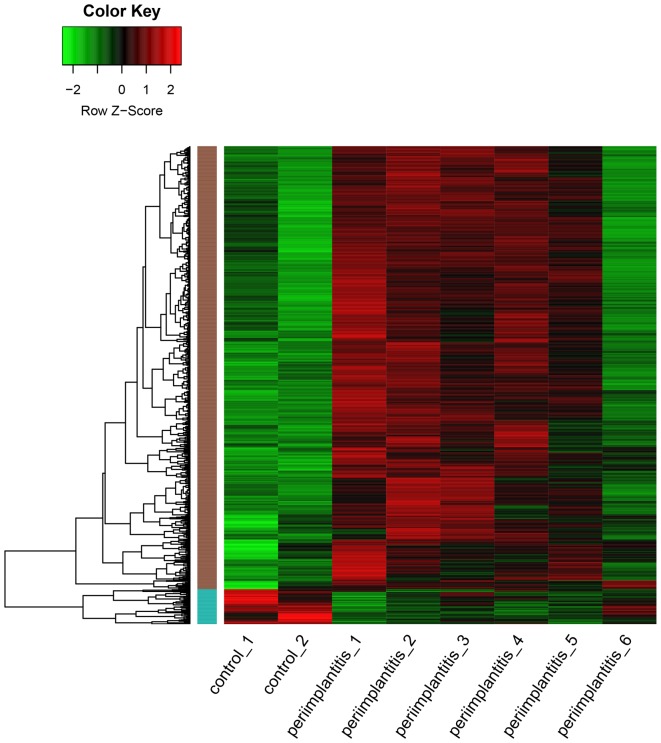
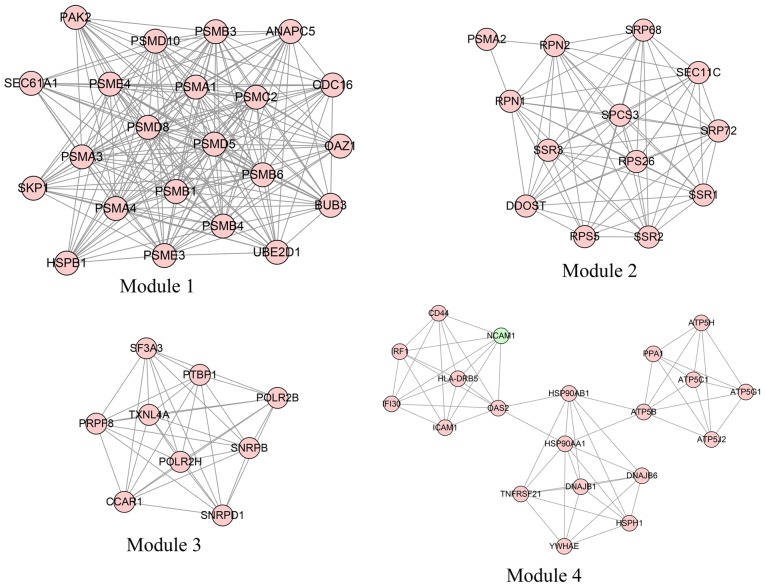
The present study attempted to identify potential key genes and pathways of peri-implantitis, and to investigate the possible mechanisms associated with it. An array data of GSE57631 was downloaded, including six samples of peri-implantitis tissue and two samples of normal tissue from the Gene Expression Omnibus (GEO) database. The differentially expressed genes (DEGs) in the peri-implantitis samples compared with normal ones were analyzed with the limma package. Moreover, Gene Ontology annotation and the Kyoto Encyclopedia of Genes and Genomes (KEGG) pathway enrichment analyses for DEGs were performed by DAVID. A protein-protein interaction (PPI) network was established using Cytoscape software, and significant modules were analyzed using Molecular Complex Detection. A total of 819 DEGs (759 upregulated and 60 downregulated) were identified in the peri-implantitis samples compared with normal ones. Moreover, the PPI network was constructed with 413 nodes and 1,114 protein pairs. Heat shock protein (90 kDa α, member 1), a hub node with higher node degrees in module 4, was significantly enriched in antigen processing, in the presentation pathway and nucleotide-binding oligomerization domain (NOD)-like receptor-signaling pathway. In addition, nuclear factor-κ-B1 () was enriched in the NOD-like receptor-signaling pathway in KEGG pathway enrichment analysis for upregulated genes. The proteasome is the most significant pathway in module 1 with the highest P-value. Therefore, the results of the present study suggested that and may be potential key genes, and the NOD-like receptor signaling pathway and proteasome may be potential pathways associated with peri-implantitis development.
本研究试图确定种植体周围炎的潜在关键基因和通路,并探讨与之相关的可能机制。从基因表达综合数据库(GEO)下载了GSE57631的阵列数据,包括6个种植体周围炎组织样本和2个正常组织样本。使用limma软件包分析种植体周围炎样本与正常样本相比的差异表达基因(DEG)。此外,通过DAVID对DEG进行基因本体注释和京都基因与基因组百科全书(KEGG)通路富集分析。使用Cytoscape软件建立蛋白质-蛋白质相互作用(PPI)网络,并使用分子复合物检测分析重要模块。与正常样本相比,在种植体周围炎样本中总共鉴定出819个DEG(759个上调和60个下调)。此外,构建的PPI网络有413个节点和1114个蛋白质对。热休克蛋白(90 kDaα,成员1)是模块4中节点度较高的枢纽节点,在抗原加工、呈递途径和核苷酸结合寡聚化结构域(NOD)样受体信号通路中显著富集。此外,在KEGG通路富集分析中,上调基因的核因子κB1在NOD样受体信号通路中富集。蛋白酶体是模块1中P值最高的最显著通路。因此,本研究结果表明,核因子κB1和热休克蛋白90 kDaα可能是潜在的关键基因,NOD样受体信号通路和蛋白酶体可能是与种植体周围炎发展相关的潜在通路。