Department of Environmental Science and Technology, Cyprus University of Technology, 30 Archbishop Kyprianou Str., 3603, Limassol, Cyprus.
Sci Rep. 2017 May 31;7(1):2523. doi: 10.1038/s41598-017-02892-w.
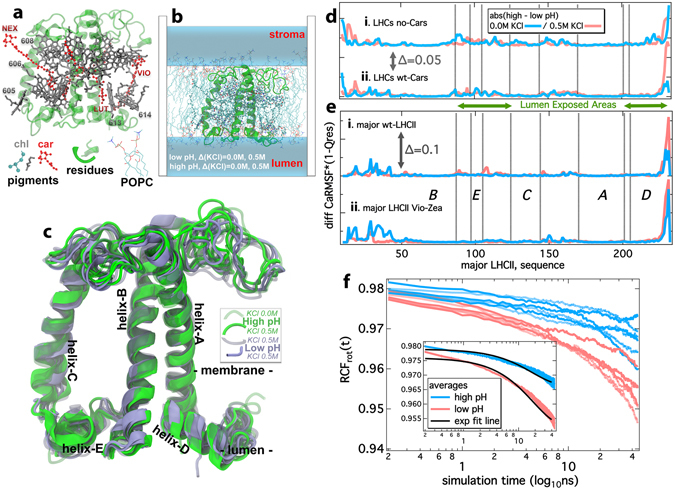
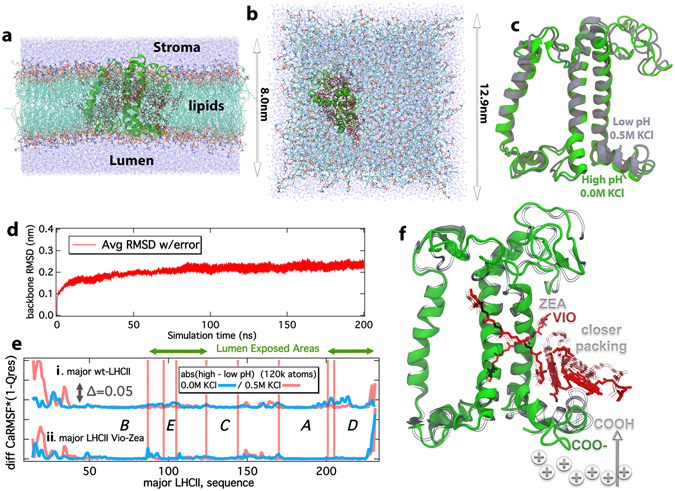
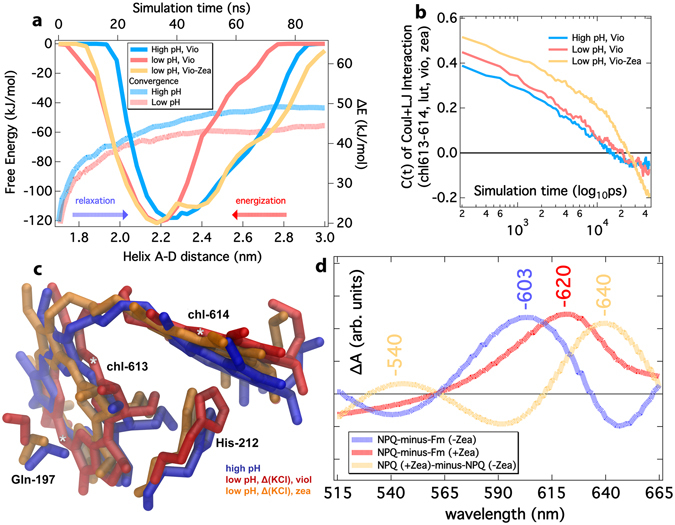
Photosynthesis is common in nature, converting sunlight energy into proton motive force and reducing power. The increased spectral range absorption of light exerted by pigments (i.e. chlorophylls, Chls) within Light Harvesting Complexes (LHCs) proves an important advantage under low light conditions. However, in the exposure to excess light, oxidative damages and ultimately cell death can occur. A down-regulatory mechanism, thus, has been evolved (non-photochemical quenching, NPQ). The mechanistic details of its major component (qE) are missing at the atomic scale. The research herein, initiates on solid evidence from the current NPQ state of the art, and reveals a detailed atomistic view by large scale Molecular Dynamics, Metadynamics and ab initio Simulations. The results demonstrate a complete picture of an elaborate common molecular design. All probed antenna proteins (major LHCII from spinach-pea, CP29 from spinach) show striking plasticity in helix-D, under NPQ conditions. This induces changes in Qy bands in excitation and absorption spectra of the near-by pigment pair (Chl613-614) that could emerge as a new quenching site. Zeaxanthin enhances this plasticity (and possibly the quenching) even at milder NPQ conditions.
光合作用在自然界中很常见,它将太阳能转化为质子动力和还原力。色素(即叶绿素,Chls)在光捕获复合物(LHCs)中对光的吸收光谱范围增加,这在低光照条件下是一个重要的优势。然而,在暴露于过量光下时,会发生氧化损伤,最终导致细胞死亡。因此,进化出了一种下调机制(非光化学猝灭,NPQ)。其主要成分(qE)的机制细节在原子尺度上仍然缺失。本文的研究从当前 NPQ 技术的现有证据出发,通过大规模分子动力学、元动力学和从头算模拟揭示了一个详细的原子级视图。结果展示了一个精心设计的常见分子的完整图景。所有探测到的天线蛋白(菠菜豌豆中的主要 LHCII、菠菜中的 CP29)在 NPQ 条件下,螺旋-D 表现出惊人的可塑性。这会导致附近色素对(Chl613-614)的激发和吸收光谱中 Qy 带的变化,这可能成为一个新的猝灭位点。玉米黄质增强了这种可塑性(可能还有猝灭作用),即使在 NPQ 条件较温和的情况下也是如此。