Li Ting, He Xiulan, Zhang Kailin, Wang Kai, Yu Ping, Mao Lanqun
Beijing National Laboratory for Molecular Sciences , Key Laboratory of Analytical Chemistry for Living Biosystems , Institute of Chemistry , The Chinese Academy of Sciences , Beijing 100190 , China.
University of Chinese Academy of Sciences , Beijing 100049 , P. R. China . Email:
Chem Sci. 2016 Oct 1;7(10):6365-6368. doi: 10.1039/c6sc02241c. Epub 2016 Jul 4.
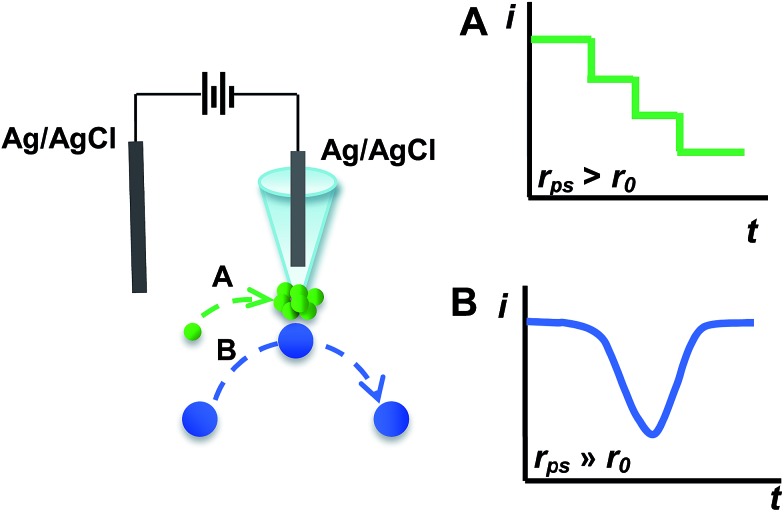
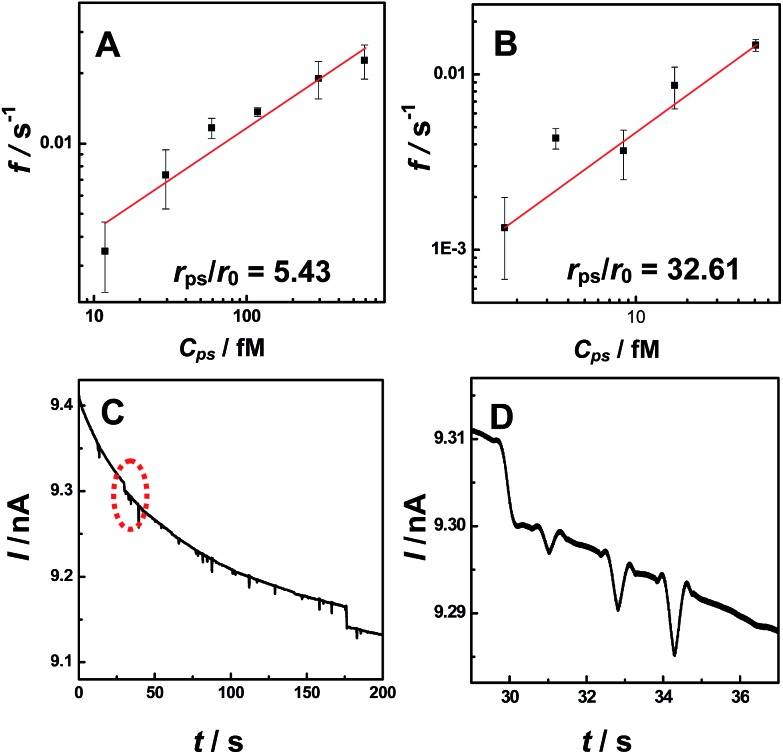
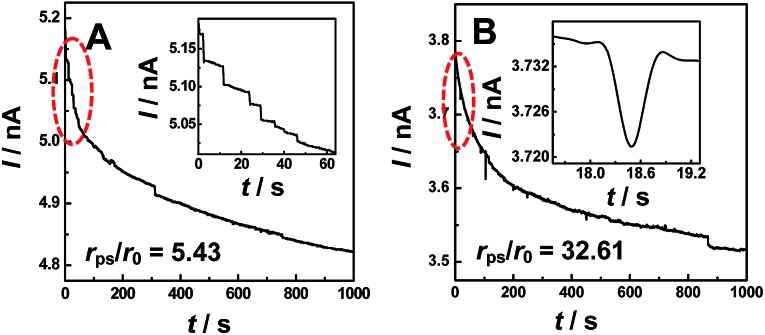
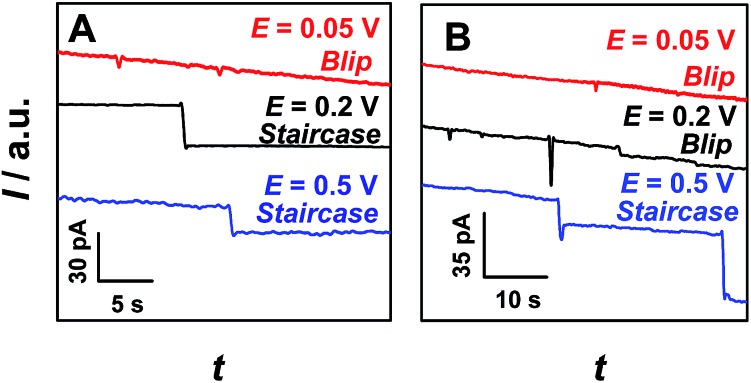
Single nanoparticle (NP) events are successfully observed at the orifice of a nanopipet by blocking the ionic current with a single NP. In addition to the traditional translocation events, we observe both staircase and blip current transients by controlling the radius ratio of NPs to nanopipet or bias potential. Confocal fluorescence microscopy and finite element simulation are used to simultaneously monitor and quantitatively understand these events, respectively. The frequency of the staircase and blip events is proportional to the NP concentration, and could be used for the quantification of NPs. This study offers a new method for NP determination and single NP behavior study.
通过用单个纳米粒子阻断离子电流,成功地在纳米吸管的管口观察到了单个纳米粒子(NP)事件。除了传统的转运事件外,我们通过控制纳米粒子与纳米吸管的半径比或偏置电位,观察到了阶梯状和尖峰状电流瞬变。共聚焦荧光显微镜和有限元模拟分别用于同时监测和定量理解这些事件。阶梯状和尖峰状事件的频率与纳米粒子浓度成正比,可用于纳米粒子的定量分析。本研究为纳米粒子的测定和单个纳米粒子行为的研究提供了一种新方法。