Mendelsohn Joshua B, Spiegel Paul, Grant Alison, Doraiswamy Sathyanarayanan, Schilperoord Marian, Larke Natasha, Burton John Wagacha, Okonji Jully A, Zeh Clement, Muhindo Bosco, Mohammed Ibrahim M, Mukui Irene N, Patterson Njogu, Sondorp Egbert, Ross David A
College of Health Professions, Pace University, New York, NY USA.
MRC Tropical Epidemiology Group, Department of Infectious Disease Epidemiology, London School of Hygiene and Tropical Medicine, London, United Kingdom.
Confl Health. 2017 May 31;11:11. doi: 10.1186/s13031-017-0111-3. eCollection 2017.
Refugees and host nationals who accessed antiretroviral therapy (ART) in a remote refugee camp in Kakuma, Kenya (2011-2013) were compared on outcome measures that included viral suppression and adherence to ART.
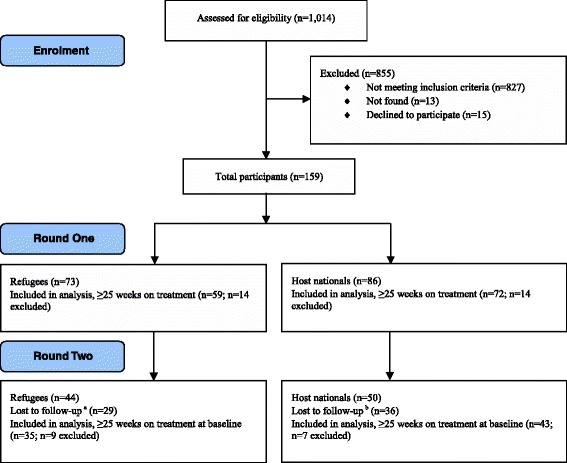
This study used a repeated cross-sectional design ( and ). All adults (≥18 years) receiving care from the refugee camp clinic and taking antiretroviral therapy (ART) for ≥30 days were invited to participate. Adherence was measured by self-report and monthly pharmacy refills. Whole blood was measured on dried blood spots. HIV-1 RNA was quantified and treatment failures were submitted for drug resistance testing. A remedial intervention was implemented in response to baseline testing. The primary outcome was viral load <5000 copies/mL. The two study rounds took place in 2011-2013.
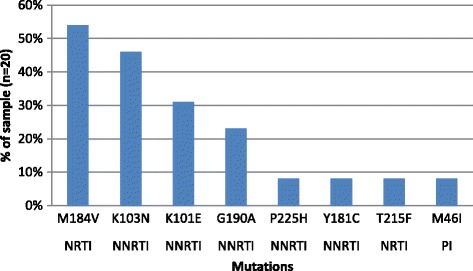
Among eligible adults, 86% (73/85) of refugees and 84% (86/102) of Kenyan host nationals participated in the survey; 60% (44/73) and 58% (50/86) of participants were recruited for follow-up viral load testing. In , refugees were older than host nationals (median age 36 years, interquartile range, IQR 31, 41 vs 32 years, IQR 27, 38); the groups had similar time on ART (median 147 weeks, IQR 38, 64 vs 139 weeks, IQR 39, 225). There was weak evidence for a difference between proportions of refugees and host nationals who were virologically suppressed (<5000 copies/mL) after 25 weeks on ART (58% vs 43%, = 0.10) and no difference in the proportions suppressed at (74% vs 70%, = 0.66). Mean adherence within each group in was similar. Refugee status was not associated with viral suppression in multivariable analysis (adjusted odds ratio: 1.69, 95% CI 0.79, 3.57; = 0.17). Among those not suppressed at either timepoint, 69% (9/13) exhibited resistance mutations.
Virologic outcomes among refugees and host nationals were similar but unacceptably low. Slight improvements were observed after a remedial intervention. Virologic monitoring was important for identifying an underperforming ART program in a remote facility that serves refugees alongside host nationals. This work highlights the importance of careful laboratory monitoring of vulnerable populations accessing ART in remote settings.
对2011年至2013年期间在肯尼亚卡库马一个偏远难民营中接受抗逆转录病毒疗法(ART)的难民和当地居民在包括病毒抑制和ART依从性等结局指标方面进行了比较。
本研究采用重复横断面设计(……)。邀请所有在难民营诊所接受治疗且接受抗逆转录病毒疗法(ART)≥30天的成年人(≥18岁)参与。通过自我报告和每月药房配药情况来衡量依从性。在干血斑上检测全血。对HIV-1 RNA进行定量,并将治疗失败病例送去进行耐药性检测。针对基线检测结果实施了一项补救干预措施。主要结局是病毒载量<5000拷贝/毫升。两轮研究于2011年至2013年进行。
在符合条件的成年人中,86%(73/85)的难民和84%(86/102)的肯尼亚当地居民参与了调查;参与调查者中有60%(44/73)和58%(50/86)被招募进行后续病毒载量检测。在……中,难民比当地居民年龄大(中位年龄36岁,四分位间距,IQR 31,41岁,而当地居民为32岁,IQR 27,38岁);两组接受ART的时间相似(中位时间147周,IQR 38,64周,而当地居民为139周,IQR 39,225周)。在接受ART 25周后,病毒学抑制(<5000拷贝/毫升)的难民和当地居民比例之间存在微弱差异证据(58%对43%,P = 0.10),在……时抑制比例无差异(74%对70%,P = 0.66)。每组在……时的平均依从性相似。在多变量分析中,难民身份与病毒抑制无关(调整后的优势比:1.69,95%CI 0.79,3.57;P = 0.17)。在两个时间点均未被抑制的患者中,69%(9/13)出现了耐药突变。
难民和当地居民之间的病毒学结局相似,但低得令人无法接受。补救干预后观察到略有改善。病毒学监测对于识别在为难民和当地居民服务的偏远机构中表现不佳的ART项目很重要。这项工作凸显了在偏远地区对接受ART的弱势群体进行仔细实验室监测的重要性。