Mazzone Roberta, Zwergel Clemens, Mai Antonello, Valente Sergio
Dipartimento di Chimica e Tecnologie del Farmaco, Sapienza Università di Roma, P.le Aldo Moro 5, 00185 Rome, Italy.
Center for Life Nano Science@Sapienza, Italian Institute of Technology, Viale Regina Elena 291, 00161 Rome, Italy.
Clin Epigenetics. 2017 May 30;9:59. doi: 10.1186/s13148-017-0358-y. eCollection 2017.
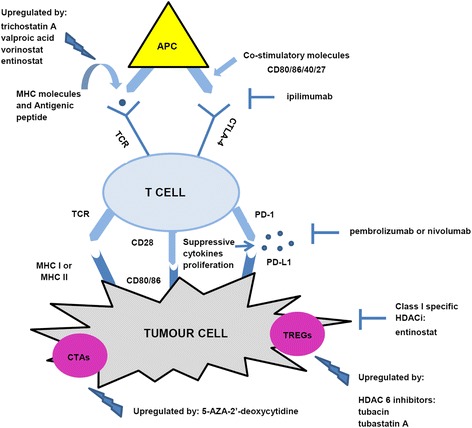
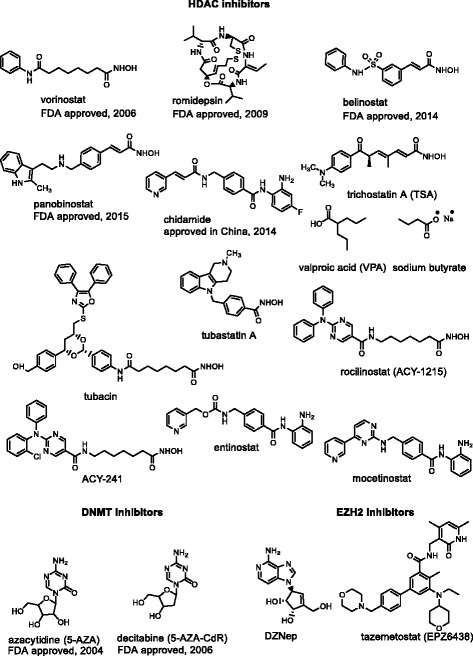
Immune checkpoint factors, such as programmed cell death protein-1/2 (PD-1, PD-2) or cytotoxic T lymphocyte-associated antigen-4 (CTLA-4) receptors, are targets for monoclonal antibodies (MAbs) developed for cancer immunotherapy. Indeed, modulating immune inhibitory pathways has been considered an important breakthrough in cancer treatment. Although immune checkpoint blockade therapy used to treat malignant diseases has provided promising results, both solid and haematological malignancies develop mechanisms that enable themselves to evade the host immune system. To overcome some major limitations and ensure safety in patients, recent strategies have shown that combining epigenetic modulators, such as inhibitors of histone deacetylases (HDACi) or DNA methyltransferases (DNMTi), with immunotherapeutics can be useful. Preclinical data generated using mouse models strongly support the feasibility and effectiveness of the proposed approaches. Indeed, co-treatment with pan- or class I-selective HDACi or DNMTi improved beneficial outcomes in both in vitro and in vivo studies. Based on the evidence of a pivotal role for HDACi and DNMTi in modulating various components belonging to the immune system, recent clinical trials have shown that both HDACi and DNMTi strongly augmented response to anti-PD-1 immunotherapy in different tumour types. This review describes the current strategies to increase immunotherapy responses, the effects of HDACi and DNMTi on immune modulation, and the advantages of combinatorial therapy over single-drug treatment.
免疫检查点因子,如程序性细胞死亡蛋白-1/2(PD-1、PD-2)或细胞毒性T淋巴细胞相关抗原-4(CTLA-4)受体,是为癌症免疫治疗开发的单克隆抗体(MAb)的靶点。事实上,调节免疫抑制途径已被视为癌症治疗的一项重要突破。尽管用于治疗恶性疾病的免疫检查点阻断疗法已取得了令人鼓舞的结果,但实体瘤和血液系统恶性肿瘤都发展出了能够逃避宿主免疫系统的机制。为了克服一些主要限制并确保患者安全,最近的策略表明,将表观遗传调节剂,如组蛋白去乙酰化酶抑制剂(HDACi)或DNA甲基转移酶抑制剂(DNMTi)与免疫治疗药物联合使用可能会有帮助。使用小鼠模型产生的临床前数据有力地支持了所提出方法的可行性和有效性。事实上,在体外和体内研究中,与泛选择性或I类选择性HDACi或DNMTi联合治疗都改善了有益结果。基于HDACi和DNMTi在调节免疫系统各种成分中起关键作用的证据,最近的临床试验表明,HDACi和DNMTi都能显著增强不同肿瘤类型对抗PD-1免疫治疗的反应。本综述描述了增强免疫治疗反应的当前策略、HDACi和DNMTi对免疫调节的影响,以及联合治疗相对于单药治疗的优势。