Feikin Daniel R, Hammitt Laura L, Murdoch David R, O'Brien Katherine L, Scott J Anthony G
International Vaccine Access Center, Department of International Health, Johns Hopkins Bloomberg School of Public Health, Baltimore, Maryland.
Division of Viral Diseases, National Center for Immunizations and Respiratory Diseases, Centers for Disease Control and Prevention, Atlanta, Georgia.
Clin Infect Dis. 2017 Jun 15;64(suppl_3):S188-S196. doi: 10.1093/cid/cix143.
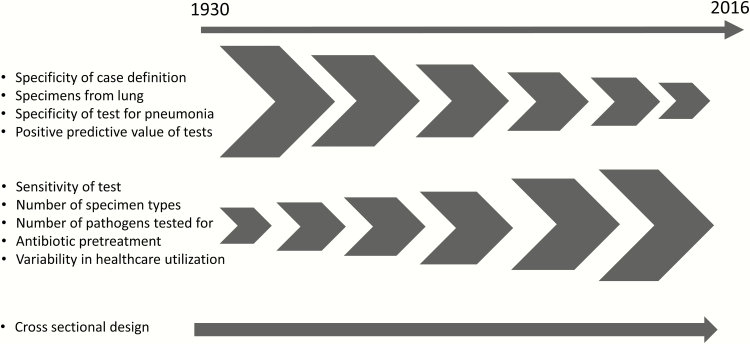
Pneumonia kills more children each year worldwide than any other disease. Nonetheless, accurately determining the causes of childhood pneumonia has remained elusive. Over the past century, the focus of pneumonia etiology research has shifted from studies of lung aspirates and postmortem specimens intent on identifying pneumococcal disease to studies of multiple specimen types distant from the lung that are tested for multiple pathogens. Some major challenges facing modern pneumonia etiology studies include the use of nonspecific and variable case definitions, poor access to pathologic lung tissue and to specimens from fatal cases, poor diagnostic accuracy of assays (especially when testing nonpulmonary specimens), and the interpretation of results when multiple pathogens are detected in a given individual. The future of childhood pneumonia etiology research will likely require integrating data from complementary approaches, including applications of advanced molecular diagnostics and vaccine probe studies, as well as a renewed emphasis on lung aspirates from radiologically confirmed pneumonia and postmortem examinations.
全球范围内,肺炎每年导致死亡的儿童数量超过其他任何疾病。尽管如此,准确确定儿童肺炎的病因仍然困难重重。在过去的一个世纪里,肺炎病因学研究的重点已从旨在识别肺炎球菌疾病的肺吸出物和尸检标本研究,转向对远离肺部的多种标本类型进行多种病原体检测的研究。现代肺炎病因学研究面临的一些主要挑战包括使用非特异性和可变的病例定义、难以获取病理肺组织和致命病例的标本、检测方法的诊断准确性差(尤其是在检测非肺部标本时),以及在个体中检测到多种病原体时对结果的解读。儿童肺炎病因学研究的未来可能需要整合来自互补方法的数据,包括先进分子诊断技术的应用和疫苗探针研究,以及重新重视经放射学确诊的肺炎患者的肺吸出物和尸检。