Zanotti Giovanni, Hunger Matthias, Perkins Julia J, Horblyuk Ruslan, Martin Monique
Pfizer Inc., 235E 42nd, New York, NY, 10017, USA.
Mapi, Konrad-Zuse-Platz 11, 81829, Munich, Germany.
BMC Cancer. 2017 Jun 2;17(1):393. doi: 10.1186/s12885-017-3379-1.
With several new therapies becoming available, treatment of metastatic breast cancer (mBC) is evolving. The objective of this study is to describe patient characteristics, treatment patterns and real-world clinical outcomes in post-menopausal women with ER+, HER2- mBC and to obtain insight into patient outcomes and potential unmet needs with current therapies.
The current study is a physician survey followed by a retrospective chart review of patient medical records by physicians in the US between March and April 2015. One hundred three physicians were asked to complete an online survey aiming to understand their satisfaction and expectations with current available treatments and potential areas of unmet need for mBC patients. Medical records from 178 females were extracted for the chart review. Using these data from medical records, patient characteristics and treatment patterns were analyzed descriptively. Time to progression (TTP) on first line, and progression-free survival (PFS) on second and third line of therapy were analyzed using the Kaplan-Meier method.
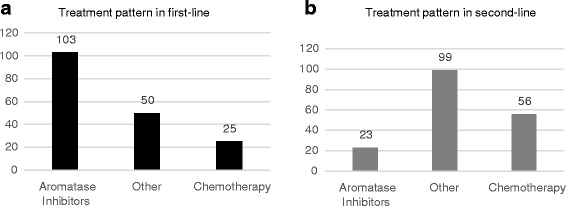
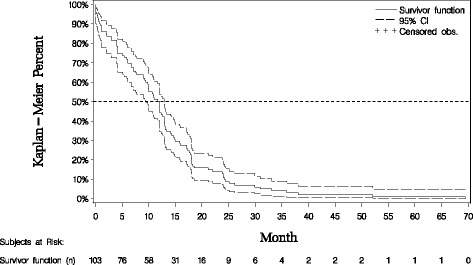
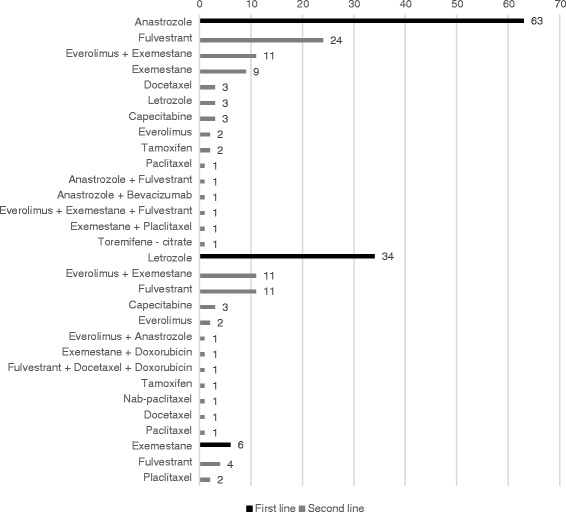
Sixty-seven percent (n = 119) of patients had metastatic disease at initial diagnosis of breast cancer. Mean age at chart data extraction was 65.8 (SD: 9.4) years. Aromatase inhibitors (AIs) were prescribed for 58% and around 13% of patients in first line and second line, respectively. Chemotherapy was prescribed to 14% in first line and 31% in second line. Median TTP on first line therapy was 12 months for patients receiving AIs as compared to 7.9 months for patients receiving chemotherapy. Across all treatment lines, bone pain and fatigue were reported as the main symptoms associated with disease progression which had an impact on patient quality of life. Physicians expressed that prolonging life was deemed the most important treatment goal, followed by preservation or improvement of quality of life.
In this study the majority of patients received endocrine therapy as first line treatment and current therapies still resulted in a short time to progression in first line. Results from the chart review and the physician survey highlight a quantitative unmet need for more effective treatments which delay disease progression and improve survival outcomes while maintaining quality of life.
随着多种新疗法的出现,转移性乳腺癌(mBC)的治疗正在不断发展。本研究的目的是描述绝经后雌激素受体阳性(ER+)、人表皮生长因子受体2阴性(HER2-)mBC患者的特征、治疗模式和真实世界临床结局,并深入了解患者结局以及当前疗法潜在的未满足需求。
本研究是一项医生调查,随后由美国医生在2015年3月至4月对患者病历进行回顾性分析。103名医生被要求完成一项在线调查,旨在了解他们对当前可用治疗方法的满意度和期望,以及mBC患者潜在的未满足需求领域。从178名女性患者的病历中提取数据进行病历回顾。利用这些病历数据,对患者特征和治疗模式进行描述性分析。采用Kaplan-Meier方法分析一线治疗的疾病进展时间(TTP)以及二线和三线治疗的无进展生存期(PFS)。
67%(n = 119)的患者在乳腺癌初诊时即有转移性疾病。提取病历数据时的平均年龄为65.8(标准差:9.4)岁。一线和二线分别有58%和约13%的患者使用芳香化酶抑制剂(AI)。一线化疗的患者比例为14%,二线为31%。接受AI治疗的患者一线治疗的中位TTP为12个月,而接受化疗的患者为7.9个月。在所有治疗线中,骨痛和疲劳被报告为与疾病进展相关的主要症状,对患者生活质量有影响。医生表示,延长生命被认为是最重要的治疗目标,其次是维持或改善生活质量。
在本研究中,大多数患者接受内分泌治疗作为一线治疗,而当前疗法一线治疗的疾病进展时间仍然较短。病历回顾和医生调查结果凸显了对更有效治疗方法的定量未满足需求,这些方法可延缓疾病进展、改善生存结局并维持生活质量。