Moores Cancer Center, University of California, San Diego, San Diego, CA, USA.
Department of Family Medicine and Public Health, University of California, San Diego, 3855 Health Sciences Drive #0901, La Jolla, CA, 92093-0901, USA.
Breast Cancer Res Treat. 2020 Jan;179(1):197-206. doi: 10.1007/s10549-019-05446-y. Epub 2019 Sep 21.
Multi-gene signatures provide biological insight and risk stratification in breast cancer. Intrinsic molecular subtypes defined by mRNA expression of 50 genes (PAM50) are prognostic in hormone-receptor positive postmenopausal breast cancer. Yet, for 25-40% in the PAM50 intermediate risk group, long-term risk remains uncertain. Our study aimed to (i) test the long-term prognostic value of the PAM50 signature in pre- and post-menopausal breast cancer; (ii) investigate if the PAM50 model could be improved by addition of other mRNAs implicated in oncogenesis.
We used archived FFPE samples from 1723 breast cancer survivors; high quality reads were obtained on 1253 samples. Transcript expression was quantified using a custom codeset with probes for > 100 targets. Cox models assessed gene signatures for breast cancer relapse and survival.
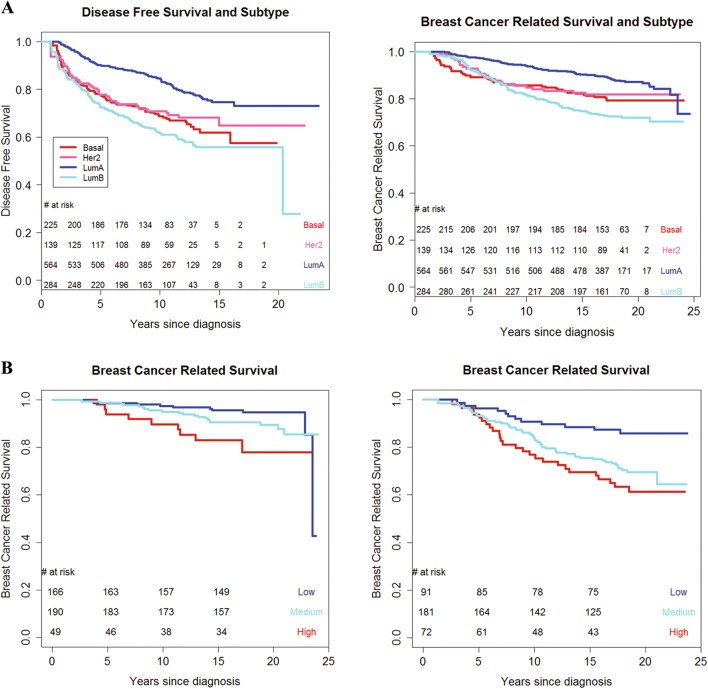
Over 15 + years of follow-up, PAM50 subtypes were (P < 0.01) associated with breast cancer outcomes after accounting for tumor stage, grade and age at diagnosis. Results did not differ by menopausal status at diagnosis. Women with Luminal B (versus Luminal A) subtype had a > 60% higher hazard. Addition of a 13-gene hypoxia signature improved prognostication with > 40% higher hazard in the highest vs lowest hypoxia tertiles.
PAM50 intrinsic subtypes were independently prognostic for long-term breast cancer survival, irrespective of menopausal status. Addition of hypoxia signatures improved risk prediction. If replicated, incorporating the 13-gene hypoxia signature into the existing PAM50 risk assessment tool, may refine risk stratification and further clarify treatment for breast cancer.
多基因标志可提供乳腺癌的生物学见解和风险分层。根据 50 个基因(PAM50)mRNA 表达定义的固有分子亚型在激素受体阳性绝经后乳腺癌中具有预后意义。然而,在 PAM50 中危组的 25-40%患者中,长期风险仍然不确定。我们的研究旨在:(i)检验 PAM50 标志在绝经前和绝经后乳腺癌中的长期预后价值;(ii)研究是否可以通过添加其他与致癌作用相关的 mRNAs 来改善 PAM50 模型。
我们使用了来自 1723 例乳腺癌幸存者的存档 FFPE 样本;在 1253 例样本中获得了高质量的读数。使用包含 >100 个靶标探针的定制代码集来定量转录物表达。Cox 模型评估了基因标志与乳腺癌复发和生存的相关性。
在超过 15 年的随访中,在考虑肿瘤分期、分级和诊断时的年龄后,PAM50 亚型(P<0.01)与乳腺癌结局相关。诊断时的绝经状态对结果没有影响。与 Luminal A 亚型(Luminal B)相比,Luminal B 亚型的女性发生乳腺癌的风险高出>60%。添加一个 13 个基因的缺氧标志可改善预后,在缺氧标志最高和最低三分位组中,发生风险高出>40%。
PAM50 固有亚型独立于绝经状态预测长期乳腺癌生存,添加缺氧标志可改善风险预测。如果得到验证,将 13 个基因的缺氧标志纳入现有的 PAM50 风险评估工具中,可能会改善风险分层,并进一步阐明乳腺癌的治疗。