Jeong Jipseol, An Injung, Oem Jae-Ku, Wang Seung-Jun, Kim Yongkwan, Shin Jeong-Hwa, Woo Chanjin, Kim Youngsik, Jo Seong-Deok, Son Kidong, Lee Saemi, Jheong Weonhwa
Environmental Health Research Department, National Institute of Environmental Research, Hwangyeong-ro42, Seo-gu, Incheon, Republic of Korea.
J Vet Med Sci. 2017 Jul 7;79(7):1204-1209. doi: 10.1292/jvms.16-0516. Epub 2017 Jun 2.
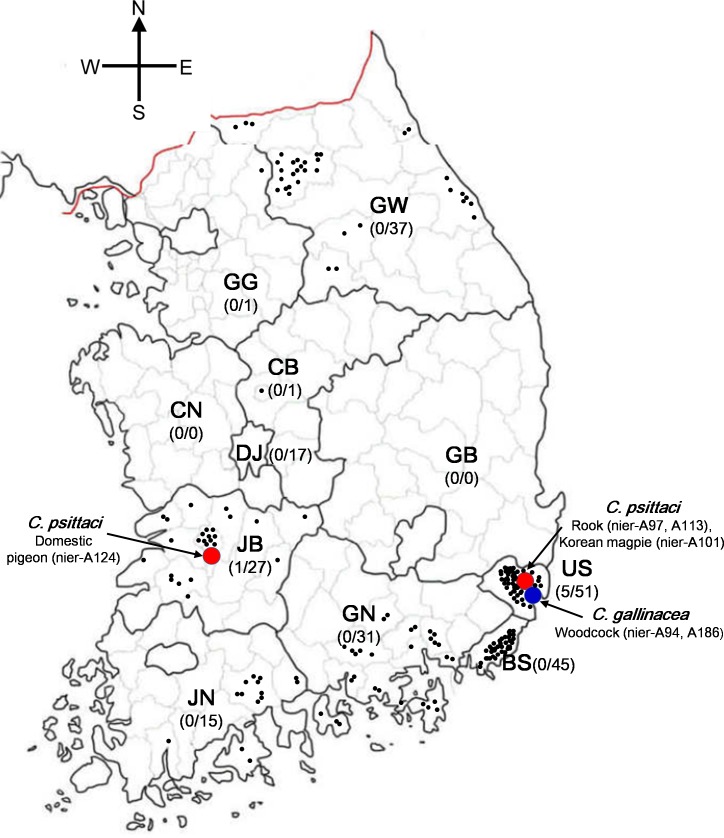
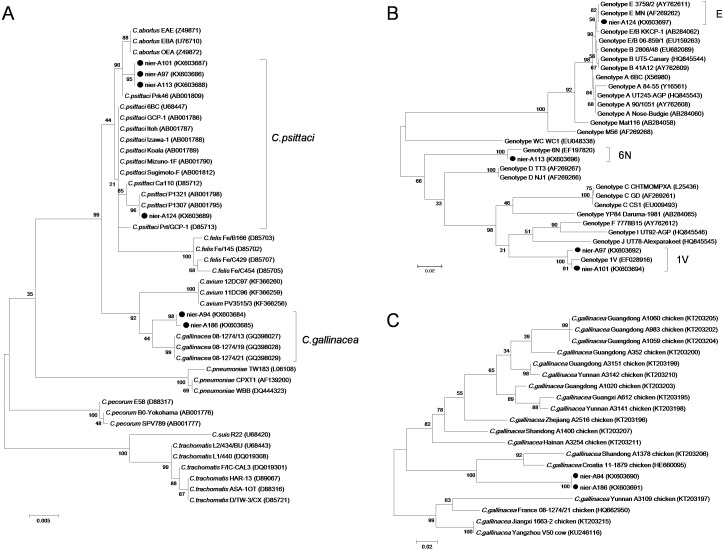
Wild birds are reservoirs for Chlamydia spp. Of the total 225 samples from wild birds during January to September 2016 in Korea, 4 (1.8%) and 2 (0.9%) showed positive for Chlamydia psittaci and Chlamydia gallinacea, respectively. Phylogenetic analyses and comparisons of sequence identities for outer-membrane protein A (ompA) revealed that Korean C. psittaci fall into three previously known genotypes; genotype E, 1V and 6N, whereas the Korean C. gallinacea were classified as new variants of C. gallinacea. Our study demonstrates that wild birds in South Korea carry at least two Chlamydia species: C. psittaci and C. gallinacea, and provides new information on the epidemiology of avian chlamydiosis in wild birds.
野生鸟类是衣原体属的宿主。2016年1月至9月期间,在韩国采集的225份野生鸟类样本中,分别有4份(1.8%)和2份(0.9%)鹦鹉热衣原体和鸡衣原体检测呈阳性。对外膜蛋白A(ompA)进行系统发育分析和序列同一性比较后发现,韩国的鹦鹉热衣原体属于三种已知基因型:E型、IV型和6N型,而韩国的鸡衣原体则被归类为鸡衣原体的新变种。我们的研究表明,韩国的野生鸟类至少携带两种衣原体:鹦鹉热衣原体和鸡衣原体,并提供了关于野生鸟类禽衣原体病流行病学的新信息。