Kuiken Todd A, Barlow Ann K, Hargrove Levi, Dumanian Gregorgy A
Director, Center for Bionic Medicine, Rehabilitation Institute of Chicago, Chicago, IL 60611.
Professor, Departments of Surgery and Physical Medicine and Rehabilitation, Northwestern University Feinberg School of Medicine, Chicago, IL.
Tech Orthop. 2017 Jun;32(2):109-116. doi: 10.1097/BTO.0000000000000194.
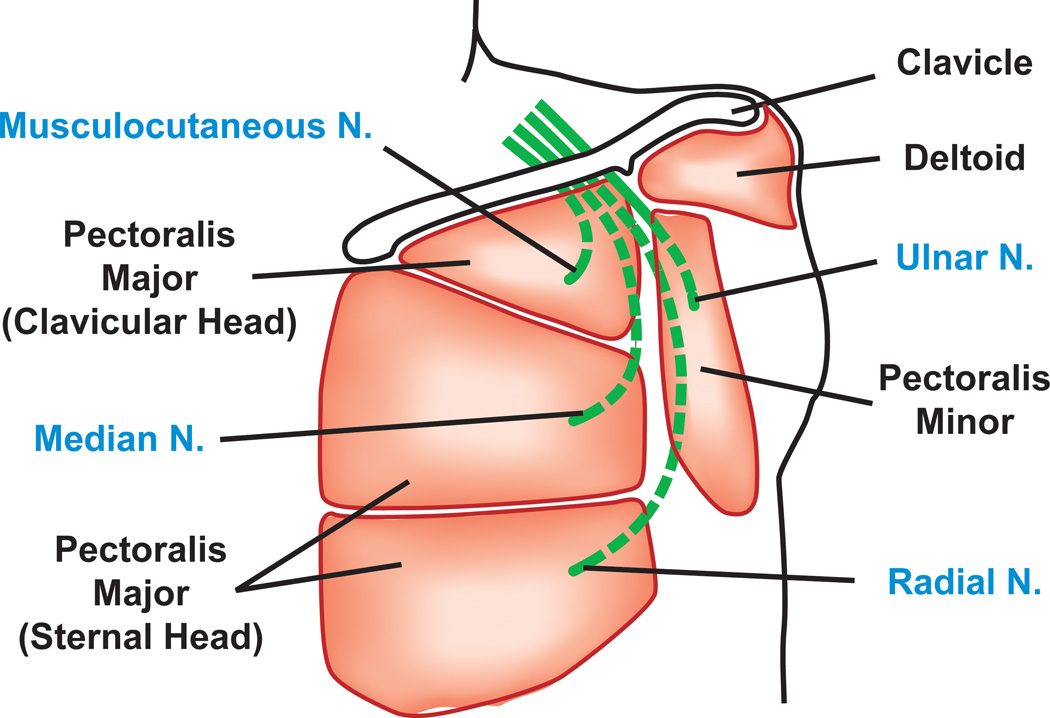
Myoelectric devices are controlled by electromyographic signals generated by contraction of residual muscles, which thus serve as biological amplifiers of neural control signals. Although nerves severed by amputation continue to carry motor control information intended for the missing limb, loss of muscle effectors due to amputation prevents access to this important control information. Targeted Muscle Reinnervation (TMR) was developed as a novel strategy to improve control of myoelectric upper limb prostheses. Severed motor nerves are surgically transferred to the motor points of denervated muscles, which, after reinnervation, contract in response to neural control signals for the missing limb. TMR creates additional control sites, eliminating the need to switch the prosthesis between different control modes. In addition, contraction of target muscles, and operation of the prosthesis, occurs in reponse to attempts to move the missing limb, making control easier and more intuitive. TMR has been performed extensively in individuals with high-level upper limb amputations and has been shown to improve functional prosthesis control. The benefits of TMR are being studied in individuals with transradial amputations and lower limb amputations. TMR is also being investigated in an ongoing clinical trial as a method to prevent or treat painful amputation neuromas.
肌电设备由残余肌肉收缩产生的肌电信号控制,因此这些肌肉充当神经控制信号的生物放大器。尽管截肢切断的神经仍继续携带原本传向缺失肢体的运动控制信息,但截肢导致的肌肉效应器缺失使得无法获取这一重要的控制信息。靶向肌肉再支配术(TMR)作为一种改善肌电上肢假肢控制的新策略而被开发出来。切断的运动神经通过手术转移至失神经支配肌肉的运动点,重新获得神经支配后,这些肌肉会对缺失肢体的神经控制信号做出收缩反应。TMR创造了额外的控制位点,无需在不同控制模式之间切换假肢。此外,目标肌肉的收缩以及假肢的操作,是对试图移动缺失肢体所做出的反应,使得控制更加容易且直观。TMR已在高位上肢截肢患者中广泛开展,并已证明可改善假肢功能控制。目前正在研究TMR对于经桡骨截肢和下肢截肢患者的益处。作为一种预防或治疗截肢后疼痛性神经瘤的方法,TMR也正在一项正在进行的临床试验中接受研究。