
非负重状态下对动力型股骨假体的神经控制。
Non-weight-bearing neural control of a powered transfemoral prosthesis.
机构信息
Center for Bionic Medicine, Rehabilitation Institute of Chicago, IL, USA.
出版信息
J Neuroeng Rehabil. 2013 Jun 19;10(1):62. doi: 10.1186/1743-0003-10-62.
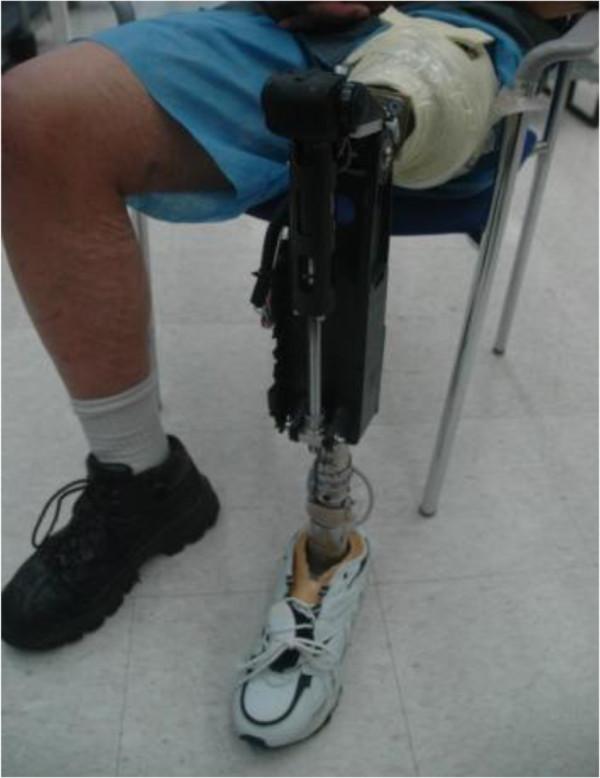
Lower limb prostheses have traditionally been mechanically passive devices without electronic control systems. Microprocessor-controlled passive and powered devices have recently received much interest from the clinical and research communities. The control systems for these devices typically use finite-state controllers to interpret data measured from mechanical sensors embedded within the prosthesis. In this paper we investigated a control system that relied on information extracted from myoelectric signals to control a lower limb prosthesis while amputee patients were seated. Sagittal plane motions of the knee and ankle can be accurately (>90%) recognized and controlled in both a virtual environment and on an actuated transfemoral prosthesis using only myoelectric signals measured from nine residual thigh muscles. Patients also demonstrated accurate (~90%) control of both the femoral and tibial rotation degrees of freedom within the virtual environment. A channel subset investigation was completed and the results showed that only five residual thigh muscles are required to achieve accurate control. This research is the first step in our long-term goal of implementing myoelectric control of lower limb prostheses during both weight-bearing and non-weight-bearing activities for individuals with transfemoral amputation.
下肢假肢传统上是没有电子控制系统的机械被动装置。微处理器控制的被动和动力装置最近受到临床和研究界的广泛关注。这些装置的控制系统通常使用有限状态控制器来解释假肢内部嵌入的机械传感器测量的数据。在本文中,我们研究了一种控制系统,该系统依赖于从肌电信号中提取的信息来控制下肢假肢,同时截瘫患者坐在座位上。使用仅从九个大腿残肢肌肉测量的肌电信号,在虚拟环境中和在驱动的股骨假肢上,膝关节和踝关节的矢状面运动可以准确 (>90%)识别和控制。患者还在虚拟环境中准确 (~90%)控制股骨和胫骨的旋转自由度。进行了通道子集研究,结果表明仅需五个大腿残肢肌肉即可实现准确控制。这项研究是我们实现下肢假肢在承重和非承重活动中使用肌电控制的长期目标的第一步,适用于股骨截肢患者。




 Zotero 插件