Chen Yan, Chen Keliang, Ding Junhua, Zhang Yumei, Yang Qing, Lv Yingru, Guo Qihao, Han Zaizhu
State Key Laboratory of Cognitive Neuroscience and Learning and IDG/McGovern Institute for Brain Research, Beijing Normal UniversityBeijing, China.
Department of Neurology, Huashan Hospital, Fudan UniversityShanghai, China.
Front Hum Neurosci. 2017 May 19;11:267. doi: 10.3389/fnhum.2017.00267. eCollection 2017.
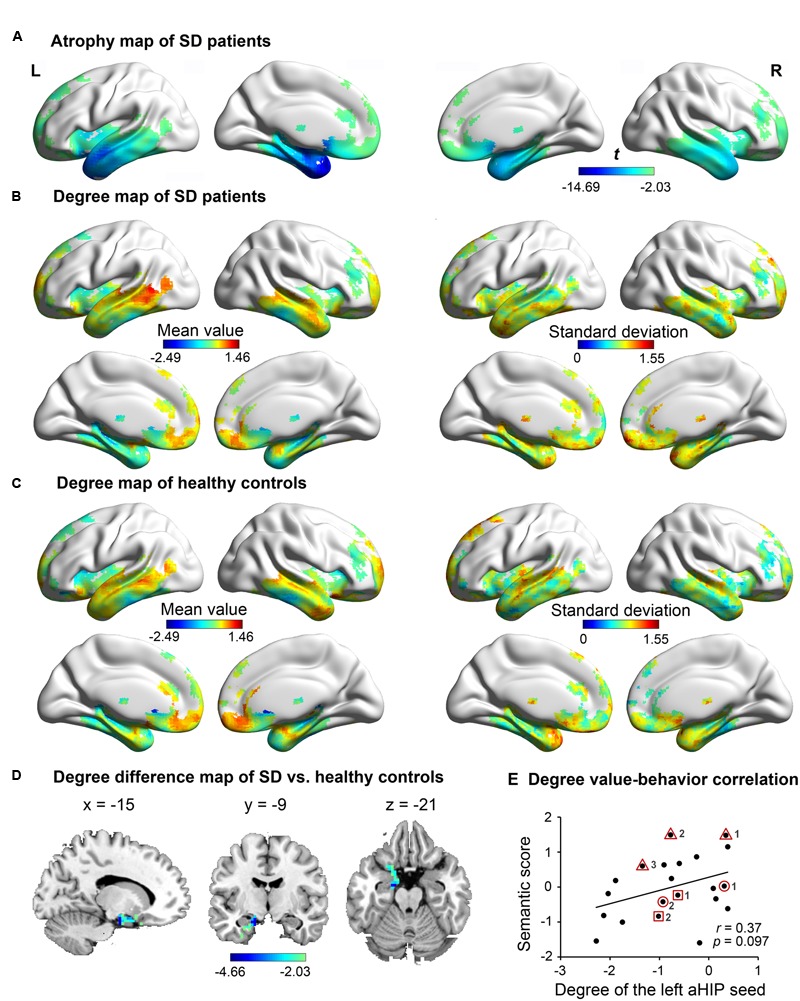
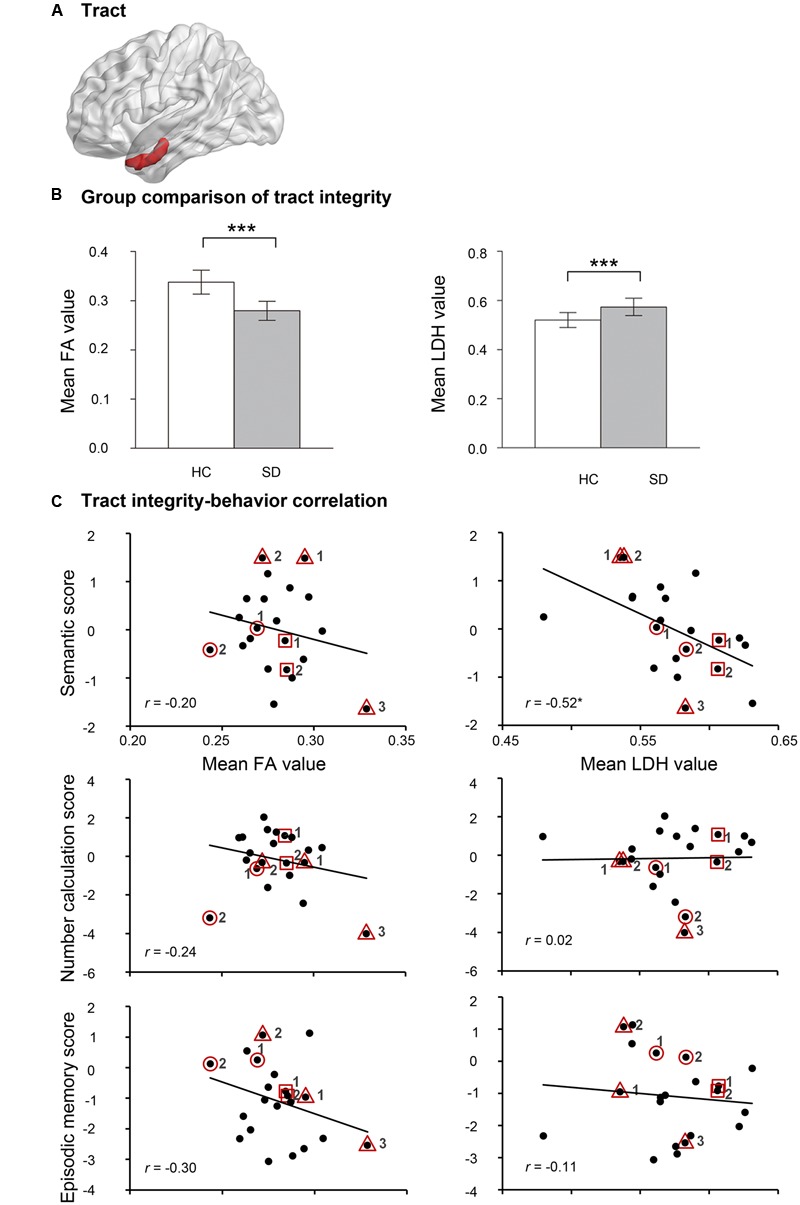
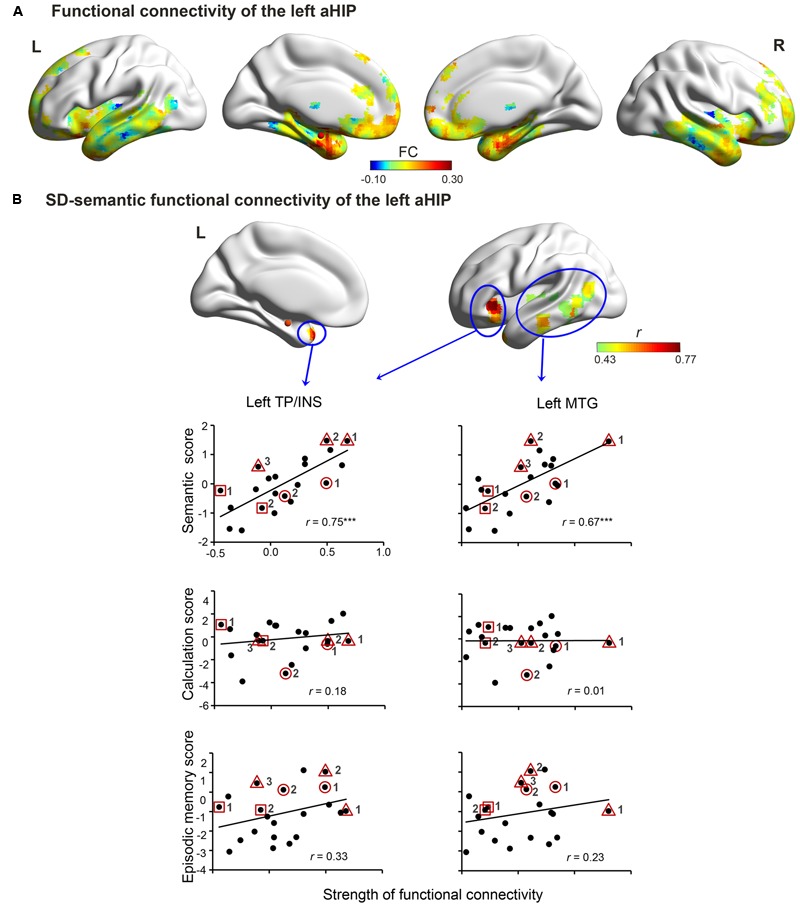
Individuals with semantic dementia (SD) typically suffer from selective semantic deficits due to degenerative brain atrophy. Although some brain regions have been found to be correlated with the semantic impairments of SD patients, it is unclear if the damage is actually responsible for SD patients' semantic disorders because these findings were primarily obtained by examining the roles of local individual regions themselves without considering the influence of other regions that are functionally or structurally connected to the local individual regions. To resolve this problem, we investigated, from the brain network perspective, the relationship between the brain-network measures of regions and connections with semantic performance in 17 SD patients. We found that the severity of semantic deficits of SD patients was significantly correlated with the degree centrality values of the left anterior hippocampus (aHIP). Moreover, the semantic performance of the patients was also significantly correlated with the strength of gray matter functional connectivity of this region and two other regions: the left temporal pole/insula (TP/INS) and the left middle temporal gyrus. We further observed that the strength of the white matter structural connectivity of the left aHIP-left TP/INS tract could effectively predict the semantic performance of SD patients. When we controlled for a wide range of potential confounding factors (e.g., total gray matter volume), the above effects still held well. These findings revealed the critical brain network with the left aHIP as the center that could be contributing to the semantic impairments of SD.
患有语义性痴呆(SD)的个体通常因退行性脑萎缩而患有选择性语义缺陷。尽管已发现一些脑区与SD患者的语义损伤相关,但尚不清楚这种损伤是否真的是SD患者语义障碍的原因,因为这些发现主要是通过检查局部单个区域本身的作用而获得的,没有考虑到与这些局部单个区域在功能或结构上相连的其他区域的影响。为了解决这个问题,我们从脑网络的角度研究了17名SD患者脑区和连接的脑网络指标与语义表现之间的关系。我们发现,SD患者语义缺陷的严重程度与左侧前海马体(aHIP)的度中心性值显著相关。此外,患者的语义表现也与该区域以及其他两个区域:左侧颞极/脑岛(TP/INS)和左侧颞中回的灰质功能连接强度显著相关。我们进一步观察到,左侧aHIP-左侧TP/INS束的白质结构连接强度可以有效预测SD患者的语义表现。当我们控制了广泛的潜在混杂因素(例如,总灰质体积)时,上述效应仍然很明显。这些发现揭示了以左侧aHIP为中心的关键脑网络,它可能导致了SD的语义损伤。