Dementia Research Centre, UCL Queen Square Institute of Neurology, University College London, 8-11 Queen Square, London, WC1N 3AR, UK.
Preventive Neurology Unit, Wolfson Institute of Preventive Medicine, Queen Mary University of London, London, UK.
Sci Rep. 2020 Oct 1;10(1):16321. doi: 10.1038/s41598-020-72847-1.
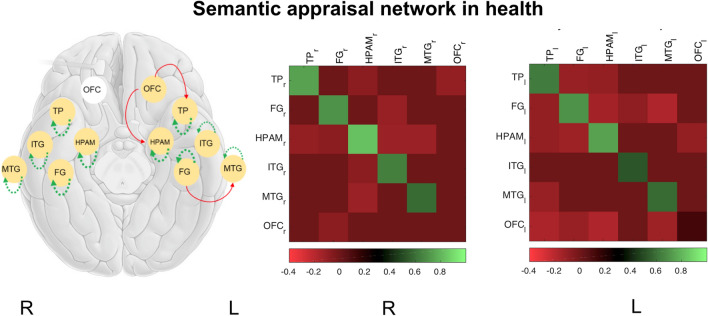
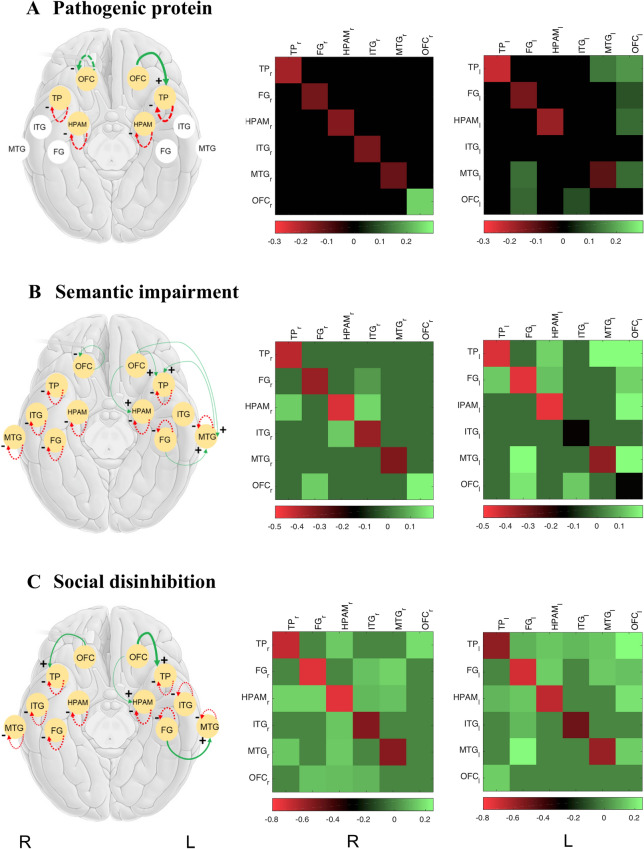
The selective destruction of large-scale brain networks by pathogenic protein spread is a ubiquitous theme in neurodegenerative disease. Characterising the circuit architecture of these diseases could illuminate both their pathophysiology and the computational architecture of the cognitive processes they target. However, this is challenging using standard neuroimaging techniques. Here we addressed this issue using a novel technique-spectral dynamic causal modelling-that estimates the effective connectivity between brain regions from resting-state fMRI data. We studied patients with semantic dementia-the paradigmatic disorder of the brain system mediating world knowledge-relative to healthy older individuals. We assessed how the effective connectivity of the semantic appraisal network targeted by this disease was modulated by pathogenic protein deposition and by two key phenotypic factors, semantic impairment and behavioural disinhibition. The presence of pathogenic protein in SD weakened the normal inhibitory self-coupling of network hubs in both antero-mesial temporal lobes, with development of an abnormal excitatory fronto-temporal projection in the left cerebral hemisphere. Semantic impairment and social disinhibition were linked to a similar but more extensive profile of abnormally attenuated inhibitory self-coupling within temporal lobe regions and excitatory projections between temporal and inferior frontal regions. Our findings demonstrate that population-level dynamic causal modelling can disclose a core pathophysiological feature of proteinopathic network architecture-attenuation of inhibitory connectivity-and the key elements of distributed neuronal processing that underwrite semantic memory.
致病性蛋白传播导致的大脑大规模网络选择性破坏是神经退行性疾病的普遍主题。对这些疾病的回路结构进行特征描述,可以阐明它们的病理生理学和它们所针对的认知过程的计算结构。然而,使用标准神经影像学技术来做到这一点具有挑战性。在这里,我们使用一种新的技术——谱动态因果建模,从静息态 fMRI 数据中估计大脑区域之间的有效连接。我们研究了语义痴呆患者——介导世界知识的大脑系统的典型障碍——与健康老年人相比。我们评估了这种疾病靶向的语义评估网络的有效连接如何受到致病性蛋白沉积以及两个关键表型因素(语义损伤和行为抑制失调)的调节。SD 中致病性蛋白的存在削弱了前内侧颞叶网络中枢的正常抑制性自耦合,左大脑半球出现异常的兴奋性额颞投射。语义损伤和社交抑制失调与颞叶区域内抑制性自耦合异常减弱以及颞叶和下额叶区域之间兴奋性投射相似但更为广泛的异常特征有关。我们的发现表明,基于群体的动态因果建模可以揭示蛋白病网络结构的核心病理生理学特征——抑制性连接减弱,以及支持语义记忆的分布式神经元处理的关键要素。