Department of Neurology, Huashan Hospital, Fudan University, Shanghai, China.
State Key Laboratory of Cognitive Neuroscience and Learning, IDG/McGovern Institute for Brain Research, Beijing Normal University, Beijing, China.
Neuroimage Clin. 2018 May 29;19:767-774. doi: 10.1016/j.nicl.2018.05.035. eCollection 2018.
Previous literature has revealed that the anterior temporal lobe (ATL) is the semantic hub of left-sided or mixed semantic dementia (SD), whilst the semantic hub of right-sided SD has not been examined.
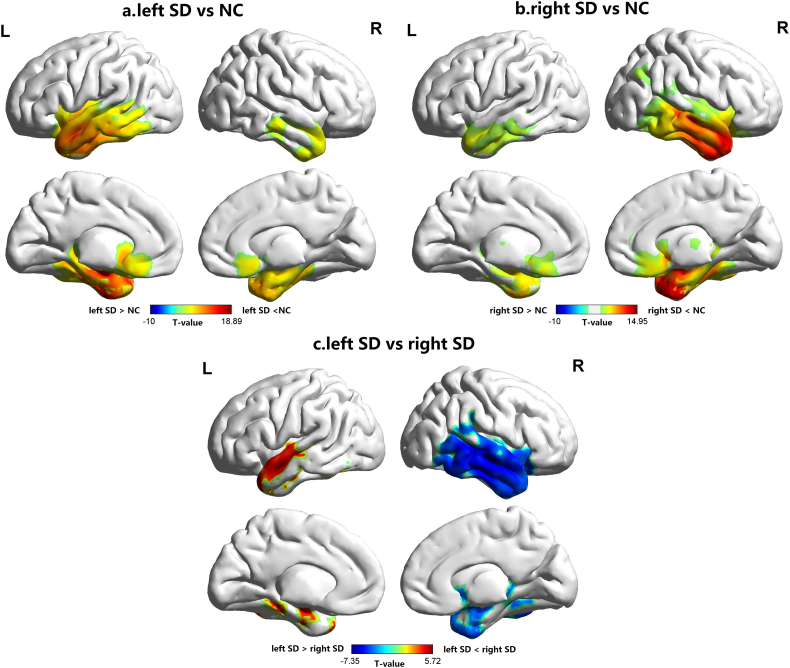
Seventeen patients with right-sided SD, 18 patients with left-sided SD and 20 normal controls (NC) underwent neuropsychological assessments and magnetic resonance imaging scans. We investigated the relationship between the degree of cerebral atrophy in the whole brain and the severity of semantic deficits in left and right-sided SD samples, respectively.
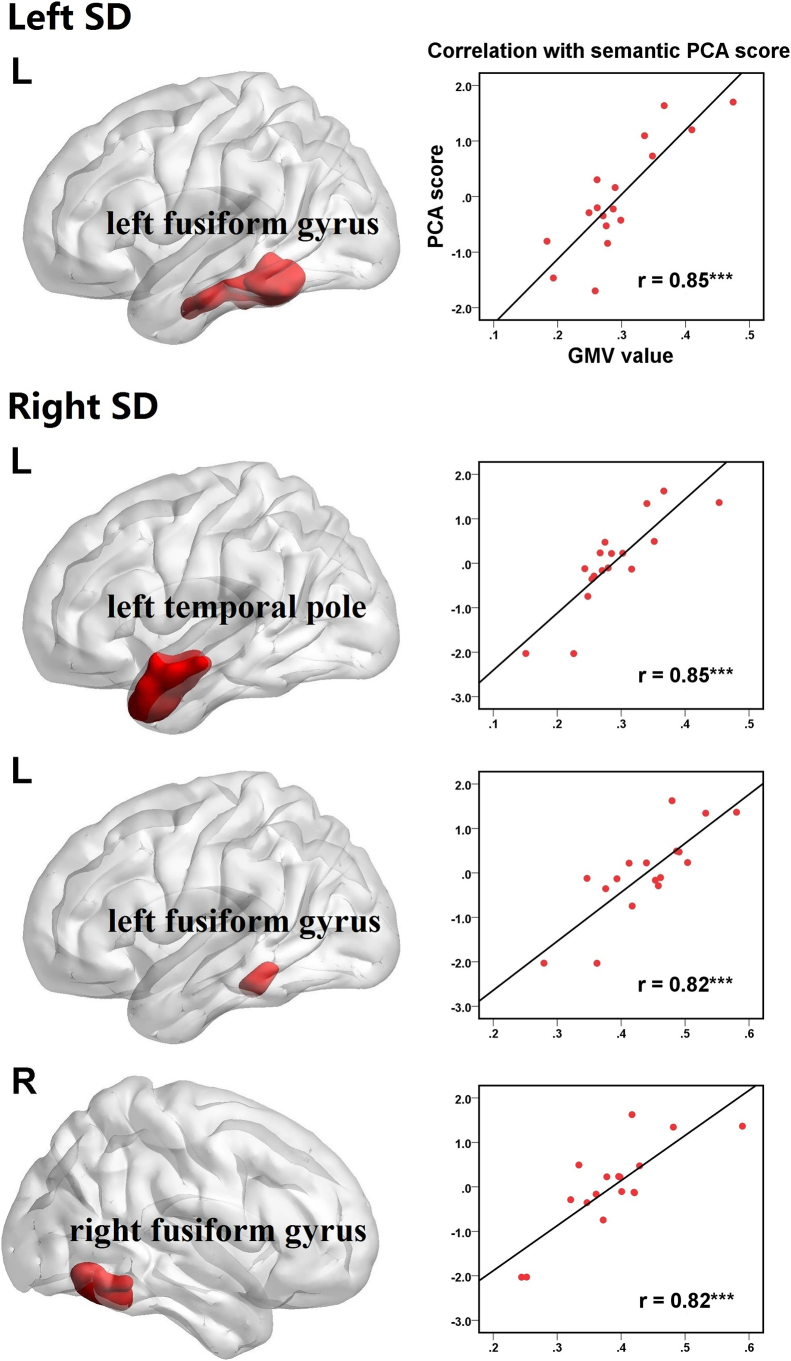
We found the semantic deficits of right-sided SD patients were related to bilateral fusiform gyri and left temporal pole, whilst the left fusiform gyrus correlated with the semantic performance of left-sided SD patients. Moreover, all the findings couldn't be accounted for by total gray matter volume (GMV) or general cognitive degradation of patients.
These results provide novel evidence for the current semantic theory, that the important regions for semantic processing include both anterior and posterior temporal lobes.
先前的文献表明,左或混合性语义性痴呆(SD)的语义中枢位于左颞叶前部(ATL),而右侧 SD 的语义中枢尚未得到检验。
17 例右侧 SD 患者、18 例左侧 SD 患者和 20 例正常对照者(NC)接受神经心理学评估和磁共振成像扫描。我们分别研究了全脑萎缩程度与左、右侧 SD 样本中语义缺陷严重程度之间的关系。
我们发现右侧 SD 患者的语义缺陷与双侧梭状回和左侧颞极有关,而左侧梭状回与左侧 SD 患者的语义表现相关。此外,所有这些发现都不能用总灰质体积(GMV)或患者的一般认知下降来解释。
这些结果为当前的语义理论提供了新的证据,即语义处理的重要区域包括前颞叶和后颞叶。