Wang Yu-Hui, Hu Han-Ning, Weng Hong, Chen Hao, Luo Chang-Liang, Ji Jia, Yin Chang-Qing, Yuan Chun-Hui, Wang Fu-Bing
Department of Laboratory Medicine, Zhongnan Hospital of Wuhan UniversityWuhan, China.
Center for Evidence-Based and Translational Medicine, Zhongnan Hospital of Wuhan UniversityWuhan, China.
Front Physiol. 2017 May 19;8:325. doi: 10.3389/fphys.2017.00325. eCollection 2017.
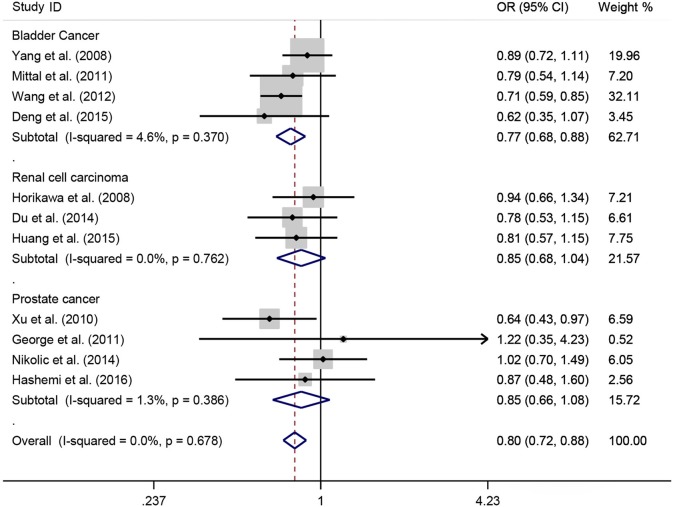
Accumulating evidence has demonstrated that some single nucleotide polymorphisms (SNPs) existing in miRNAs correlate with the susceptibility to urological cancers. However, a clear consensus still not reached due to the limited statistical power in individual study. Thus, we concluded a meta-analysis to systematically evaluate the association between microRNA SNPs and urological cancer risk. Eligible studies were collected from PubMed, Embase, Web of Science, and CNKI databases. Pooled odds ratio (OR) and corresponding 95% confidence interval (95% CI) were calculated to assess the strength of the relationships between three SNPs (miR-196a2, C>T rs11614913; miR-146a, G>C rs2910164; and miR-499, A>G rs3746444) and the risk of urological cancers. In addition, the stability of our analysis was evaluated by publication bias, sensitivity and heterogeneity analysis. Overall, a total of 17,019 subjects from 14 studies were included in this meta-analysis. We found that CT (miR-196a2, C>T rs11614913) was a risk factor for renal cell carcinoma (CT vs. CC: OR = 1.72, 95%CI = 1.05-2.80, = 0.03, = 66%), especially in Asian population (CT vs. CC: OR = 1.17, 95%CI = 1.04-1.32, < 0.01, = 0%). miR-146a G>C rs2910164 was a protective factor of urological cancers (C vs. G: OR = 0.87, 95%CI = 0.81-0.93, < 0.01, = 0%), especially for bladder cancer. miR-499 A>G rs3746444 was correlated with an increased risk of urological cancers, specifically in Asian population. In conclusion, our meta-analysis suggests that polymorphisms in microRNAs, miR-196a2, C>T rs11614913, miR-146a G>C rs2910164 and miR-499 A>G rs3746444, may be associated with the development of urological cancers and the risks mainly exist in Asian populations.
越来越多的证据表明,miRNA中存在的一些单核苷酸多态性(SNP)与泌尿系统癌症的易感性相关。然而,由于个体研究的统计效力有限,尚未达成明确的共识。因此,我们进行了一项荟萃分析,以系统评估微小RNA单核苷酸多态性与泌尿系统癌症风险之间的关联。从PubMed、Embase、Web of Science和中国知网数据库中收集符合条件的研究。计算合并比值比(OR)和相应的95%置信区间(95%CI),以评估三个SNP(miR-196a2,C>T rs11614913;miR-146a,G>C rs2910164;和miR-499,A>G rs3746444)与泌尿系统癌症风险之间关系的强度。此外,通过发表偏倚、敏感性和异质性分析评估我们分析的稳定性。总体而言,本荟萃分析纳入了来自14项研究的总共17019名受试者。我们发现CT(miR-196a2,C>T rs11614913)是肾细胞癌的一个危险因素(CT vs. CC:OR = 1.72,95%CI = 1.05 - 2.80,P = 0.03,I² = 66%),尤其是在亚洲人群中(CT vs. CC:OR = 1.17,95%CI = 1.04 - 1.32,P < 0.01,I² = 0%)。miR-146a G>C rs2910164是泌尿系统癌症的一个保护因素(C vs. G:OR = 0.87,95%CI = 0.81 - 0.93,P < 0.01,I² = 0%),尤其是对膀胱癌。miR-499 A>G rs3746444与泌尿系统癌症风险增加相关,特别是在亚洲人群中。总之,我们的荟萃分析表明,微小RNA中的多态性,即miR-196a2,C>T rs11614913、miR-146a G>C rs2910164和miR-499 A>G rs3746444,可能与泌尿系统癌症的发生有关,且风险主要存在于亚洲人群中。