Dennis Megan Y, Harshman Lana, Nelson Bradley J, Penn Osnat, Cantsilieris Stuart, Huddleston John, Antonacci Francesca, Penewit Kelsi, Denman Laura, Raja Archana, Baker Carl, Mark Kenneth, Malig Maika, Janke Nicolette, Espinoza Claudia, Stessman Holly A F, Nuttle Xander, Hoekzema Kendra, Lindsay-Graves Tina A, Wilson Richard K, Eichler Evan E
Genome Center, MIND Institute, and Department of Biochemistry & Molecular Medicine, University of California, Davis, CA 95616, USA.
Department of Genome Sciences, University of Washington School of Medicine, Seattle, WA 98195, USA.
Nat Ecol Evol. 2017;1(3):69. doi: 10.1038/s41559-016-0069. Epub 2017 Feb 17.
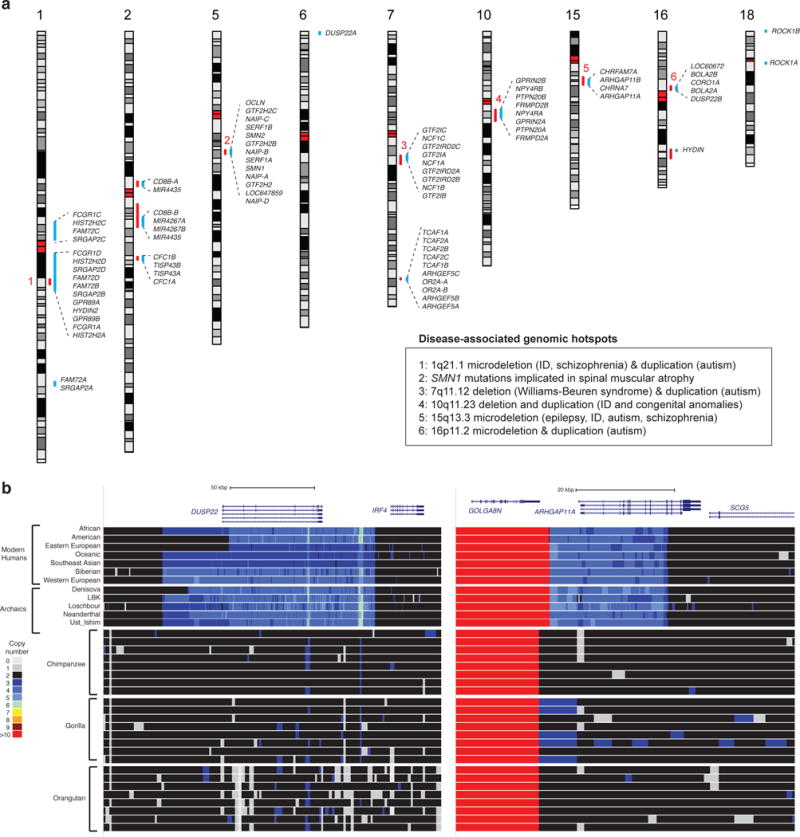
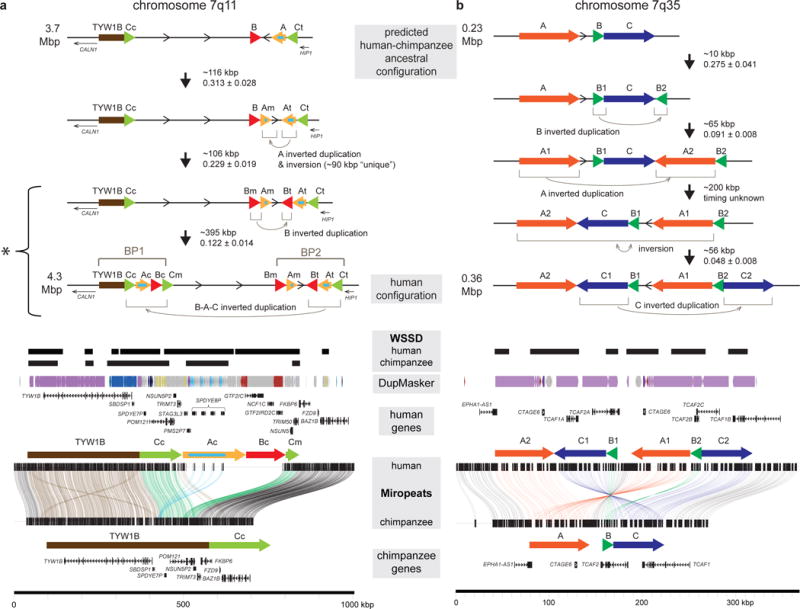
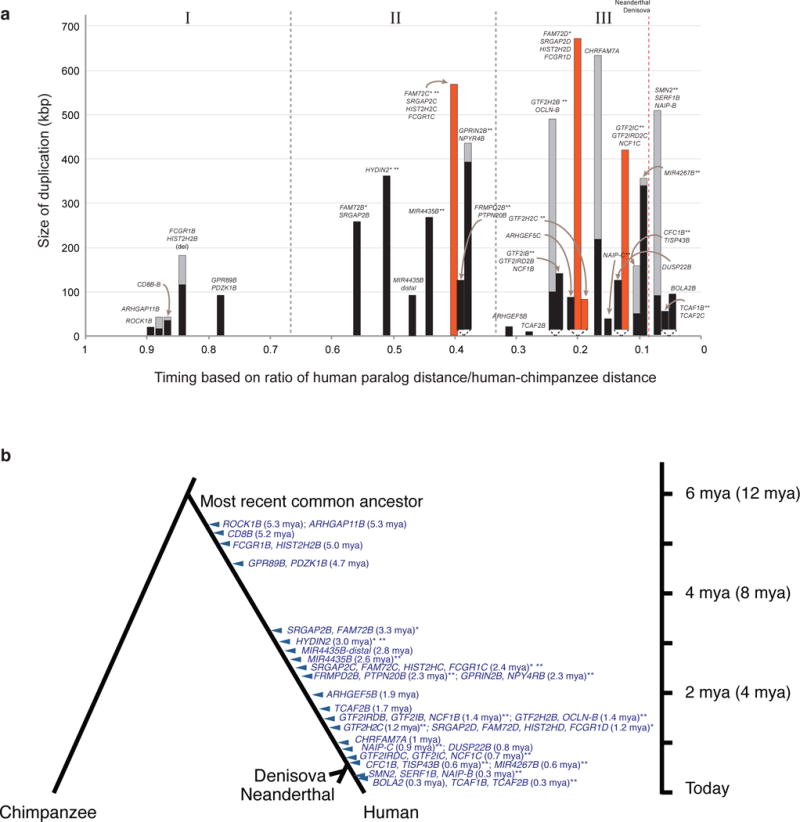
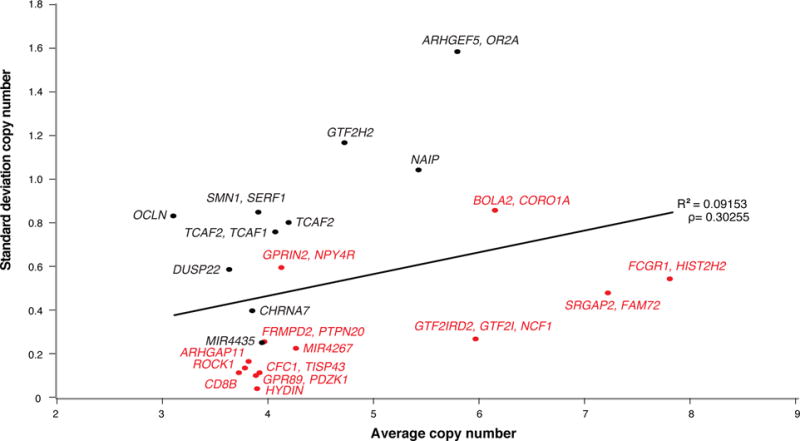
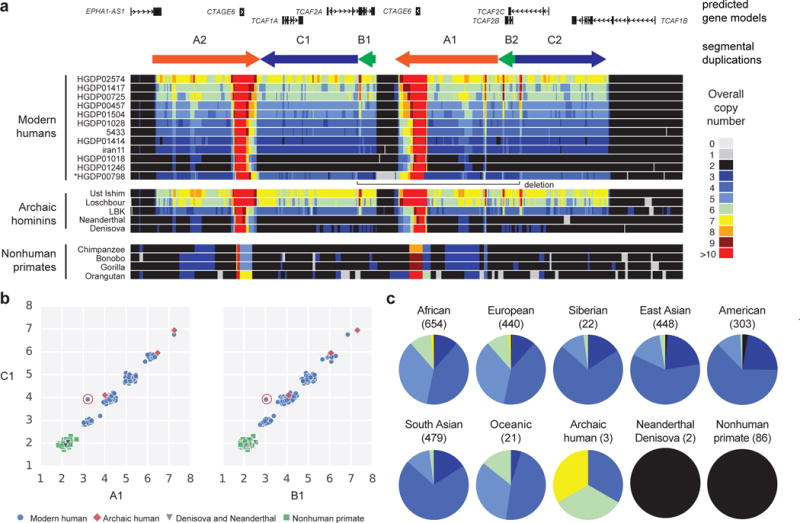
Segmental duplications contribute to human evolution, adaptation and genomic instability but are often poorly characterized. We investigate the evolution, genetic variation and coding potential of human-specific segmental duplications (HSDs). We identify 218 HSDs based on analysis of 322 deeply sequenced archaic and contemporary hominid genomes. We sequence 550 human and nonhuman primate genomic clones to reconstruct the evolution of the largest, most complex regions with protein-coding potential (n=80 genes/33 gene families). We show that HSDs are non-randomly organized, associate preferentially with ancestral ape duplications termed "core duplicons", and evolved primarily in an interspersed inverted orientation. In addition to -specific gene expansions (e.g., ), we highlight ten gene families (e.g., and ) where copy number never returns to the ancestral state, there is evidence of mRNA splicing, and no common gene-disruptive mutations are observed in the general population. Such duplicates are candidates for the evolution of human-specific adaptive traits.
节段性重复有助于人类进化、适应和基因组不稳定,但通常特征描述不足。我们研究了人类特异性节段性重复(HSDs)的进化、遗传变异和编码潜力。基于对322个深度测序的古代和当代原始人基因组的分析,我们鉴定出218个HSDs。我们对550个人类和非人类灵长类基因组克隆进行测序,以重建具有蛋白质编码潜力的最大、最复杂区域(n = 80个基因/33个基因家族)的进化过程。我们发现HSDs呈非随机组织,优先与称为“核心重复子”的祖先猿重复相关联,并且主要以散布的反向方向进化。除了特定基因的扩增(例如),我们还重点介绍了十个基因家族(例如和),这些基因家族的拷贝数从未恢复到祖先状态,有mRNA剪接的证据,并且在普通人群中未观察到常见的基因破坏突变。这些重复基因是人类特异性适应性性状进化的候选基因。