Tourani Sogand, Zarezadeh Mohammad, Raadabadi Mehdi, Pourshariati Fatemeh
School of Health Management and Information Sciences, Iran University of Medical Sciences, Tehran, Iran.
Students Scientific Research Center, Tehran University of Medical Sciences, Tehran, Iran.
Int J Reprod Biomed. 2017 Mar;15(3):147-154.
Equity in distribution of resources is considered as an important priority in health care systems. Equitable distribution of obstetrics and gynecology (Ob/Gyn) services in the country level is critical in maternal and neonatal health for qualitative promotion of maternal care in pregnancy, delivery, and post-delivery periods.
The present study aimed at determining regional disparity of obstetrics and gynecology services and its association with children and infants mortality rates.
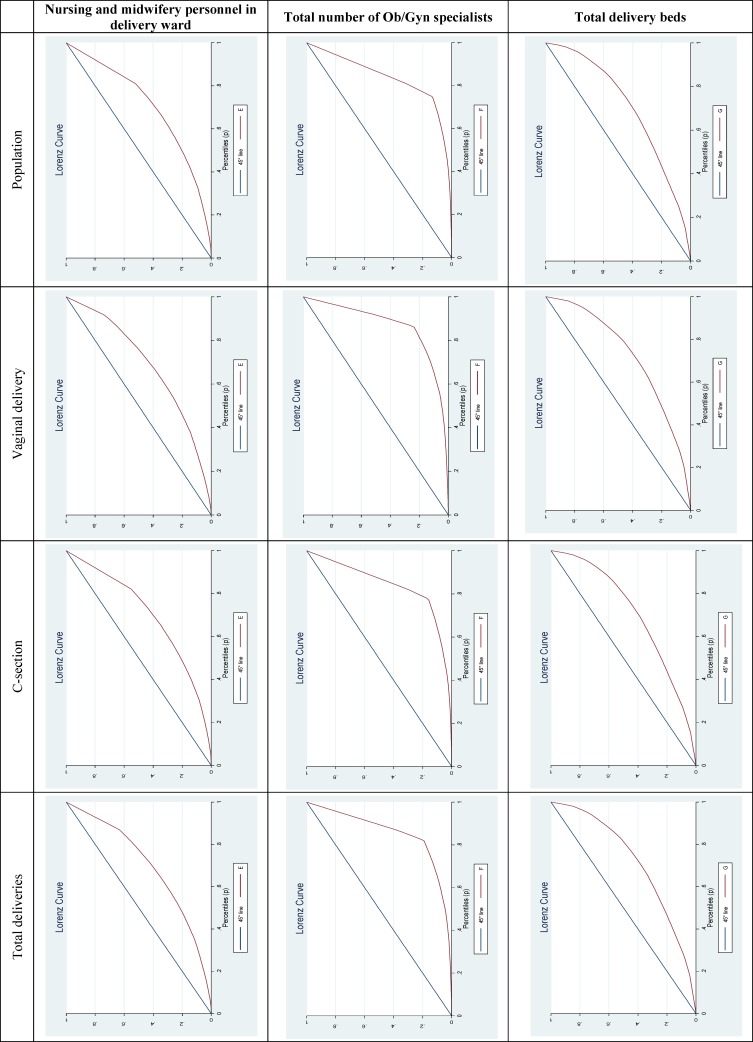
This was a descriptive-analytical study conducted in 2015 to investigate distribution of Ob/Gyn services using three indicators of number of nursing and midwifery personnel, total Ob/Gyn specialists, and total delivery beds among 30 provinces of the country. Equity criteria in the present study included population, normal vaginal deliveries, cesarean sections, and total deliveries. Data were gathered using a researcher-made form and Stata 12 was used to calculate Gini coefficient. The association of Ob/Gyn services with children and infant mortality rates was investigated using SPSS package and linear regression test.
The lowest Gini coefficient was observed in distribution of nursing and midwifery personnel in delivery wards in terms of vaginal delivery (0.38 from 1) and the highest value was related to distribution of Ob/Gyn specialists in terms of vaginal delivery (0.73 from 1). Infant mortality was significantly associated with number of nursing and midwifery personnel in delivery wards, and total number of Ob/Gyn specialists.
Considering new population policies in Iran and increased fertility rate, it is recommended to facilitate accessibility of the required services for the women, particularly those of reproductive age.
资源分配的公平性被视为医疗保健系统的一个重要优先事项。在国家层面上,妇产科服务的公平分配对于孕产妇和新生儿健康至关重要,有助于在孕期、分娩期和产后提高孕产妇护理质量。
本研究旨在确定妇产科服务的地区差异及其与儿童和婴儿死亡率的关联。
这是一项于2015年开展的描述性分析研究,利用护理和助产人员数量、妇产科专科医生总数以及该国30个省份的分娩床位总数这三个指标来调查妇产科服务的分布情况。本研究中的公平标准包括人口、顺产、剖宫产以及总分娩量。数据通过研究者自行编制的表格收集,使用Stata 12软件计算基尼系数。利用SPSS软件包和线性回归检验来研究妇产科服务与儿童和婴儿死亡率之间的关联。
就顺产而言,产房护理和助产人员分布的基尼系数最低(1分制下为0.38),而妇产科专科医生分布的基尼系数最高(1分制下为0.73)。婴儿死亡率与产房护理和助产人员数量以及妇产科专科医生总数显著相关。
鉴于伊朗的新人口政策以及生育率上升,建议为妇女,尤其是育龄妇女提供更便捷的所需服务。