Wanders Johanna O P, Holland Katharina, Karssemeijer Nico, Peeters Petra H M, Veldhuis Wouter B, Mann Ritse M, van Gils Carla H
Julius Center for Health Sciences and Primary Care, University Medical Center Utrecht, P.O. Box 85500, 3508 GA, Utrecht, The Netherlands.
Department of Radiology and Nuclear Medicine, Radboud University Medical Center, Geert Grooteplein 10, 6525 GA, Nijmegen, The Netherlands.
Breast Cancer Res. 2017 Jun 5;19(1):67. doi: 10.1186/s13058-017-0859-9.
In the light of the breast density legislation in the USA, it is important to know a woman's breast cancer risk, but particularly her risk of a tumor that is not detected through mammographic screening (interval cancer). Therefore, we examined the associations of automatically measured volumetric breast density with screen-detected and interval cancer risk, separately.
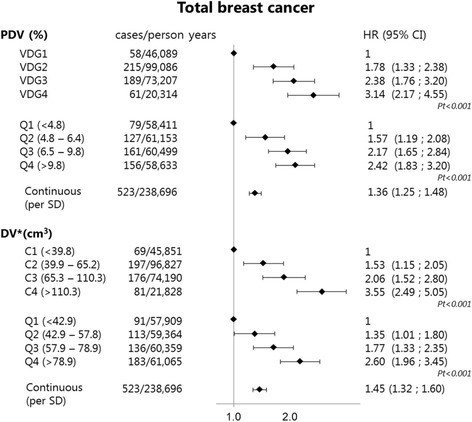
Volumetric breast measures were assessed automatically using Volpara version 1.5.0 (Matakina, New Zealand) for the first available digital mammography (DM) examination of 52,814 women (age 50 - 75 years) participating in the Dutch biennial breast cancer screening program between 2003 and 2011. Breast cancer information was obtained from the screening registration system and through linkage with the Netherlands Cancer Registry. We excluded all screen-detected breast cancers diagnosed as a result of the first digital screening examination. During a median follow-up period of 4.2 (IQR 2.0-6.2) years, 523 women were diagnosed with breast cancer of which 299 were screen-detected and 224 were interval breast cancers. The associations between volumetric breast measures and breast cancer risk were determined using Cox proportional hazards analyses.
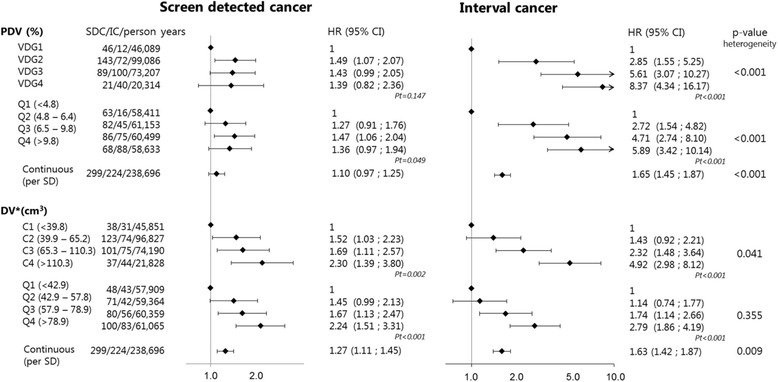
Percentage dense volume was found to be positively associated with both interval and screen-detected breast cancers (hazard ratio (HR) 8.37 (95% CI 4.34-16.17) and HR 1.39 (95% CI 0.82-2.36), respectively, for Volpara density grade category (VDG) 4 compared to VDG1 (p for heterogeneity < 0.001)). Dense volume (DV) was also found to be positively associated with both interval and screen-detected breast cancers (HR 4.92 (95% CI 2.98-8.12) and HR 2.30 (95% CI 1.39-3.80), respectively, for VDG-like category (C)4 compared to C1 (p for heterogeneity = 0.041)). The association between percentage dense volume categories and interval breast cancer risk (HR 8.37) was not significantly stronger than the association between absolute dense volume categories and interval breast cancer risk (HR 4.92).
Our results suggest that both absolute dense volume and percentage dense volume are strong markers of breast cancer risk, but that they are even stronger markers for predicting the occurrence of tumors that are not detected during mammography breast cancer screening.
鉴于美国的乳房密度立法,了解女性患乳腺癌的风险很重要,尤其是她患通过乳房X线筛查未被发现的肿瘤(间期癌)的风险。因此,我们分别研究了自动测量的乳房体积密度与筛查发现的癌症和间期癌风险之间的关联。
使用Volpara 1.5.0版本(新西兰Matakina公司)对参与2003年至2011年荷兰两年一次乳腺癌筛查项目的52814名女性(年龄50 - 75岁)的首次可用数字化乳腺摄影(DM)检查进行乳房体积测量的自动评估。乳腺癌信息从筛查登记系统获取,并通过与荷兰癌症登记处的链接获得。我们排除了因首次数字化筛查检查而诊断出的所有筛查发现的乳腺癌。在中位随访期4.2(四分位间距2.0 - 6.2)年期间,523名女性被诊断患有乳腺癌,其中299例为筛查发现,224例为间期乳腺癌。使用Cox比例风险分析确定乳房体积测量与乳腺癌风险之间的关联。
发现致密体积百分比与间期癌和筛查发现的乳腺癌均呈正相关(与VDG1相比,Volpara密度等级类别(VDG)4的风险比(HR)分别为8.37(95%置信区间4.34 - 16.17)和HR 1.39(95%置信区间0.82 - 2.36),异质性p < 0.001)。致密体积(DV)也被发现与间期癌和筛查发现的乳腺癌均呈正相关(与C1相比,VDG样类别(C)4的HR分别为4.92(95%置信区间2.98 - 8.12)和HR 2.30(95%置信区间1.39 - 3.80),异质性p = 0.041)。致密体积百分比类别与间期乳腺癌风险之间的关联(HR 8.37)并不比绝对致密体积类别与间期乳腺癌风险之间的关联(HR 4.9)显著更强。
我们的结果表明,绝对致密体积和致密体积百分比都是乳腺癌风险的有力标志物,但它们更是预测在乳房X线乳腺癌筛查期间未被发现的肿瘤发生的更强标志物。