Muzaffar Syed Nabeel, Baronia Arvind Kumar, Azim Afzal, Verma Anupam, Gurjar Mohan, Poddar Banani, Singh Ratender Kumar
Department of Critical Care Medicine, Sanjay Gandhi Postgraduate Institute of Medical Sciences, Lucknow, Uttar Pradesh, India.
Department of Transfusion Medicine, Sanjay Gandhi Postgraduate Institute of Medical Sciences, Lucknow, Uttar Pradesh, India.
Indian J Crit Care Med. 2017 May;21(5):268-273. doi: 10.4103/ijccm.IJCCM_72_17.
Thromboelastography (TEG) is a global test of coagulation which analyzes the whole coagulation process. TEG is popular in trauma, liver transplant, and cardiac surgeries, but studies in sepsis are limited. We have assessed the utility of TEG for evaluating coagulopathy in nonbleeding patients with sepsis.
A prospective, observational study was done in 12-bedded Intensive Care Unit (ICU) of a tertiary care hospital in North India, during May 2014-November 2014. After ethical clearance, all patients at ICU admission with sepsis were included in the study. Exclusion criteria were age <18 years, plasma/platelet transfusion before admission, patients on oral antiplatelets/anticoagulants, or with underlying hematological disorders. At admission, blood samples for TEG were analyzed by kaolin-based TEG analyzer within an hour of collecting 2.7 ml citrated blood from arterial line. TEG parameters included reaction time (R), K time (K), alpha angle (a), maximum amplitude (MA), coagulation index (CI), and lysis index (LY 30).
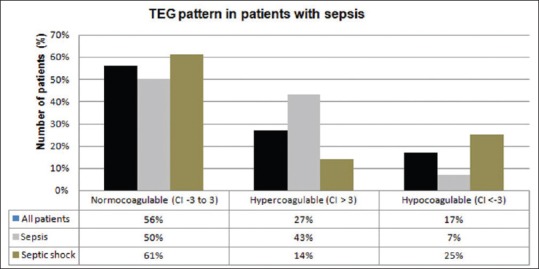
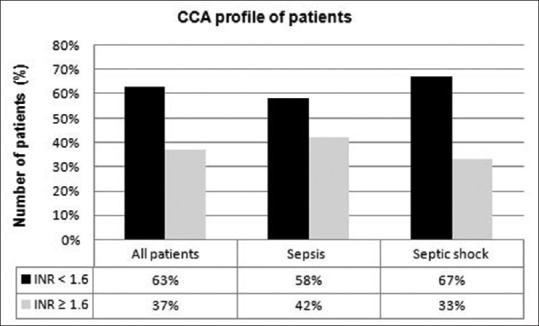
In TEG, mean values of R, K, a, MA, CI, and LY30 were 6.45 ± 2.59 (min), 1.67 ± 0.96 (min), 66.37 ± 10.44 (), 67.08 ± 10.33 (mm), 0.63 ± 3.46, and 2.23 ± 4.08 (%), respectively. In conventional coagulation assay (CCA), mean values of international normalized ratio (INR), platelet, and fibrinogen were 1.63 ± 0.57, 153.96 ± 99.16 (×10 /mm), and 301.33 ± 112.82 (mg/dl), respectively. In those with deranged INR (INR ≥1.6), 60% were normocoagulable and 20% were hypercoagulable. Similarly, 81% patients with thrombocytopenia (platelet count <1,00,000/mL) were normocoagulable.
TEG could differentiate among normocoagulant, hypocoagulant, hypercoagulant states (unlike CCAs). Patients with septic shock had trend toward hypocoagulant state while those without shock had trend toward hypercoagulant state.
血栓弹力图(TEG)是一种全面的凝血检测方法,可分析整个凝血过程。TEG在创伤、肝移植和心脏手术中应用广泛,但在脓毒症方面的研究有限。我们评估了TEG在评估非出血性脓毒症患者凝血病中的作用。
2014年5月至2014年11月,在印度北部一家三级医院的12张床位的重症监护病房(ICU)进行了一项前瞻性观察研究。经伦理批准后,所有入住ICU的脓毒症患者均纳入研究。排除标准为年龄<18岁、入院前接受血浆/血小板输注、口服抗血小板/抗凝药物的患者或患有潜在血液系统疾病的患者。入院时,在从动脉导管采集2.7 ml枸橼酸盐血后1小时内,用基于高岭土的TEG分析仪分析用于TEG的血样。TEG参数包括反应时间(R)、K时间(K)、α角(a)、最大振幅(MA)、凝血指数(CI)和溶解指数(LY 30)。
在TEG中,R、K、a、MA、CI和LY30的平均值分别为6.45±2.59(分钟)、1.67±0.96(分钟)、66.37±10.44(度)、67.08±10.33(毫米)、0.63±3.46和2.