Chelkeba Legese, Ahmadi Arezoo, Abdollahi Mohammad, Najafi Atabak, Ghadimi Mohammad Hosein, Mosaed Reza, Mojtahedzadeh Mojtaba
Department of Clinical Pharmacy, Faculty of Pharmacy, Tehran University of Medical Sciences, International Campus, Jimma University, Jimma, Ethiopia.
Department of Anesthesiology and Critical Care Medicine, Sina Hospital, Faculty of Medicine, Tehran University of Medical Sciences, Tehran, Iran.
Indian J Crit Care Med. 2017 May;21(5):287-293. doi: 10.4103/ijccm.IJCCM_343_16.
Severe sepsis and septic shock is characterized by inflammation and oxidative stress. Selenium levels have been reported to be low due to loss or increased requirements during severe sepsis and septic shock. We investigated the effect of high-dose parenteral selenium administration in septic patients.
A prospective, randomized control clinical trial was performed in septic patients. After randomization, patients in selenium group received high-dose parenteral sodium selenite (2 mg intravenous [IV] bolus followed by 1.5 mg IV continuous infusion daily for 14 days) plus standard therapy and the control group received standard therapy. The primary endpoint was mortality at 28 days. Changes in the mean levels of high mobility group box-1 (HMGB-1) protein and superoxide dismutase (SOD), duration of vasopressor therapy, incidence of acute renal failure, and 60 days' mortality were secondary endpoints.
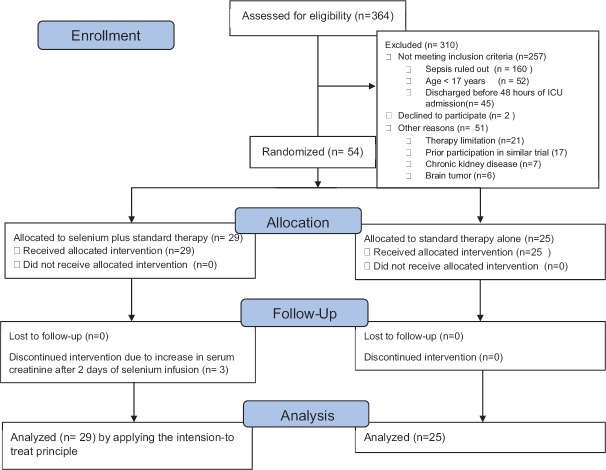
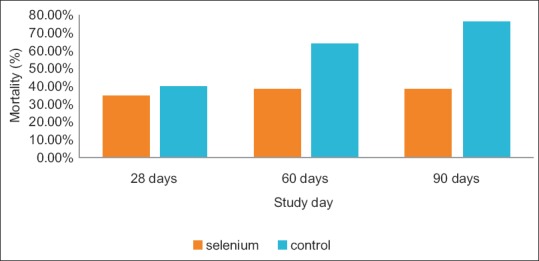
Fifty-four patients were randomized into selenium group ( = 29) and control group ( = 25). There was no significant difference in 28-day mortality. No significant difference between the two groups with respect to the average levels of HMGB-1 protein and SOD at any point in time over the course of 14 days had observed.
In early administration within the first 6 h of sepsis diagnosis, our study demonstrated that high-dose parenteral selenium administration had no significant effect either on 28-day mortality or the mean levels of HMGB-1 and SOD (Trial Registration: IRCT201212082887N4 at WHO Clinical Trial Registry, August 29, 2014).
严重脓毒症和脓毒性休克的特征是炎症和氧化应激。据报道,在严重脓毒症和脓毒性休克期间,由于硒的流失或需求增加,硒水平会降低。我们研究了高剂量胃肠外给予硒对脓毒症患者的影响。
对脓毒症患者进行了一项前瞻性随机对照临床试验。随机分组后,硒组患者接受高剂量胃肠外亚硒酸钠治疗(静脉推注2毫克,随后每天持续静脉输注1.5毫克,共14天)加标准治疗,对照组接受标准治疗。主要终点是28天死亡率。高迁移率族蛋白B1(HMGB-1)、超氧化物歧化酶(SOD)平均水平的变化、血管升压药治疗持续时间、急性肾衰竭发生率和60天死亡率为次要终点。
54例患者被随机分为硒组(n = 29)和对照组(n = 25)。28天死亡率无显著差异。在14天的病程中,任何时间点两组间HMGB-1蛋白和SOD的平均水平均无显著差异。
在脓毒症诊断后的前6小时内尽早给药,我们的研究表明,高剂量胃肠外给予硒对28天死亡率或HMGB-1和SOD的平均水平均无显著影响(试验注册号:世界卫生组织临床试验注册中心的IRCT201212082887N4,2014年8月29日)。