Department of Biochemistry and Molecular Pharmacology, University of Massachusetts Medical School, Worcester, MA, 01605, USA.
Department of Radiology, The Second Hospital of Tianjin Medical University, Tianjin, 300211, P. R. China.
Adv Mater. 2017 Jul;29(28). doi: 10.1002/adma.201604789. Epub 2017 Jun 6.
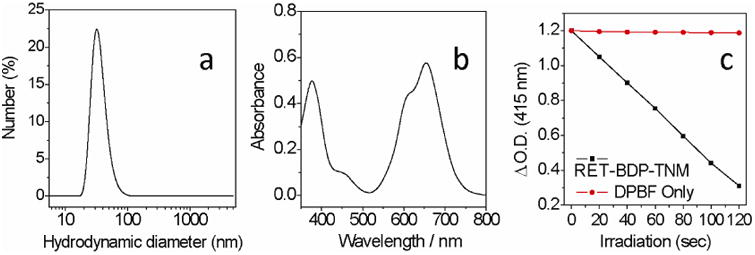
Photodynamic therapy (PDT) is an important cancer treatment modality due to its minimally invasive nature. However, the efficiency of existing PDT drug molecules in the deep-tissue-penetrable near-infrared (NIR) region has been the major hurdle that has hindered further development and clinical usage of PDT. Thus, herein a strategy is presented to utilize a resonance energy transfer (RET) mechanism to construct a novel dyad photosensitizer which is able to dramatically boost NIR photon utility and enhance singlet oxygen generation. In this work, the energy donor moiety (distyryl-BODIPY) is connected to a photosensitizer (i.e., diiodo-distyryl-BODIPY) to form a dyad molecule (RET-BDP). The resulting RET-BDP shows significantly enhanced absorption and singlet oxygen efficiency relative to that of the acceptor moiety of the photosensitizer alone in the NIR range. After being encapsulated with biodegradable copolymer pluronic F-127-folic acid (F-127-FA), RET-BDP molecules can form uniform and small organic nanoparticles that are water soluble and tumor targetable. Used in conjunction with an exceptionally low-power NIR LED light irradiation (10 mW cm ), these nanoparticles show superior tumor-targeted therapeutic PDT effects against cancer cells both in vitro and in vivo relative to unmodified photosensitizers. This study offers a new method to expand the options for designing NIR-absorbing photosensitizers for future clinical cancer treatments.
光动力疗法(PDT)是一种重要的癌症治疗方式,因为它具有微创的特点。然而,现有 PDT 药物分子在可穿透深层组织的近红外(NIR)区域的效率一直是阻碍 PDT 进一步发展和临床应用的主要障碍。因此,本文提出了一种利用共振能量转移(RET)机制构建新型偶联光敏剂的策略,该策略能够显著提高近红外光子的利用效率,增强单线态氧的生成。在这项工作中,能量供体部分(二苯乙烯-BODIPY)与光敏剂(即二碘二苯乙烯-BODIPY)相连,形成偶联分子(RET-BDP)。与单独的光敏剂的受体部分相比,所得的 RET-BDP 在 NIR 范围内表现出显著增强的吸收和单线态氧效率。用可生物降解的共聚物 Pluronic F-127-叶酸(F-127-FA)包封后,RET-BDP 分子可以形成均匀的、水溶性的、肿瘤靶向的小有机纳米颗粒。与超低功率的近红外 LED 光照射(10 mW cm )联合使用时,这些纳米颗粒在体外和体内对癌细胞的肿瘤靶向治疗 PDT 效果均优于未修饰的光敏剂。本研究为设计用于未来临床癌症治疗的近红外吸收光敏剂提供了一种新方法。