Samotus Olivia, Lee Jack, Jog Mandar
London Health Sciences Centre - Lawson Health Research Institute, Department of Clinical Neurological Sciences, London, Ontario, Canada.
University of Western, Schulich School of Medicine and Dentistry, London, Ontario, Canada.
PLoS One. 2017 Jun 6;12(6):e0178670. doi: 10.1371/journal.pone.0178670. eCollection 2017.
Current pharmacological agents used to treat Parkinson disease (PD) tremor and essential tremor (ET) provide suboptimal benefit and are commonly associated with significant adverse effects. Botulinum toxin type A (BoNT-A) has been shown to be effective for wrist tremor though functionally bothersome muscle weakness frequently occurs. This is the longest study to date demonstrating that BoNT-A therapy coupled with kinematic guidance can provide efficacious outcomes for upper limb tremor with minimized unwanted weakness.
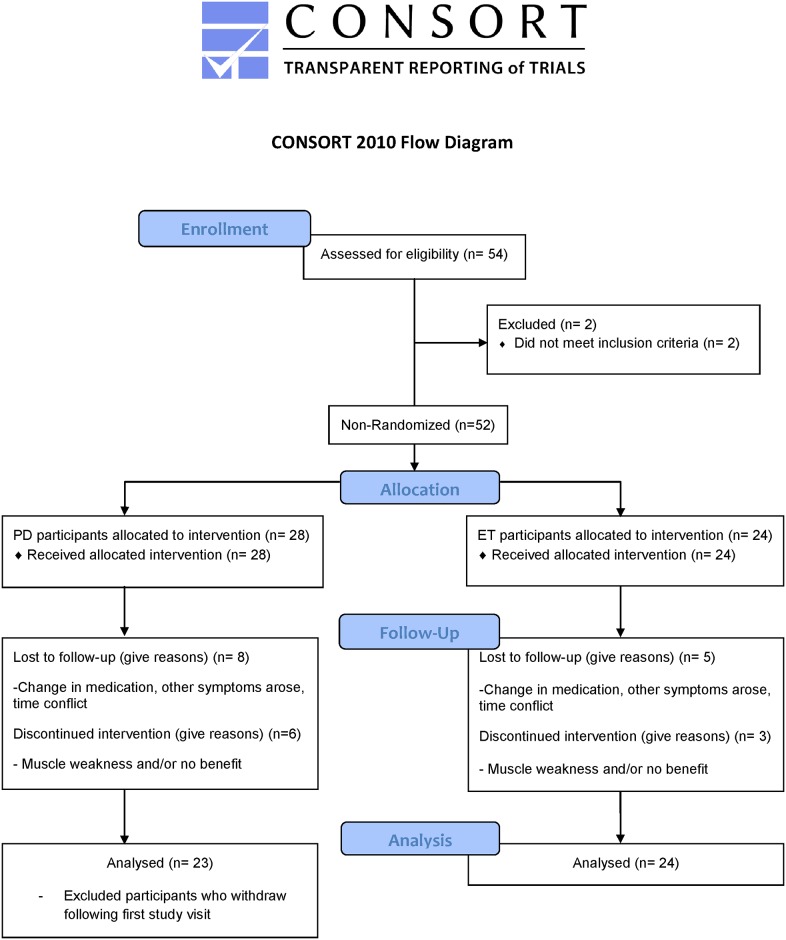
A total of 28 PD and 24 ET participants with bothersome, disabling tremor, received six serial BoNT-A treatments every 16 weeks starting at week 0 with a follow-up visit 6 weeks following a treatment, totaling 96 weeks. Clinical scales, including Fahn-Tolosa-Marin tremor rating scale (FTM), and sensor-based tremor assessments were conducted at each visit. Kinematics was utilized to identify which arm muscles contributed to the tremulous movements and the experienced injector used clinical expertise in determining BoNT-A dosages.
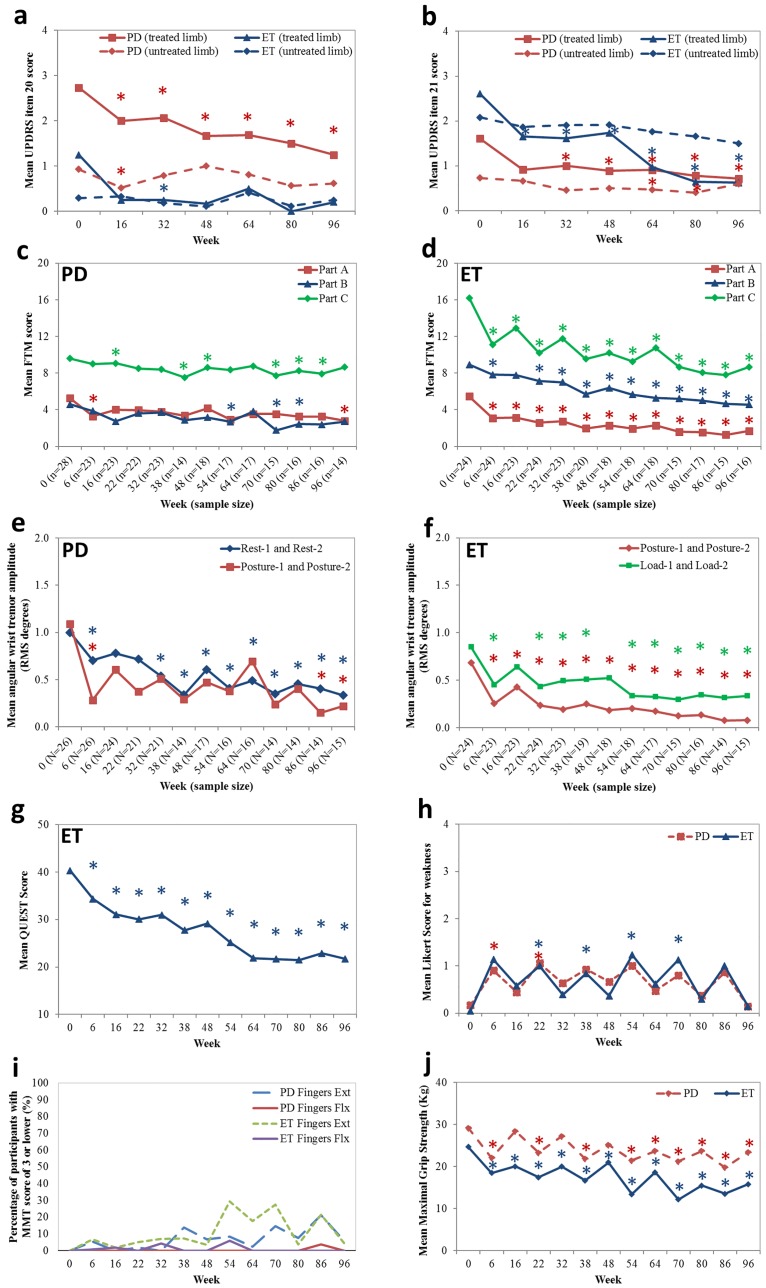
Following BoNT-A treatment, clinical ratings of tremor severity and functional ability (FTM) showed significant improvements following the first treatment which was maintained up to week 96 in PD and ET. Kinematics detected a significant reduction in PD and ET tremor amplitudes by 70% and 76% over the treatment course, respectively. By objectively distinguishing tremulous muscles and tremor severity, adverse effects were limited to mild perceived weakness by participants in injected muscles during follow-ups. Following the fourth treatment, BoNT-A dosages in flexor and extensor wrist muscles and biceps were reduced for those experiencing residual weakness which ultimately did not interfere with tremor relief or arm function.
Kinematics is an objective method that can aid clinicians in assessing and determining optimal BoNT-A parameters to alleviate both PD and ET tremor. BoNT-A injections are tolerable and effective when focal therapy regimens are determined and optimized kinematically over a long-term.
目前用于治疗帕金森病(PD)震颤和特发性震颤(ET)的药物疗效欠佳,且通常伴有明显的不良反应。A型肉毒毒素(BoNT-A)已被证明对腕部震颤有效,但其常导致功能性的肌肉无力,令人困扰。这是迄今为止时间最长的一项研究,表明BoNT-A疗法结合运动学指导可为上肢震颤提供有效的治疗效果,并将不必要的肌无力降至最低。
共有28名患有令人困扰的、致残性震颤的PD患者和24名ET患者,从第0周开始,每16周接受6次连续的BoNT-A治疗,每次治疗后6周进行随访,共计96周。每次随访时进行临床量表评估,包括法恩-托洛萨-马林震颤评定量表(FTM),以及基于传感器的震颤评估。利用运动学来确定哪些手臂肌肉导致了震颤运动,经验丰富的注射者运用临床专业知识来确定BoNT-A的剂量。
BoNT-A治疗后,震颤严重程度和功能能力(FTM)的临床评分在首次治疗后即有显著改善,在PD和ET患者中一直维持到第96周。运动学检测发现,在整个治疗过程中,PD和ET的震颤幅度分别显著降低了70%和76%。通过客观区分震颤肌肉和震颤严重程度,随访期间的不良反应仅限于参与者感觉注射肌肉有轻度无力。在第四次治疗后,对于仍有残余无力的患者,减少了腕部屈肌和伸肌以及二头肌的BoNT-A剂量,而这最终并未影响震颤缓解或手臂功能。
运动学是一种客观的方法,可帮助临床医生评估和确定最佳的BoNT-A参数,以减轻PD和ET震颤。当通过运动学确定并长期优化局部治疗方案时,BoNT-A注射是可耐受且有效的。