Yamamoto Kyosuke, Togami Takashi, Yamaguchi Norio, Ninomiya Seishi
PS Solutions Corp., 1-5-2 Higashi-Shimbashi, Minato-ku, Tokyo 105-7104, Japan.
Graduate School of Agricultural and Life Sciences, The University of Tokyo, 1-1-1 Midori-cho, Nishi-Tokyo, Tokyo 188-0002, Japan.
Sensors (Basel). 2017 Jun 5;17(6):1290. doi: 10.3390/s17061290.
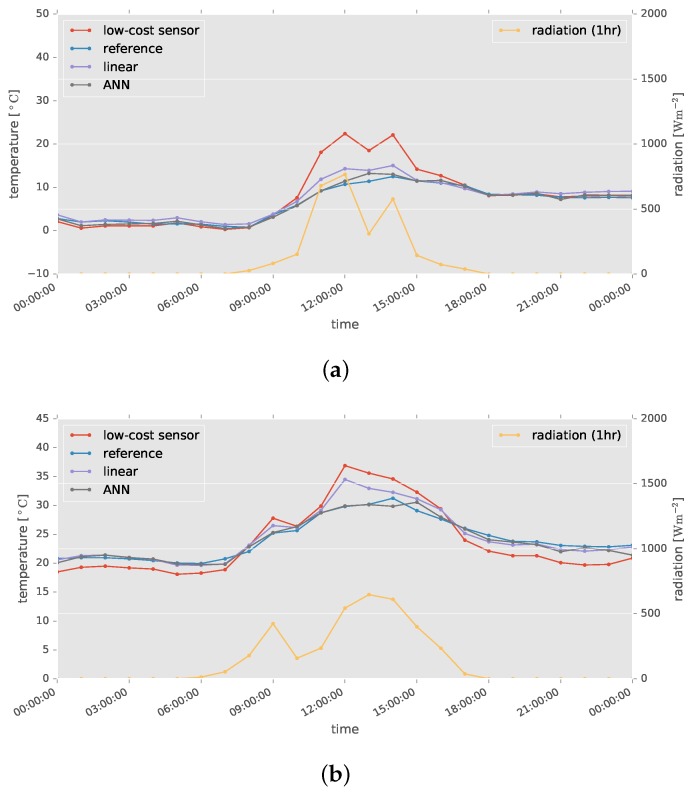
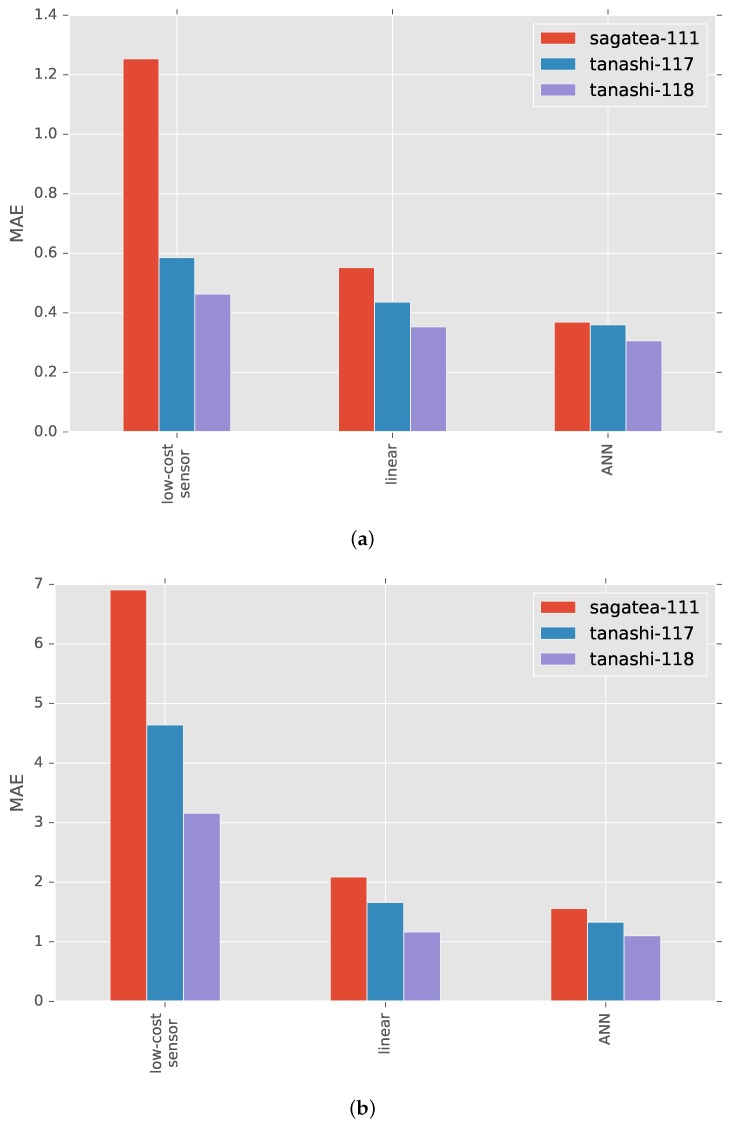
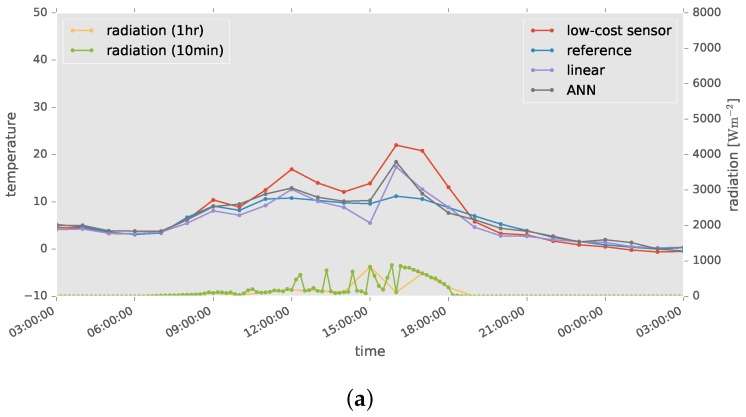
The measurement of air temperature is strongly influenced by environmental factors such as solar radiation, humidity, wind speed and rainfall. This is problematic in low-cost air temperature sensors, which lack a radiation shield or a forced aspiration system, exposing them to direct sunlight and condensation. In this study, we developed a machine learning-based calibration method for air temperature measurement by a low-cost sensor. An artificial neural network (ANN) was used to balance the effect of multiple environmental factors on the measurements. Data were collected over 305 days, at three different locations in Japan, and used to evaluate the performance of the approach. Data collected at the same location and at different locations were used for training and testing, and the former was also used for -fold cross-validation, demonstrating an average improvement in mean absolute error (MAE) from 1.62 to 0.67 by applying our method. Some calibration failures were noted, due to abrupt changes in environmental conditions such as solar radiation or rainfall. The MAE was shown to decrease even when the data collected in different nearby locations were used for training and testing. However, the results also showed that negative effects arose when data obtained from widely-separated locations were used, because of the significant environmental differences between them.
气温测量受到多种环境因素的强烈影响,如太阳辐射、湿度、风速和降雨。这对于低成本气温传感器来说是个问题,因为它们缺乏辐射屏蔽或强制通风系统,容易受到阳光直射和冷凝水的影响。在本研究中,我们开发了一种基于机器学习的低成本传感器气温测量校准方法。使用人工神经网络(ANN)来平衡多种环境因素对测量结果的影响。在日本的三个不同地点收集了305天的数据,并用于评估该方法的性能。在同一地点和不同地点收集的数据分别用于训练和测试,前者还用于K折交叉验证,结果表明,应用我们的方法后,平均绝对误差(MAE)从1.62降至0.67。由于太阳辐射或降雨等环境条件的突然变化,出现了一些校准失败的情况。即使使用在附近不同地点收集的数据进行训练和测试,MAE也会降低。然而,结果还表明,当使用从相距很远的地点获得的数据时,会产生负面影响,因为这些地点之间存在显著的环境差异。