Kawakita Takako, Masato Nisimura, Takiguchi Eri, Abe Akiko, Irahara Minoru
Department of Obsterics and Gynecology, Institute of Biomedical Sciences, Tokushima University Graduate School, Tokushima 770-8503, Japan.
Exp Ther Med. 2017 Jun;13(6):2939-2945. doi: 10.3892/etm.2017.4346. Epub 2017 Apr 18.
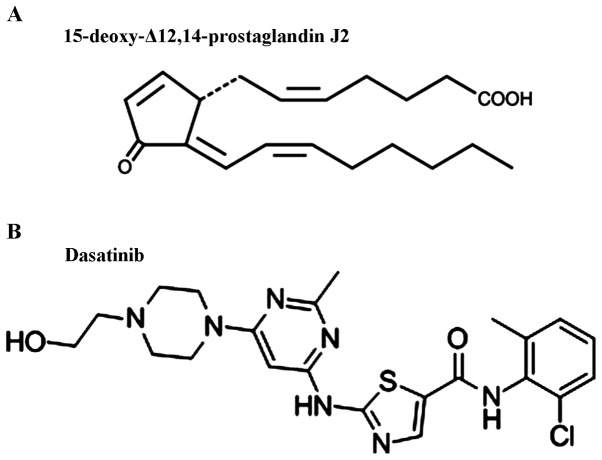
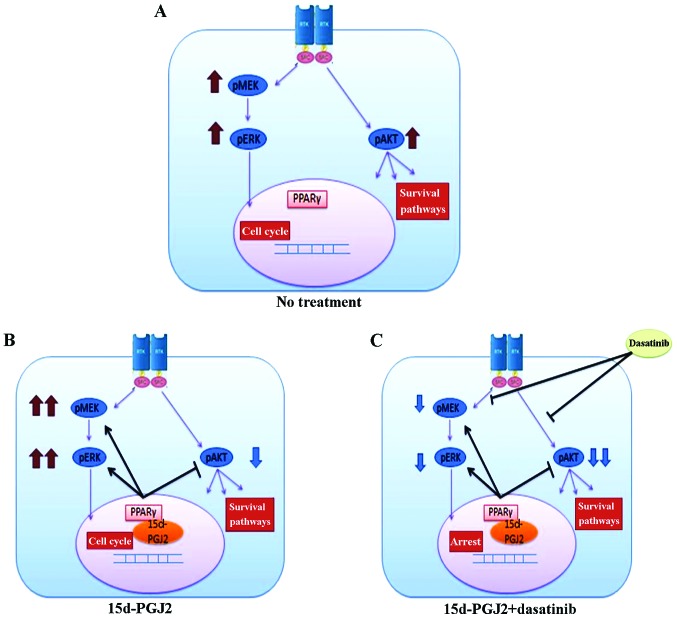
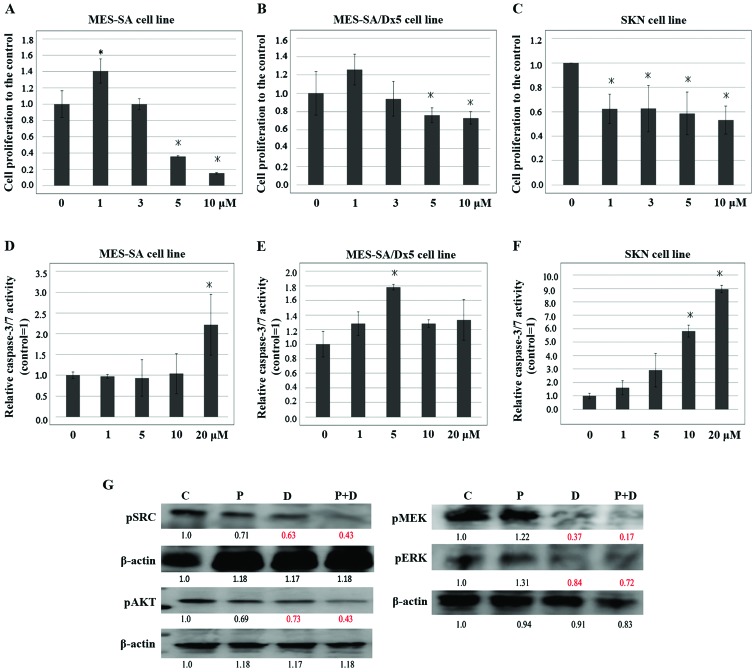
Effective chemotherapeutic strategies for uterine sarcoma are lacking; existing therapies achieve poor response rates. Previous studies have identified the prostaglandin 15-deoxy-Δ12,14-prostaglandin J2 (15d-PGJ2) as a potential anticancer treatment; however, its effectiveness in uterine sarcoma has not been examined. Furthermore, the molecular mechanisms underlying the cytotoxic mechanism of 15d-PGJ2 remain unclear. Here, we evaluated the effects of 15d-PGJ2 alone and in combination with the tyrosine kinas inhibitor (TKI) dasatinib in uterine sarcoma cell lines (MES-SA, MES-SA/DX5 and SKN). 15d-PGJ2 inhibited cell growth and increased apoptosis. Western blotting demonstrated that 15d-PGJ2 treatment increased MEK and ERK phosphorylation, and decreased levels of phosphorylated AKT. Dasatinib in combination with 15d-PGJ2 significantly reduced cell proliferation compared with 15d-PGJ2 alone, and repressed both the AKT and MAPK pathways. The cell growth inhibition rate in the PGJ2 was 21.5±12.0, 35.3±5.4 and 28.3±4.2%, respectively (MES-SA, MES-SA/DX5 and SKN cell lines) and the cell growth inhibition rate in the combination therapy was significantly higher compared with 15d-PGJ2 alone (MES-SA; 64.2±0.8, MES-SA/DX5;23.9±8.2 and SKN; 41.4±17.6%). The PGJ2 IC determined by MTT assay was 27.41,10.46 and 17.38 µmol/l, respectively (MES-SA, MES-SA/DX5 and SKN cell lines) and the dasatinib IC was 6.68,17.30 and 6.25 µmol/l, respectively. Our findings demonstrate that 15d-PGJ2 suppresses proliferation by inactivating the AKT pathway in uterine sarcoma. Furthermore, combining 15d-PGJ2 with dasatinib produced a synergistic effect on cancer cell inhibition by repressing 15d-PGJ2-mediated activation of MAPK signaling, and further repressing AKT signaling. These results suggest that 15d-PGJ2 could be used in combination with dasatinib as a potential therapeutic approach for uterine sarcoma.
子宫肉瘤缺乏有效的化疗策略;现有疗法的缓解率很低。先前的研究已确定前列腺素15-脱氧-Δ12,14-前列腺素J2(15d-PGJ2)为一种潜在的抗癌治疗方法;然而,其在子宫肉瘤中的有效性尚未得到检验。此外,15d-PGJ2细胞毒性机制背后的分子机制仍不清楚。在此,我们评估了单独使用15d-PGJ2以及将其与酪氨酸激酶抑制剂(TKI)达沙替尼联合使用对子宫肉瘤细胞系(MES-SA、MES-SA/DX5和SKN)的影响。15d-PGJ2抑制细胞生长并增加细胞凋亡。蛋白质免疫印迹法表明,15d-PGJ2处理可增加MEK和ERK磷酸化,并降低磷酸化AKT的水平。与单独使用15d-PGJ2相比,达沙替尼与15d-PGJ2联合使用可显著降低细胞增殖,并抑制AKT和MAPK途径。PGJ2对MES-SA、MES-SA/DX5和SKN细胞系的细胞生长抑制率分别为21.5±12.0%、35.3±5.4%和28.3±4.2%,联合治疗的细胞生长抑制率显著高于单独使用15d-PGJ2(MES-SA为64.2±0.8%,MES-SA/DX5为23.9±8.2%,SKN为41.4±17.6%)。通过MTT法测定的PGJ2的IC50分别为27.41、10.46和17.38 μmol/L(MES-SA、MES-SA/DX5和SKN细胞系),达沙替尼的IC50分别为6.68、17.30和6.25 μmol/L。我们的研究结果表明,15d-PGJ2通过使子宫肉瘤中的AKT途径失活来抑制增殖。此外,将15d-PGJ2与达沙替尼联合使用可通过抑制15d-PGJ2介导的MAPK信号激活并进一步抑制AKT信号,对癌细胞抑制产生协同作用。这些结果表明,15d-PGJ2可与达沙替尼联合使用,作为子宫肉瘤的一种潜在治疗方法。