Department of Medical Oncology, Harvard Medical School, Dana-Farber Cancer Institute, Boston, MA, USA.
Department of Biostatistics and Computational Biology, Dana-Farber Cancer Institute, Boston, MA, USA.
Leukemia. 2018 Jan;32(1):111-119. doi: 10.1038/leu.2017.182. Epub 2017 Jun 7.
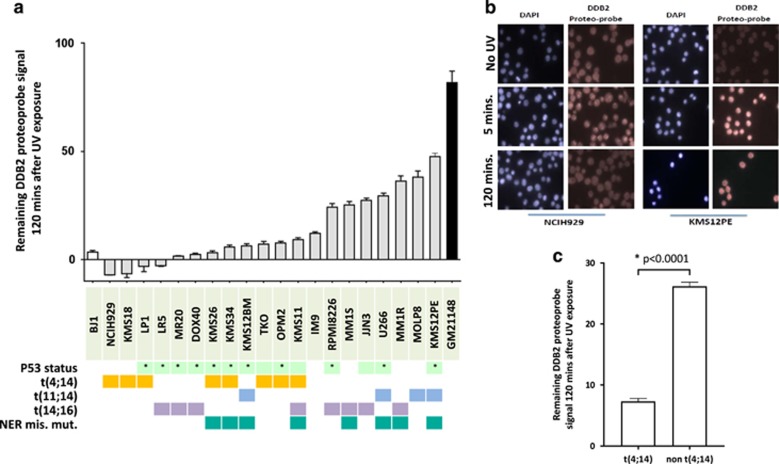
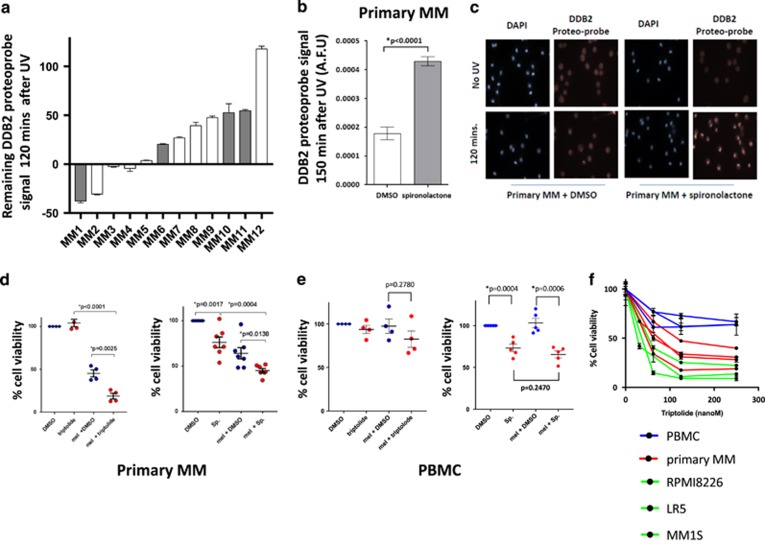
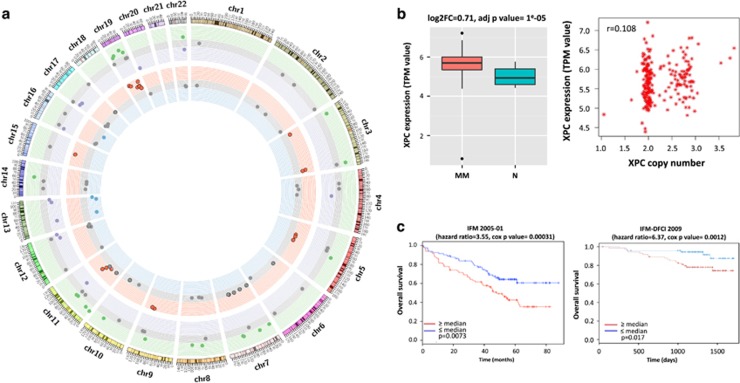
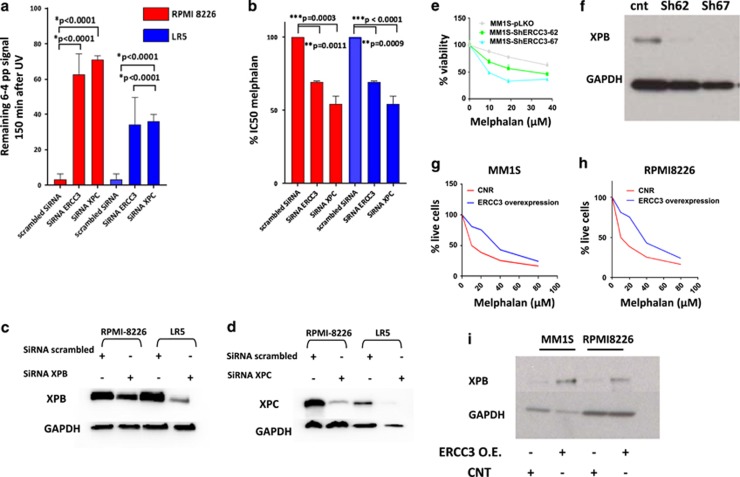
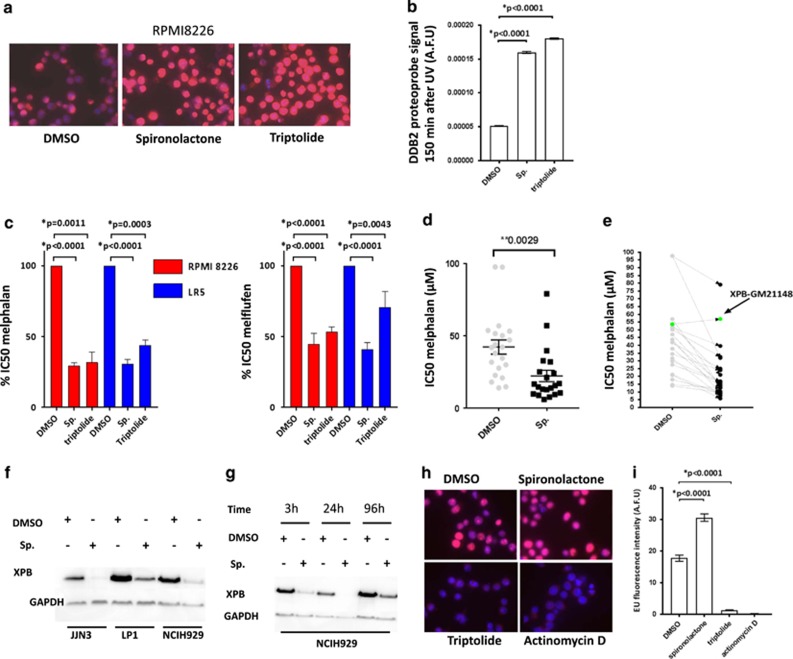
Despite the development of novel drugs, alkylating agents remain an important component of therapy in multiple myeloma (MM). DNA repair processes contribute towards sensitivity to alkylating agents and therefore we here evaluate the role of nucleotide excision repair (NER), which is involved in the removal of bulky adducts and DNA crosslinks in MM. We first evaluated NER activity using a novel functional assay and observed a heterogeneous NER efficiency in MM cell lines and patient samples. Using next-generation sequencing data, we identified that expression of the canonical NER gene, excision repair cross-complementation group 3 (ERCC3), significantly impacted the outcome in newly diagnosed MM patients treated with alkylating agents. Next, using small RNA interference, stable knockdown and overexpression, and small-molecule inhibitors targeting xeroderma pigmentosum complementation group B (XPB), the DNA helicase encoded by ERCC3, we demonstrate that NER inhibition significantly increases sensitivity and overcomes resistance to alkylating agents in MM. Moreover, inhibiting XPB leads to the dual inhibition of NER and transcription and is particularly efficient in myeloma cells. Altogether, we show that NER impacts alkylating agents sensitivity in myeloma cells and identify ERCC3 as a potential therapeutic target in MM.
尽管新型药物不断发展,但烷化剂在多发性骨髓瘤 (MM) 的治疗中仍然是一个重要组成部分。DNA 修复过程有助于对烷化剂的敏感性,因此我们在这里评估核苷酸切除修复 (NER) 的作用,NER 参与 MM 中大量加合物和 DNA 交联的清除。我们首先使用新的功能测定法评估了 NER 活性,并在 MM 细胞系和患者样本中观察到 NER 效率存在异质性。使用下一代测序数据,我们发现经典 NER 基因,切除修复交叉互补组 3 (ERCC3) 的表达显著影响接受烷化剂治疗的新诊断 MM 患者的结局。接下来,我们通过小 RNA 干扰、稳定敲低和过表达以及靶向 Xeroderma Pigmentosum 互补组 B (XPB) 的小分子抑制剂(ERCC3 编码的 DNA 解旋酶),证明 NER 抑制可显著提高 MM 中对烷化剂的敏感性并克服耐药性。此外,抑制 XPB 可导致 NER 和转录的双重抑制,并且在骨髓瘤细胞中尤为有效。总之,我们表明 NER 会影响骨髓瘤细胞中烷化剂的敏感性,并确定 ERCC3 是 MM 中的一个潜在治疗靶点。