Gómez-Ariza Carlos J, Martín María C, Morales Julia
Department of Psychology, University of JaénJaén, Spain.
Department of Psychology, Loyola Andalucía UniversitySevilla, Spain.
Front Neurosci. 2017 May 23;11:282. doi: 10.3389/fnins.2017.00282. eCollection 2017.
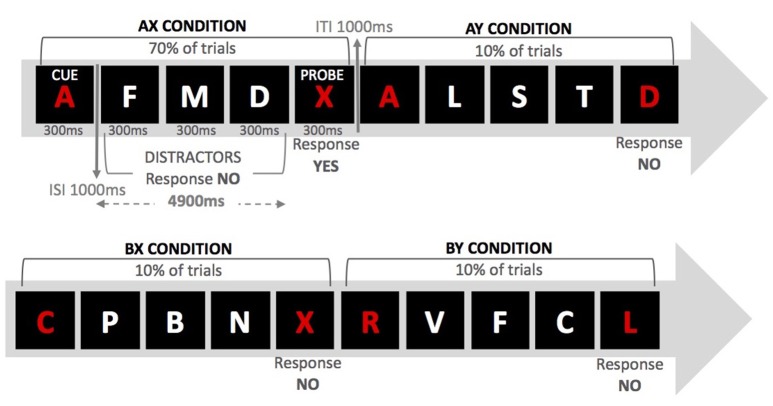
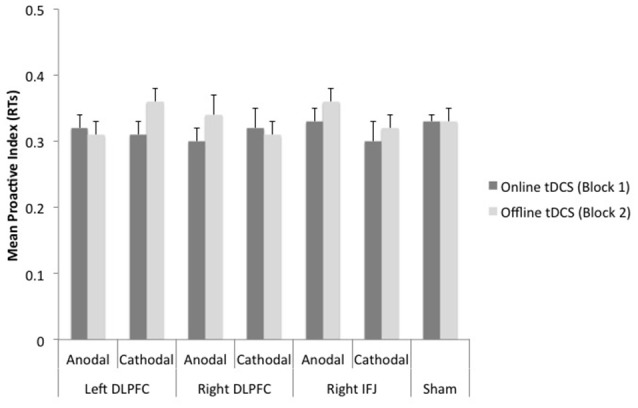
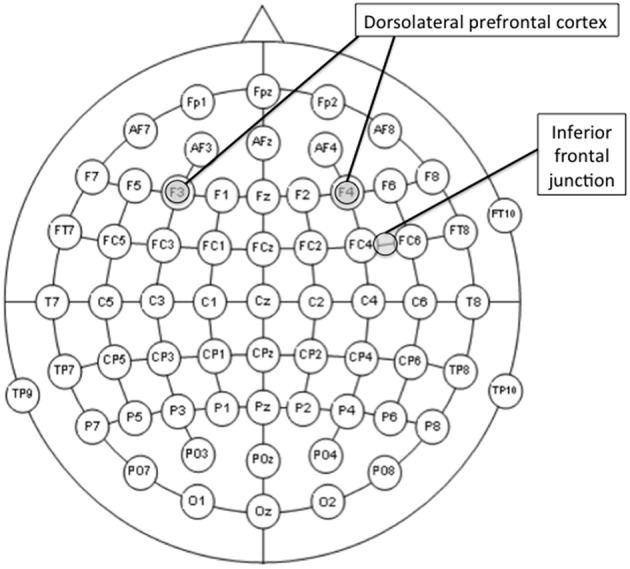
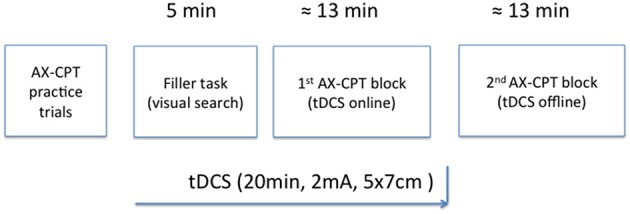
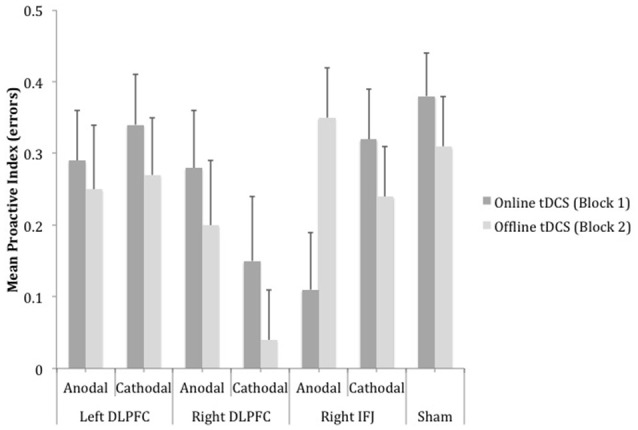
Behavioral and neuroimaging data support the distinction of two different modes of cognitive control: proactive, which involves the active and sustained maintenance of task-relevant information to bias behavior in accordance with internal goals; and reactive, which entails the detection and resolution of interference at the time it occurs. Both control modes may be flexibly deployed depending on a variety of conditions (i.e., age, brain alterations, motivational factors, prior experience). Critically, and in line with specific predictions derived from the dual mechanisms of control account (Braver, 2012), findings from neuroimaging studies indicate that the same lateral prefrontal regions (i.e., left dorsolateral cortex and right inferior frontal junction) may implement different control modes on the basis of temporal dynamics of activity, which would be modulated in response to external or internal conditions. In the present study, we aimed to explore whether transcraneal direct current stimulation over either the left dorsolateral prefrontal cortex or the right inferior frontal junction would differentially modulate performance on the AX-CPT, a well-validated task that provides sensitive and reliable behavioral indices of proactive/reactive control. The study comprised six conditions of real stimulation [3 (site: left dorsolateral, right dorsolateral and right inferior frontal junction) × 2 (polarity: anodal and cathodal)], and one sham condition. The reference electrode was always placed extracephalically. Performance on the AX-CPT was assessed through two blocks of trials. The first block took place while stimulation was being delivered, whereas the second block was administered after stimulation completion. The results indicate that both offline cathodal stimulation of the right dorsolateral prefrontal cortex and online anodal stimulation of the right inferior frontal junction led participants to be much less proactive, with such a dissociation suggesting that both prefrontal regions differentially contribute to the adjustment of cognitive control modes. tDCS of the left-DLPFC failed to modulate cognitive control. These results partially support the predictions derived from the dual mechanisms of control account.
主动模式,涉及对与任务相关信息的主动和持续维持,以根据内部目标使行为产生偏差;以及反应模式,需要在干扰出现时对其进行检测和解决。这两种控制模式都可以根据各种条件(即年龄、大脑变化、动机因素、先前经验)灵活部署。至关重要的是,与基于控制账户双重机制得出的具体预测一致(Braver,2012),神经影像学研究结果表明,相同的外侧前额叶区域(即左侧背外侧皮质和右侧额下交界区)可能会根据活动的时间动态实施不同的控制模式,而这种时间动态会根据外部或内部条件进行调节。在本研究中,我们旨在探讨经颅直流电刺激左侧背外侧前额叶皮质或右侧额下交界区是否会对AX连续性能测试(AX-CPT)的表现产生不同的调节作用,AX-CPT是一项经过充分验证的任务,能提供主动/反应控制的敏感且可靠的行为指标。该研究包括六种真实刺激条件[3(部位:左侧背外侧、右侧背外侧和右侧额下交界区)×2(极性:阳极和阴极)],以及一种假刺激条件。参考电极始终放置在头皮外。通过两个试验块评估AX-CPT的表现。第一个试验块在施加刺激时进行,而第二个试验块在刺激完成后进行。结果表明,右侧背外侧前额叶皮质的离线阴极刺激和右侧额下交界区的在线阳极刺激都会使参与者的主动性大大降低,这种分离表明两个前额叶区域对认知控制模式的调整有不同的贡献。左侧背外侧前额叶皮质的经颅直流电刺激未能调节认知控制。这些结果部分支持了基于控制账户双重机制得出的预测。