Käthner Ivo, Halder Sebastian, Hintermüller Christoph, Espinosa Arnau, Guger Christoph, Miralles Felip, Vargiu Eloisa, Dauwalder Stefan, Rafael-Palou Xavier, Solà Marc, Daly Jean M, Armstrong Elaine, Martin Suzanne, Kübler Andrea
Institute of Psychology, University of WürzburgWürzburg, Germany.
g.tec Medical Engineering GmbHSchiedlberg, Austria.
Front Neurosci. 2017 May 22;11:286. doi: 10.3389/fnins.2017.00286. eCollection 2017.
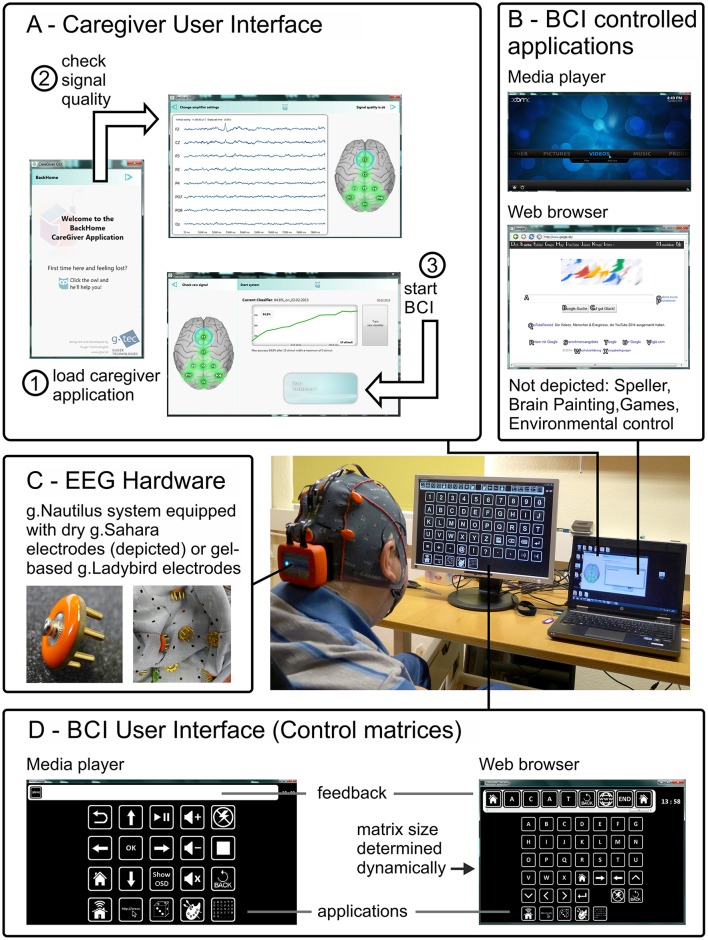
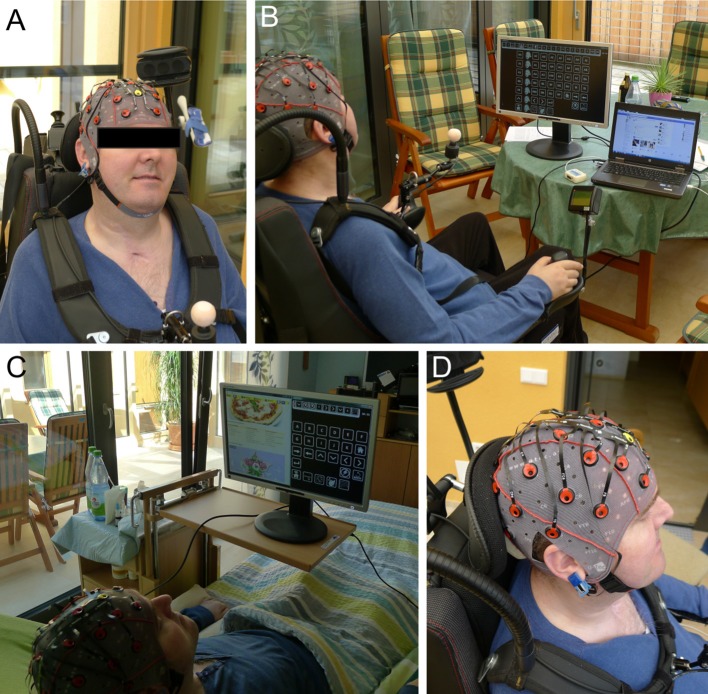
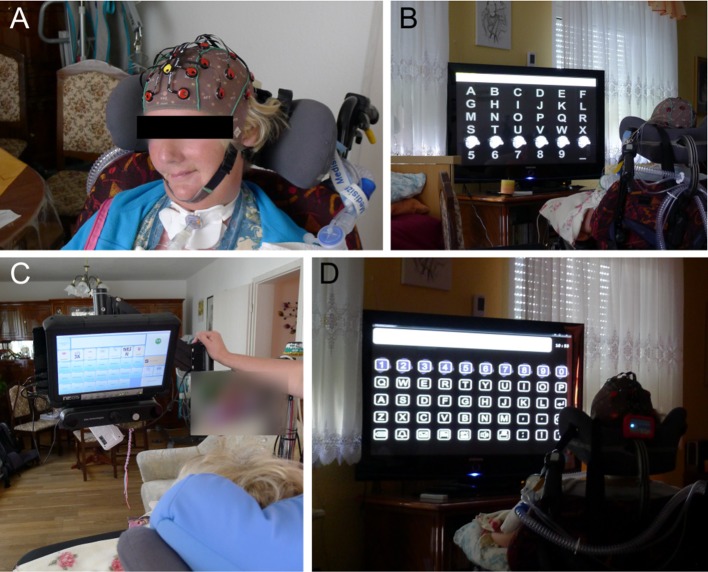
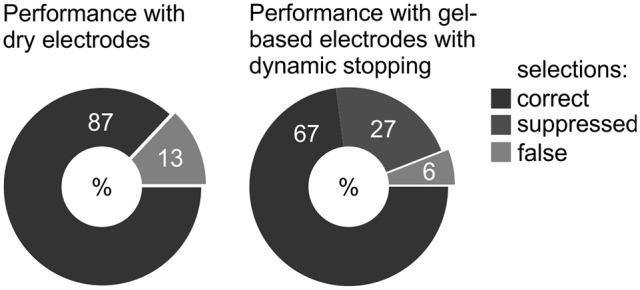
Current brain-computer interface (BCIs) software is often tailored to the needs of scientists and technicians and therefore complex to allow for versatile use. To facilitate home use of BCIs a multifunctional P300 BCI with a graphical user interface intended for non-expert set-up and control was designed and implemented. The system includes applications for spelling, web access, entertainment, artistic expression and environmental control. In addition to new software, it also includes new hardware for the recording of electroencephalogram (EEG) signals. The EEG system consists of a small and wireless amplifier attached to a cap that can be equipped with gel-based or dry contact electrodes. The system was systematically evaluated with a healthy sample, and targeted end users of BCI technology, i.e., people with a varying degree of motor impairment tested the BCI in a series of individual case studies. Usability was assessed in terms of effectiveness, efficiency and satisfaction. Feedback of users was gathered with structured questionnaires. Two groups of healthy participants completed an experimental protocol with the gel-based and the dry contact electrodes ( = 10 each). The results demonstrated that all healthy participants gained control over the system and achieved satisfactory to high accuracies with both gel-based and dry electrodes (average error rates of 6 and 13%). Average satisfaction ratings were high, but certain aspects of the system such as the wearing comfort of the dry electrodes and design of the cap, and speed (in both groups) were criticized by some participants. Six potential end users tested the system during supervised sessions. The achieved accuracies varied greatly from no control to high control with accuracies comparable to that of healthy volunteers. Satisfaction ratings of the two end-users that gained control of the system were lower as compared to healthy participants. The advantages and disadvantages of the BCI and its applications are discussed and suggestions are presented for improvements to pave the way for user friendly BCIs intended to be used as assistive technology by persons with severe paralysis.
当前的脑机接口(BCI)软件通常是根据科学家和技术人员的需求定制的,因此很复杂,以实现多功能使用。为了便于在家中使用BCI,设计并实现了一种具有图形用户界面的多功能P300 BCI,旨在供非专业人员进行设置和控制。该系统包括拼写、网络访问、娱乐、艺术表达和环境控制等应用程序。除了新软件外,它还包括用于记录脑电图(EEG)信号的新硬件。EEG系统由一个连接到帽子上的小型无线放大器组成,该帽子可以配备基于凝胶的或干式接触电极。该系统在一组健康样本中进行了系统评估,并且BCI技术的目标最终用户,即不同程度运动障碍的人在一系列个案研究中测试了BCI。从有效性、效率和满意度方面评估了可用性。通过结构化问卷收集用户的反馈。两组健康参与者使用基于凝胶的电极和干式接触电极完成了一个实验方案(每组n = 10)。结果表明,所有健康参与者都能够控制系统,并且使用基于凝胶的电极和干式电极都达到了令人满意到较高的准确率(平均错误率分别为6%和13%)。平均满意度评分很高,但系统的某些方面,如干式电极的佩戴舒适度、帽子的设计以及速度(两组中)受到了一些参与者的批评。六名潜在的最终用户在监督会议期间测试了该系统。实现的准确率差异很大,从无法控制到高度控制,准确率与健康志愿者相当。与健康参与者相比,两名能够控制系统的最终用户的满意度评分较低。讨论了BCI及其应用的优缺点,并提出了改进建议,为旨在供严重瘫痪者用作辅助技术的用户友好型BCI铺平道路。