Mishra Sujata, Joseph Renu Ann, Gupta Prakash C, Pezzack Brendon, Ram Faujdar, Sinha Dhirendra N, Dikshit Rajesh, Patra Jayadeep, Jha Prabhat
Centre for Global Health Research, St. Michael's Hospital and Dalla Lana School of Public Health, University of Toronto, Toronto, Ontario, Canada.
Healis-Sekhsaria Institute of Public Health,Mumbai, Maharashtra, India.
BMJ Glob Health. 2016 Apr 6;1(1):e000005. doi: 10.1136/bmjgh-2015-000005. eCollection 2016.
Smoking of cigarettes or bidis (small, locally manufactured smoked tobacco) in India has likely changed over the last decade. We sought to document trends in smoking prevalence among Indians aged 15-69 years between 1998 and 2015.
Comparison of 3 nationally representative surveys representing 99% of India's population; the Special Fertility and Mortality Survey (1998), the Sample Registration System Baseline Survey (2004) and the Global Adult Tobacco Survey (2010).
India.
About 14 million residents from 2.5 million homes, representative of India.
Age-standardised smoking prevalence and projected absolute numbers of smokers in 2015. Trends were stratified by type of tobacco smoked, age, gender and education level.
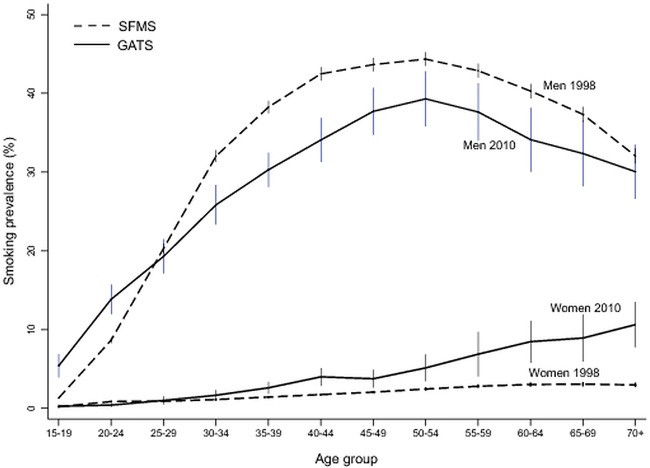
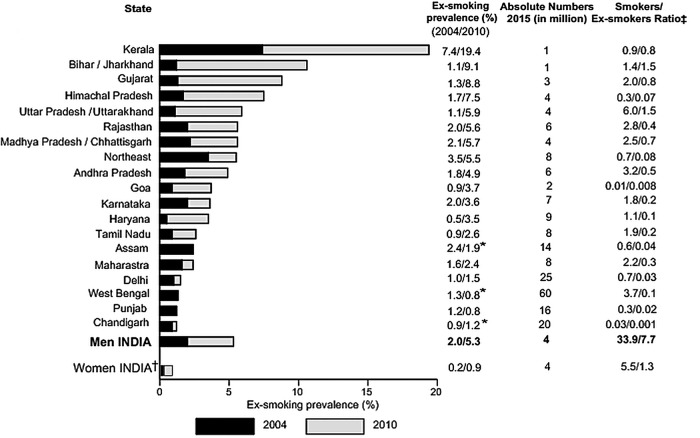
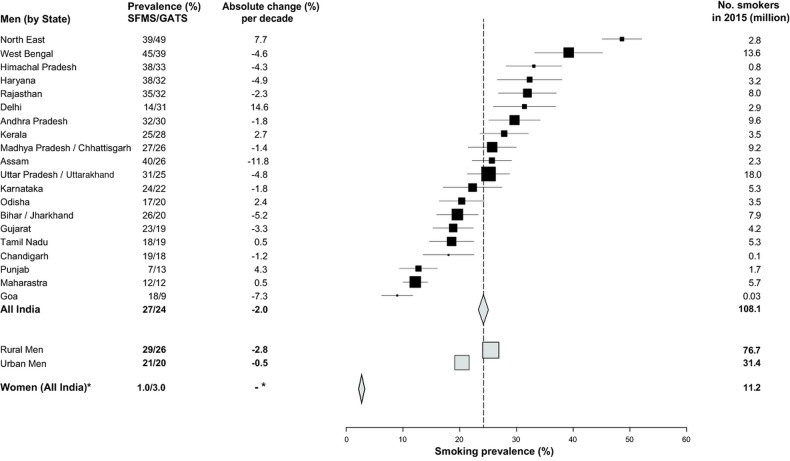
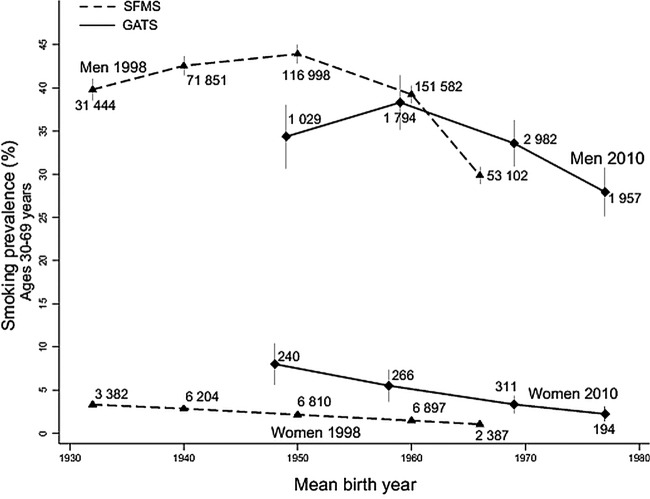
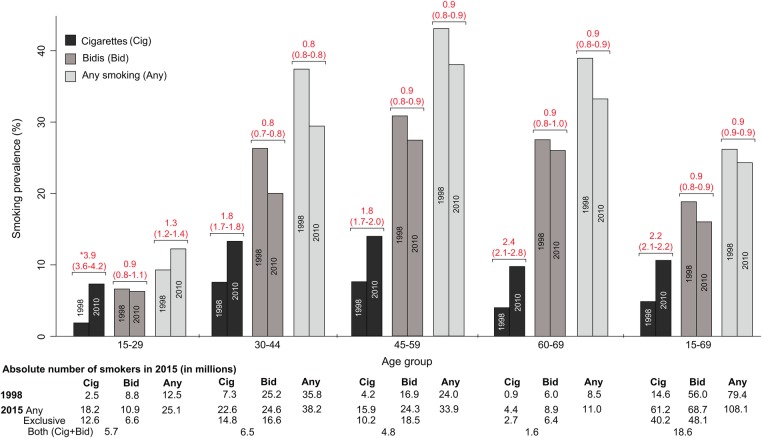
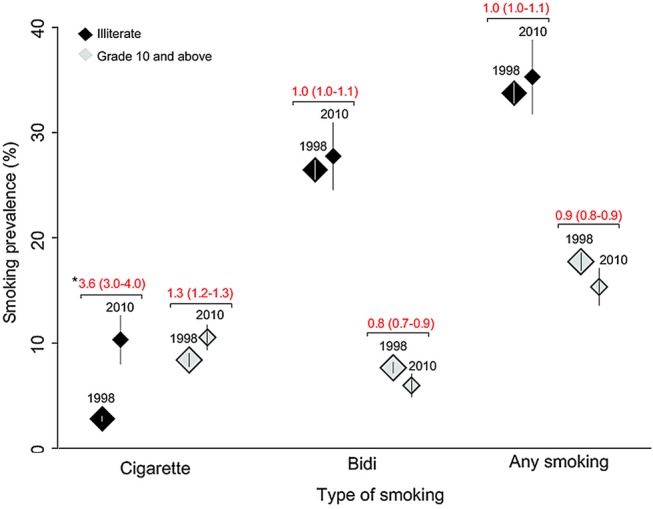
The age-standardised prevalence of any smoking in men at ages 15-69 years fell from about 27% in 1998 to 24% in 2010, but rose at ages 15-29 years. During this period, cigarette smoking in men became about twofold more prevalent at ages 15-69 years and fourfold more prevalent at ages 15-29 years. By contrast, bidi smoking among men at ages 15-69 years fell modestly. The age-standardised prevalence of any smoking in women at these ages was 2.7% in 2010. The smoking prevalence in women born after 1960 was about half of the prevalence in women born before 1950. By contrast, the intergenerational changes in smoking prevalence in men were much smaller. The absolute numbers of men smoking any type of tobacco at ages 15-69 years rose by about 29 million or 36% in relative terms from 79 million in 1998 to 108 million in 2015. This represents an average increase of about 1.7 million male smokers every year. By 2015, there were roughly equal numbers of men smoking cigarettes or bidis. About 11 million women aged 15-69 smoked in 2015. Among illiterate men, the prevalence of smoking rose (most sharply for cigarettes) but fell modestly among men with grade 10 or more education. The ex-smoking prevalence in men at ages 45-59 years rose modestly but was low: only 5% nationally with about 4 current smokers for every former smoker.
Despite modest decreases in smoking prevalence, the absolute numbers of male smokers aged 15-69 years has increased substantially over the last 15 years. Cigarettes are displacing bidi smoking, most notably among young adult men and illiterate men. Tobacco control policies need to adapt to these changes, most notably with higher taxation on tobacco products, so as to raise the currently low levels of adult smoking cessation.
在过去十年间,印度的卷烟或比迪烟(当地生产的小型烟熏烟草)吸烟情况可能已发生变化。我们试图记录1998年至2015年间15 - 69岁印度人群的吸烟流行趋势。
对三项具有全国代表性的调查进行比较,这三项调查涵盖了印度99%的人口;分别是特别生育率和死亡率调查(1998年)、样本登记系统基线调查(2004年)以及全球成人烟草调查(2010年)。
印度。
来自250万户家庭的约1400万居民,具有印度代表性。
年龄标准化吸烟流行率以及2015年吸烟者的预计绝对数量。趋势按吸烟类型、年龄、性别和教育水平进行分层。
15 - 69岁男性的任何类型吸烟的年龄标准化流行率从1998年的约27%降至2010年的24%,但在15 - 29岁年龄段有所上升。在此期间,15 - 69岁男性的卷烟吸烟率增加了约两倍,15 - 29岁年龄段增加了四倍。相比之下,15 - 69岁男性的比迪烟吸烟率略有下降。2010年,这些年龄段女性的任何类型吸烟的年龄标准化流行率为2.7%。1960年后出生的女性吸烟流行率约为1950年前出生女性的一半。相比之下,男性吸烟流行率的代际变化要小得多。15 - 69岁吸食任何类型烟草的男性绝对数量从1998年的7900万增加到2015年的1.08亿,增加了约2900万,相对增幅为36%。这意味着每年平均增加约170万男性吸烟者。到2015年,吸卷烟和吸比迪烟的男性人数大致相等。2015年,约有1100万15 - 69岁的女性吸烟。在文盲男性中,吸烟率上升(卷烟最为明显),但在接受过10年级及以上教育的男性中略有下降。45 - 59岁男性的戒烟率略有上升,但很低:全国仅为5 %,每有1名戒烟者,约有4名当前吸烟者。
尽管吸烟流行率略有下降,但在过去15年中,年龄在15 - 69岁的男性吸烟者绝对数量大幅增加。卷烟正在取代比迪烟吸烟,在年轻成年男性和文盲男性中尤为明显。烟草控制政策需要适应这些变化,最显著的是提高烟草产品税收,以提高目前较低的成人戒烟水平。