Faubion W A, Camilleri M, Murray J A, Kelly P, Amadi B, Kosek M N, Enders F, Larson J, Grover M, Boe G, Dyer R, Singh R
Division of Gastroenterology and Hepatology, Mayo Clinic, Rochester, Minnesota, USA.
Queen Mary, University of London, University of Zambia School of Medicine, London, UK.
BMJ Glob Health. 2016 Jul 4;1(1):e000066. doi: 10.1136/bmjgh-2016-000066. eCollection 2016.
Environmental enteric dysfunction (EED) is an asymptomatic intestinal disorder affecting populations living in conditions of poor sanitation and hygiene. The study tested intestinal barrier function in infants with EED.
We prospectively studied an advanced high-performance liquid chromatography mass spectrometry assay of urine collected after oral intake of the monosaccharide, L-rhamnose and the disaccharide, lactulose, in 112 children from three continents.
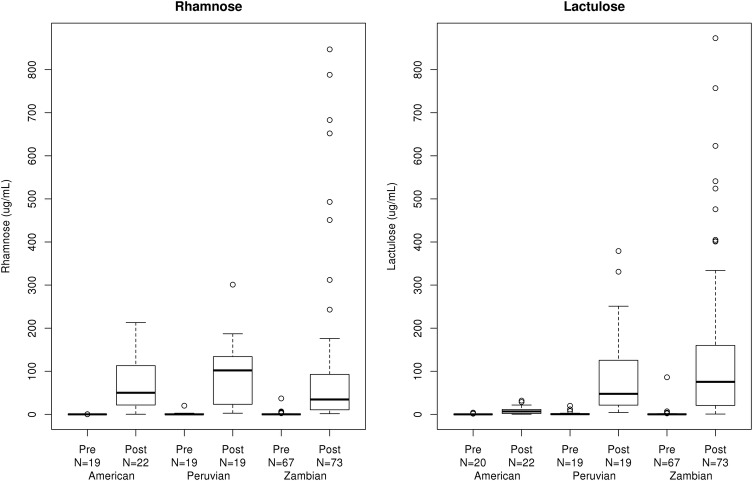
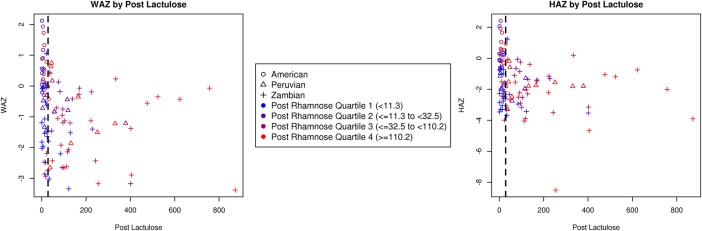
Compared to the US cohort (n=27), the cohorts of children from Peru (n=19) and Zambia (n=85) were older with evidence of growth impairment. The median (range) of age (months) was 8.0 (2.0 to 13.0), 27.0 (15.0 to 29.0) and 21.0 (12.0 to 36.0), respectively. The median (range) of height for age Z score was -0.1 (-1.8 to 2.4), -1.8 (-3.3 to -0.2) and -2.3 (-8.5 to 1.2), respectively. Among children with valid sugar data (n=22 USA, n=19 Peru, n=73 Zambia), there were no significant differences in the median rhamnose urine concentrations between the three groups. The median (range) lactulose concentration (µg/mL) was 6.78 (0.29 to 31.90), 47.60 (4.23 to 379.00) and 75.40 (0.67 to 873.00) in the US, Peruvian and Zambian cohorts, respectively (p<0.001). The lactulose/rhamnose ratio (LRR) was higher in cohorts from Peru (0.75, 0.15, 5.02) and Zambia (2.26, 0.08, 14.48) compared to the US (0.14, 0.06, 1.00) cohort (p<0.001). In a multivariate effect modification model, higher weight-for-age z scores were associated with lower post-dose lactulose when rhamnose excretion was constant (p=0.003).
This non-invasive two saccharide permeability protocol measures changes in intestinal permeability in children with EED and permits the identification of individuals for interventional trials.
环境性肠道功能障碍(EED)是一种影响生活在卫生条件差的环境中的人群的无症状肠道疾病。该研究检测了患有EED的婴儿的肠道屏障功能。
我们前瞻性地研究了来自三大洲的112名儿童口服单糖L-鼠李糖和双糖乳糖后收集的尿液的先进高效液相色谱质谱分析法。
与美国队列(n = 27)相比,来自秘鲁(n = 19)和赞比亚(n = 85)的儿童队列年龄更大,并有生长发育迟缓的迹象。年龄(月)的中位数(范围)分别为8.0(2.0至13.0)、27.0(15.0至29.0)和21.0(12.0至36.0)。年龄别身高Z评分的中位数(范围)分别为-0.1(-1.8至2.4)、-1.8(-3.3至-0.2)和-2.3(-8.5至1.2)。在有有效糖数据的儿童中(美国22例,秘鲁19例,赞比亚73例),三组之间鼠李糖尿浓度中位数无显著差异。美国、秘鲁和赞比亚队列中乳糖浓度(μg/mL)的中位数(范围)分别为6.78(0.29至31.90)、47.60(4.23至379.00)和75.40(0.67至873.00)(p<0.001)。与美国队列(0.14,0.06,1.00)相比,秘鲁(0.75,0.15,5.02)和赞比亚(2.26,0.08,14.48)队列的乳糖/鼠李糖比率(LRR)更高(p<0.001)。在多变量效应修正模型中,当鼠李糖排泄量恒定时,年龄别体重Z评分越高,给药后乳糖含量越低(p = 0.003)。
这种非侵入性的双糖通透性检测方法可测量患有EED的儿童的肠道通透性变化,并有助于识别适合进行干预试验的个体。