Karimi Karen, Faraklas Iris, Lewis Giavonni, Ha Daniel, Walker Bridget, Zhai Yan, Graves Gareth, Dissanaike Sharmila
Department of Surgery, Texas Tech University Health Sciences Center, 3601 4th Street MS 8312, Lubbock, TX 79430 USA.
Department of Surgery, University of Utah Health Sciences Center, 30 N 1900 East, Salt Lake City, UT 84132 USA.
Burns Trauma. 2017 Jun 4;5:18. doi: 10.1186/s41038-017-0083-y. eCollection 2017.
There is increasing evidence that sex differences may influence responses after thermal injury and affect clinical outcomes. The objective of this study was to evaluate the relationships between sex, thermal injury, body size, and inpatient mortality in burn patients.
Medical records of adults with >20% total body surface area (TBSA) burn injury admitted to two American Burn Association (ABA)-verified burn centers between 2008 and 2014 were retrospectively reviewed. Injury details and baseline characteristics, including body size as estimated by body surface area (BSA) and body mass index (BMI) were recorded, along with details of the hospital course. The primary outcome of inpatient mortality was compared between sexes.
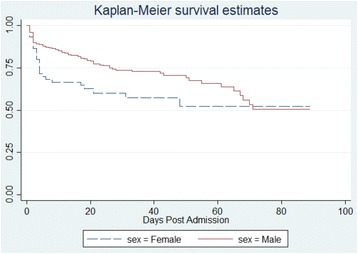
Out of 334 subjects, 60 were women (18%). Median TBSA was 33% (IQR 25-49) in this cohort, with 19% full thickness burns and 30% inhalation injury. Despite no significant difference in age, presence of inhalation injury, TBSA, or depth of burn, women had significantly higher rates of inpatient mortality (45 vs. 29%, = 0.01). BSA was significantly lower in women vs. men ( < 0.001), but this difference was not more pronounced among non-survivors. There was no difference in BMI between men and women non-survivors. Although not significant ( = 0.28), women succumbed to their injuries sooner than men (day 4 vs. 10 post-injury).
Women are less likely to survive burn injuries and die sooner than men with similar injuries. Body size does not appear to modulate this effect. Burn centers should be aware of the higher mortality risk in women with large burns.
越来越多的证据表明,性别差异可能会影响热损伤后的反应,并影响临床结果。本研究的目的是评估烧伤患者的性别、热损伤、体型与住院死亡率之间的关系。
回顾性分析2008年至2014年间入住两家经美国烧伤协会(ABA)认证的烧伤中心、烧伤总面积(TBSA)>20%的成年患者的病历。记录损伤细节和基线特征,包括通过体表面积(BSA)和体重指数(BMI)估计的体型,以及住院病程细节。比较两性的住院死亡率这一主要结局。
在334名受试者中,60名是女性(18%)。该队列的TBSA中位数为33%(四分位间距25 - 49),其中19%为全层烧伤,30%有吸入性损伤。尽管在年龄、是否存在吸入性损伤、TBSA或烧伤深度方面无显著差异,但女性的住院死亡率显著更高(45%对29%,P = 0.01)。女性的BSA显著低于男性(P < 0.001),但这种差异在非幸存者中并不更明显。男性和女性非幸存者的BMI无差异。尽管不显著(P = 0.28),但女性比男性更早死于损伤(伤后第4天对第10天)。
与受伤情况相似的男性相比,女性烧伤后存活的可能性较小,且死亡更早。体型似乎并未调节这种影响。烧伤中心应意识到大面积烧伤女性的死亡风险更高。