Lucchetta Rosa Camila, Riveros Bruno Salgado, Pontarolo Roberto, Radominski Rosana Bento, Otuki Michel Fleith, Fernandez-Llimos Fernando, Correr Cassyano Januário
Laboratório de Serviços Clínicos e Evidências em Saúde, Departamento de Farmácia, Universidade Federal do Paraná (UFPR), Curitiba, PR, BR.
Serviço de Endocrinologia e Metabolismo, Hospital de Clínicas, Universidade Federal do Paraná (UFPR), Curitiba, PR, BR.
Clinics (Sao Paulo). 2017 May;72(5):317-324. doi: 10.6061/clinics/2017(05)10.
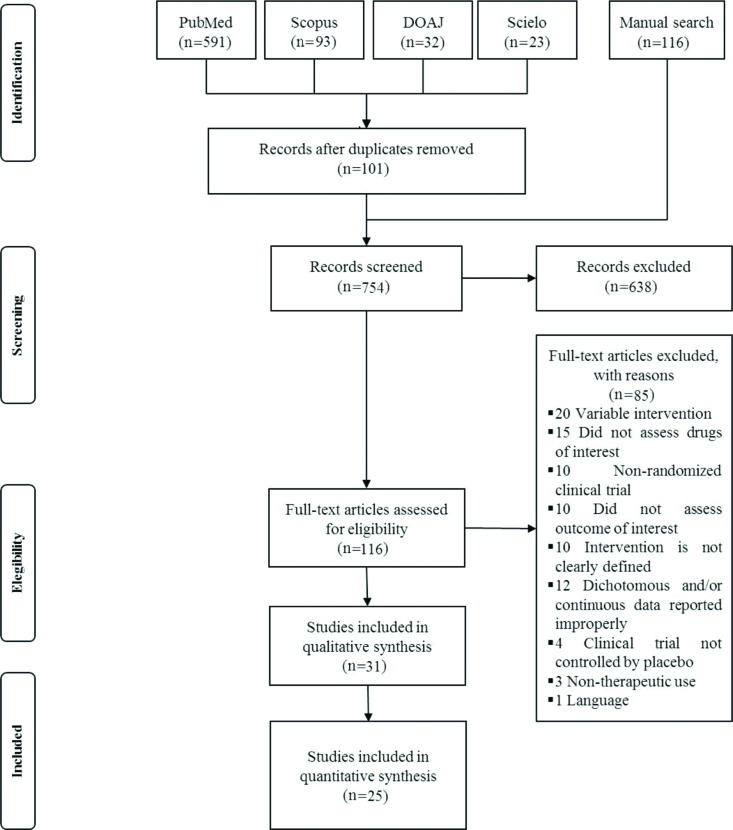
The aim of this study was to evaluate efficacy and safety of amfepramone, fenproporex and mazindol as a monotherapy for the treatment of obese or overweight patients. A systematic review of primary studies was conducted, followed by a direct meta-analysis (random effect) and mixed treatment comparison. Medline and other databases were searched. Heterogeneity was explored through I2 associated with a p-value. Of 739 identified publications, 25 were included in the meta-analysis. The global evaluation of Cochrane resulted in 19 studies with a high level of bias and six with unclear risk. Due to the lack of information in primary studies, direct meta-analyses were conducted only for amfepramone and mazindol. Compared to placebo, amfepramone resulted in higher weight loss in the short-term (<180 days; mean difference (MD) -1.281 kg; p<0.05; I2: 0.0%; p=0.379) and long-term (≥180 days; MD -6.518 kg; p<0.05; I2: 0.0%; p=0.719). Only studies with long-term follow up reported efficacy in terms of abdominal circumference and 5-10% weight reduction. These results corroborated the finding that the efficacy of amfepramone is greater than that of placebo. Treatment with mazindol showed greater short-term weight loss than that with placebo (MD -1.721 kg; p<0.05; I2: 0.9%; p=0.388). However, metabolic outcomes were poorly described, preventing a meta-analysis. A mixed treatment comparison corroborated the direct meta-analysis. Considering the high level of risk of bias and the absence of important published outcomes for anti-obesity therapy assessments, this study found that the evaluated drugs showed poor evidence of efficacy in the treatment of overweight and obese patients. Robust safety data were not identified to suggest changes in their regulatory status.
本研究旨在评估安非拉酮、芬普雷司和马吲哚作为单一疗法治疗肥胖或超重患者的疗效和安全性。我们对原始研究进行了系统评价,随后进行了直接荟萃分析(随机效应)和混合治疗比较。检索了Medline及其他数据库。通过与p值相关的I²来探讨异质性。在739篇已识别的出版物中,有25篇纳入了荟萃分析。Cochrane的综合评价结果显示,19项研究存在高度偏倚风险,6项研究的风险不明确。由于原始研究中缺乏相关信息,仅对安非拉酮和马吲哚进行了直接荟萃分析。与安慰剂相比,安非拉酮在短期(<180天;平均差值(MD)-1.281 kg;p<0.05;I²:0.0%;p=0.379)和长期(≥180天;MD -6.518 kg;p<0.05;I²:0.0%;p=0.719)均导致更高的体重减轻。只有长期随访研究报告了腹围和体重减轻5 - 10%方面的疗效。这些结果证实了安非拉酮的疗效大于安慰剂这一发现。马吲哚治疗显示出比安慰剂更大的短期体重减轻(MD -1.721 kg;p<0.05;I²: