Batista Vania, Richter Daniel, Combs Stephanie E, Jäkel Oliver
Hospital for Radiooncology and Radiation Therapy, Heidelberg University Hospital, Heidelberg, Germany.
University Clinic of Erlangen, Erlangen, Germany.
Radiat Oncol. 2017 Jun 8;12(1):94. doi: 10.1186/s13014-017-0832-x.
Managing inter-fractional anatomy changes is a challenging task in radiotherapy of pancreatic tumors, especially in scanned carbon-ion delivery. This treatment planning study aims to focus on clinically feasible solutions, such as the beam angle selection and margin design to increase the robustness against inter-fractional uncertainties.
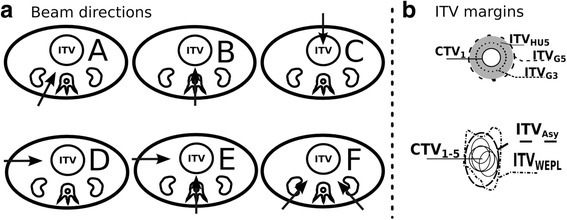
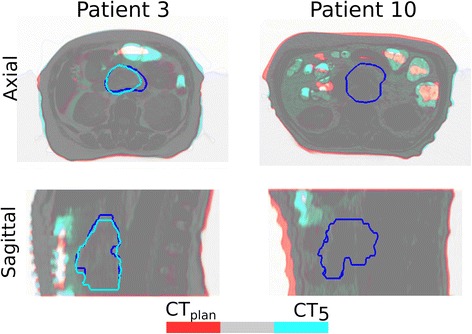
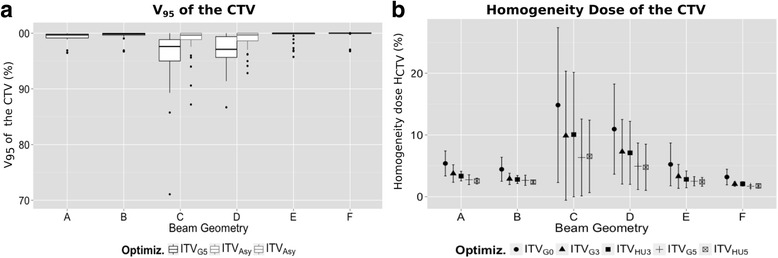
This study included 10 patients with weekly 3D-CT imaging and physician-approved Clinical Target Volume (CTV). The study was directed to keep the CTV-coverage using six beam angle configurations in combination with different Internal Target Volume (ITV) concepts. These were: geometric-margin (symmetric 3 and 5 mm margin); range-equivalent margins with an isotropic HU replacement; and to evaluate the need of asymmetric margins the water-equivalent range path (WEPL) was determined per patient from the set of CTs. Plan optimization and forward dose calculation in each week-CT were performed with the research treatment planning system TRiP98 and the plan quality evaluated in terms of CTV coverage (V95) and homogeneity dose (H = D5-D95).
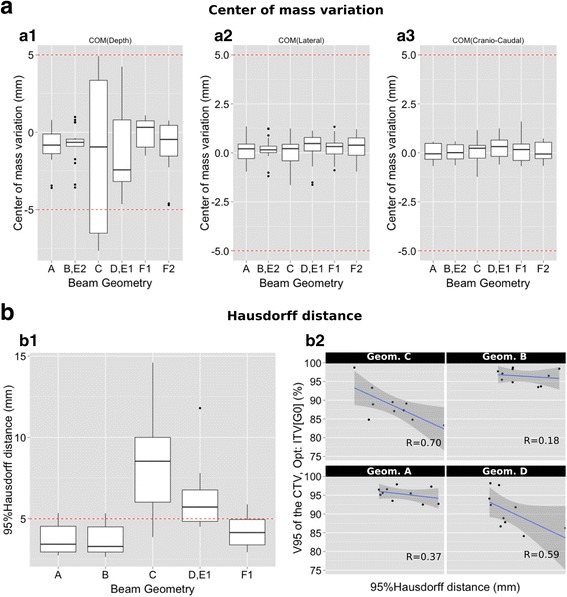
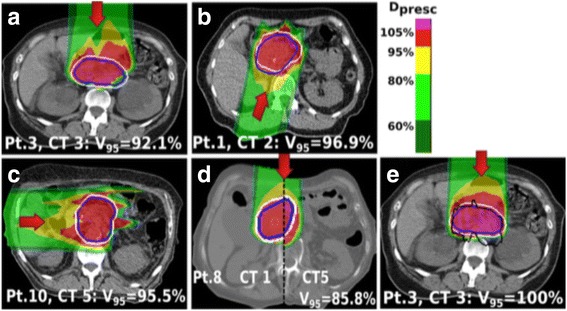
The beam geometry had a substantial impact on the target irradiation over the treatment course, with the single posterior or two beams showing the best average coverage of the CTV. The use of geometric margins for the more robust beam geometries showed acceptable results, with a V95 of (99.2 ± 1.2)% for the 5 mm-margin. For the non-robust configurations, due to substantial changes in the radiological depth, the use of this margin results in a V95 that might be below 80%, only showing improvement when the range changes are included.
Selection of adequate beam configurations and treatment margins in ion-beam therapy of pancreatic tumors is of great importance. For a single posterior beam or two beam configurations, application of geometrical margins compensate for dose degradation induced by inter-fractional anatomy changes for the majority of the analyzed treatment fractions.
在胰腺肿瘤的放射治疗中,尤其是在扫描碳离子放疗中,应对分次间的解剖结构变化是一项具有挑战性的任务。本治疗计划研究旨在关注临床可行的解决方案,如射野角度选择和边界设计,以提高对分次间不确定性的鲁棒性。
本研究纳入了10例每周进行3D-CT成像且经医生批准的临床靶区体积(CTV)的患者。该研究旨在通过六种射野角度配置结合不同的内靶区体积(ITV)概念来保持CTV覆盖。这些概念包括:几何边界(对称3和5毫米边界);具有各向同性HU替换的射程等效边界;为评估非对称边界的需求,根据CT组为每位患者确定水等效射程路径(WEPL)。使用研究性治疗计划系统TRiP98在每周的CT中进行计划优化和正向剂量计算,并根据CTV覆盖(V95)和剂量均匀性(H = D5 - D95)评估计划质量。
射野几何形状在整个治疗过程中对靶区照射有重大影响,单后野或双野显示出对CTV的最佳平均覆盖。对于更稳健的射野几何形状使用几何边界显示出可接受的结果,5毫米边界的V95为(99.2±1.2)%。对于不稳健的配置,由于放射学深度的显著变化,使用此边界会导致V95可能低于80%,只有在纳入射程变化时才会显示出改善。
在胰腺肿瘤的离子束治疗中选择合适的射野配置和治疗边界非常重要。对于单后野或双野配置,应用几何边界可补偿大多数分析治疗分次中因分次间解剖结构变化引起的剂量下降。