Muller Julius, Parizotto Eneida, Antrobus Richard, Francis James, Bunce Campbell, Stranks Amanda, Nichols Marshall, McClain Micah, Hill Adrian V S, Ramasamy Adaikalavan, Gilbert Sarah C
The Jenner Institute, University of Oxford, Old Road Campus Research Building, Oxford, OX3 7DQ, UK.
Immune Targeting Systems Ltd (now AltImmune Ltd), 2 Royal College Street, London, NW1 0NH, UK.
J Transl Med. 2017 Jun 8;15(1):134. doi: 10.1186/s12967-017-1235-3.
Influenza challenge trials are important for vaccine efficacy testing. Currently, disease severity is determined by self-reported scores to a list of symptoms which can be highly subjective. A more objective measure would allow for improved data analysis.
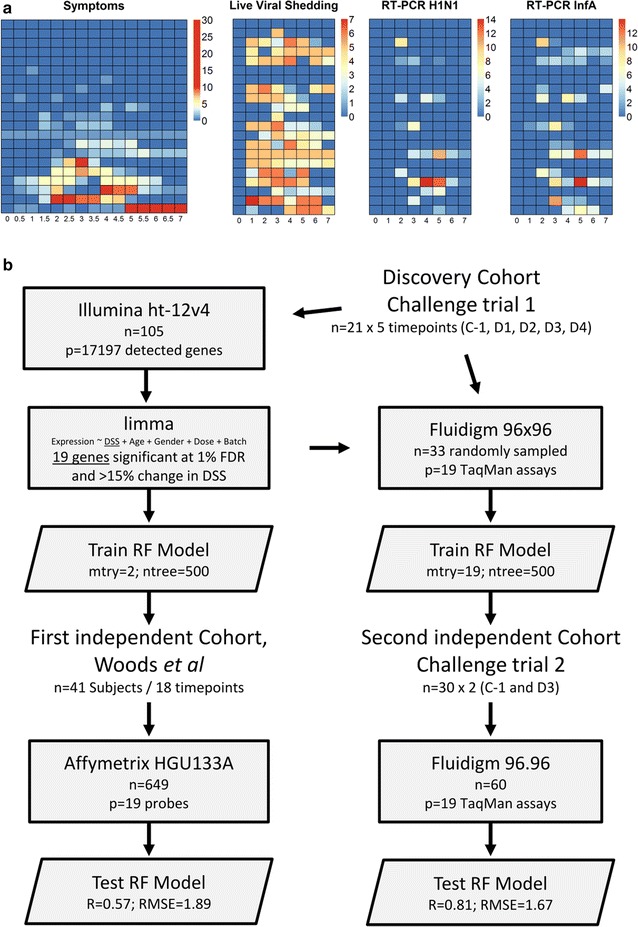
Twenty-one volunteers participated in an influenza challenge trial. We calculated the daily sum of scores (DSS) for a list of 16 influenza symptoms. Whole blood collected at baseline and 24, 48, 72 and 96 h post challenge was profiled on Illumina HT12v4 microarrays. Changes in gene expression most strongly correlated with DSS were selected to train a Random Forest model and tested on two independent test sets consisting of 41 individuals profiled on a different microarray platform and 33 volunteers assayed by qRT-PCR.
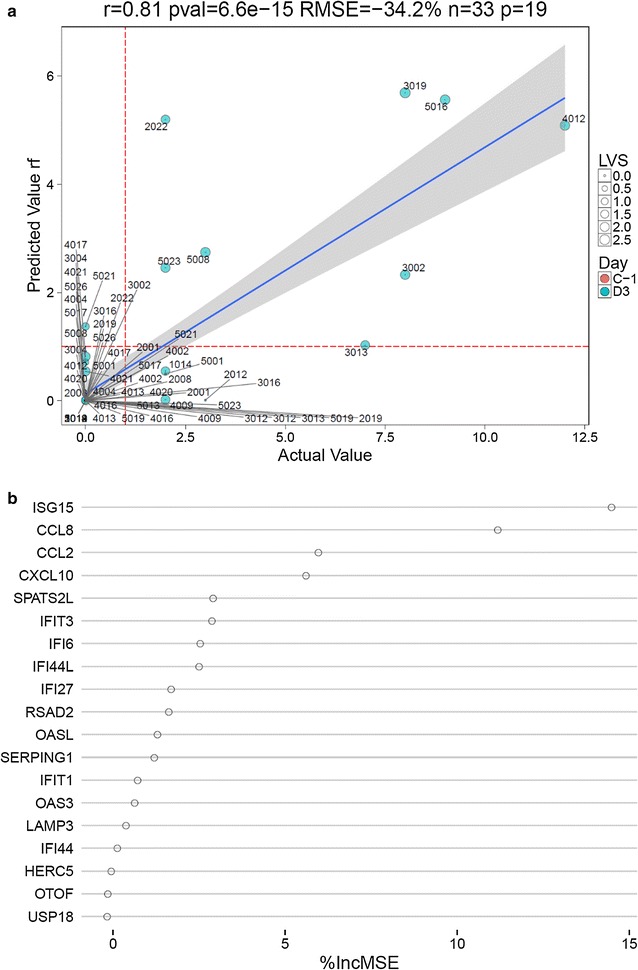
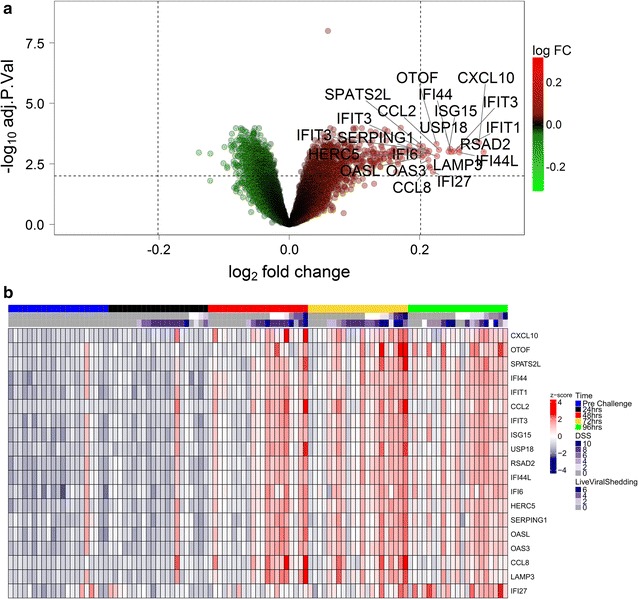
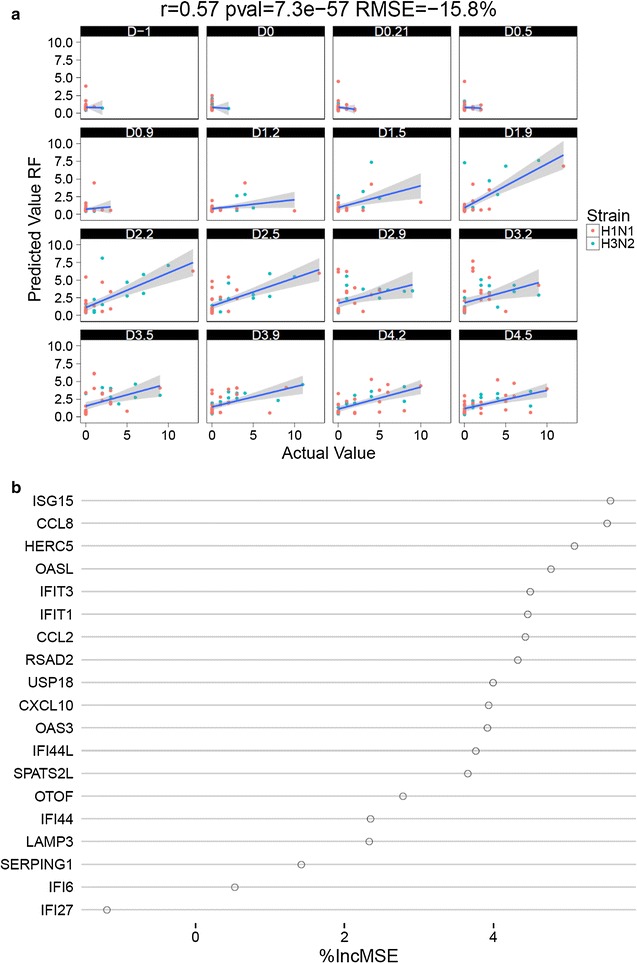
1456 probes are significantly associated with DSS at 1% false discovery rate. We selected 19 genes with the largest fold change to train a random forest model. We observed good concordance between predicted and actual scores in the first test set (r = 0.57; RMSE = -16.1%) with the greatest agreement achieved on samples collected approximately 72 h post challenge. Therefore, we assayed samples collected at baseline and 72 h post challenge in the second test set by qRT-PCR and observed good concordance (r = 0.81; RMSE = -36.1%).
We developed a 19-gene qRT-PCR panel to predict DSS, validated on two independent datasets. A transcriptomics based panel could provide a more objective measure of symptom scoring in future influenza challenge studies. Trial registration Samples were obtained from a clinical trial with the ClinicalTrials.gov Identifier: NCT02014870, first registered on December 5, 2013.
流感攻毒试验对于疫苗效力测试至关重要。目前,疾病严重程度是通过对一系列症状的自我报告评分来确定的,这可能具有高度主观性。一种更客观的测量方法将有助于改进数据分析。
21名志愿者参与了一项流感攻毒试验。我们计算了16种流感症状列表的每日评分总和(DSS)。在基线以及攻毒后24、48、72和96小时采集的全血在Illumina HT12v4微阵列上进行分析。选择与DSS相关性最强的基因表达变化来训练随机森林模型,并在两个独立测试集上进行测试,这两个测试集分别由在不同微阵列平台上分析的41名个体和通过qRT-PCR检测的33名志愿者组成。
在错误发现率为1%时,1456个探针与DSS显著相关。我们选择了19个变化倍数最大的基因来训练随机森林模型。我们在第一个测试集中观察到预测分数与实际分数之间有良好的一致性(r = 0.57;均方根误差 = -16.1%),在攻毒后约72小时采集的样本上一致性最佳。因此,我们通过qRT-PCR对第二个测试集中在基线和攻毒后72小时采集的样本进行检测,观察到良好的一致性(r = 0.81;均方根误差 = -36.1%)。
我们开发了一个由19个基因组成的qRT-PCR检测板来预测DSS,并在两个独立数据集上进行了验证。基于转录组学的检测板可为未来流感攻毒研究中的症状评分提供更客观的测量方法。试验注册 样本取自一项临床试验,临床试验.gov标识符:NCT02014870,于2013年12月5日首次注册。