Yoshida Naohisa, Naito Yuji, Murakami Takaaki, Hirose Ryohei, Ogiso Kiyoshi, Inada Yutaka, Dohi Osamu, Kamada Kazuhiro, Uchiyama Kazuhiko, Handa Osamu, Konishi Hideyuki, Siah Kewin Tien Ho, Yagi Nobuaki, Fujita Yasuko, Kishimoto Mitsuo, Yanagisawa Akio, Itoh Yoshito
Department of Molecular Gastroenterology and Hepatology, Kyoto Prefectural University of Medicine, Graduate School of Medical Science, Kyoto, Japan.
Division of Gastroenterology & Hepatology, University Medicine Cluster, National University Hospital, Singapore.
Endosc Int Open. 2017 Jun;5(6):E518-E525. doi: 10.1055/s-0043-105495. Epub 2017 Jun 7.
BACKGROUND/STUDY AIM: Linked color imaging (LCI) by a laser endoscope (Fujifilm Co, Tokyo, Japan) is a novel narrow band light observation. In this study, we aimed to investigate whether LCI could improve the visibility of colorectal polyps using endoscopic videos.
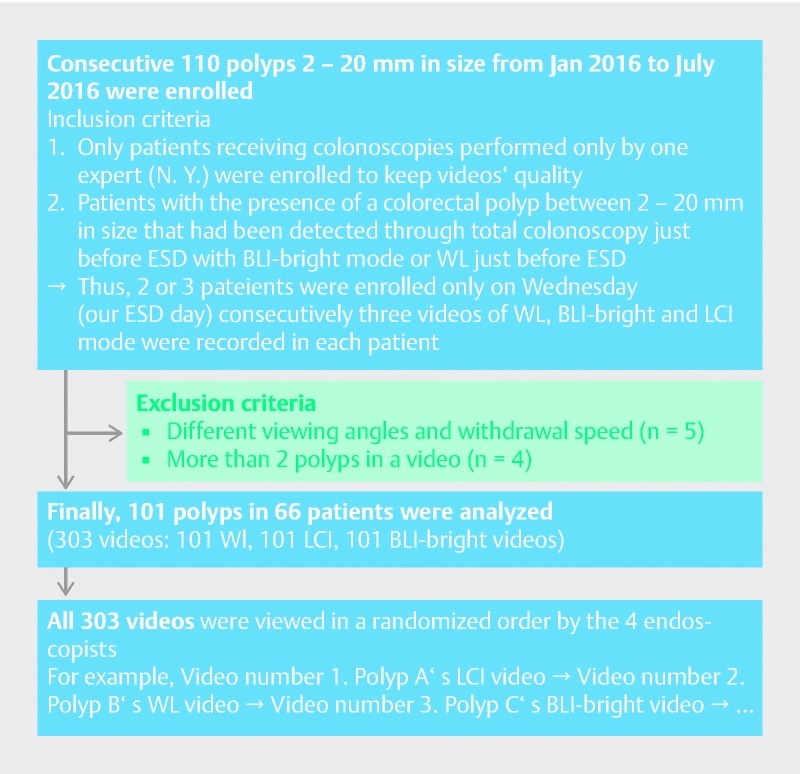
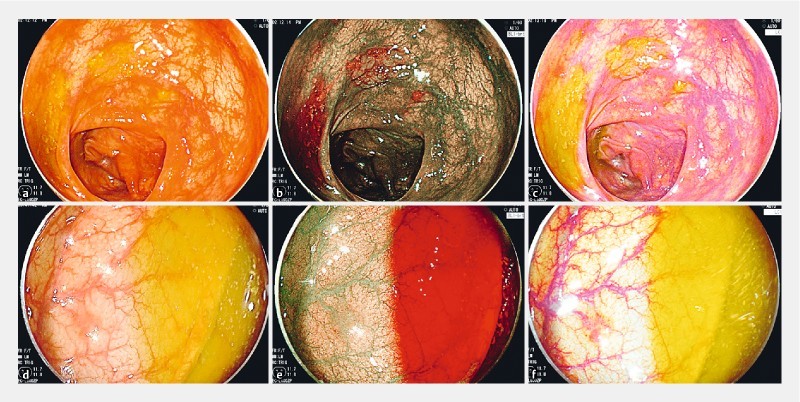
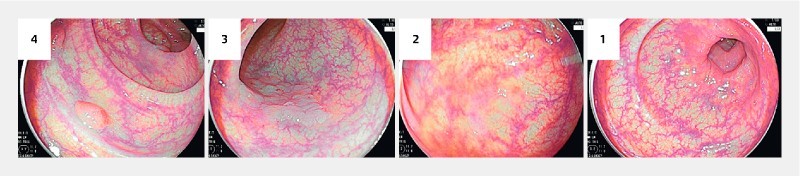
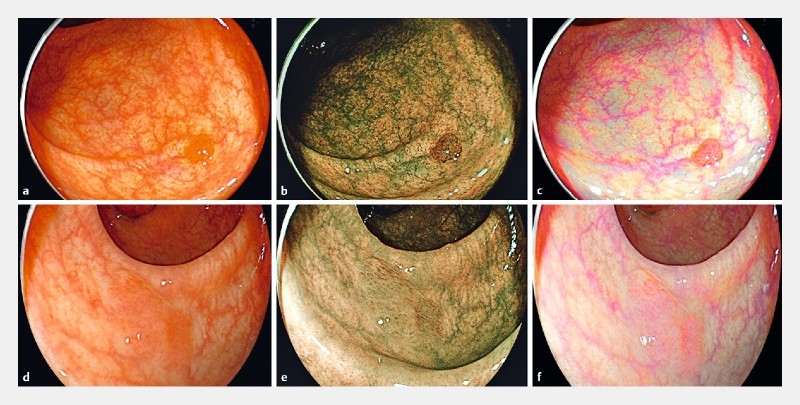
We prospectively recorded videos of consecutive polyps 2 - 20 mm in size diagnosed as neoplastic polyps. Three videos, white light (WL), blue laser imaging (BLI)-bright, and LCI, were recorded for each polyp by one expert. After excluding inappropriate videos, all videos were evaluated in random order by two experts and two non-experts according to a published polyp visibility score from four (excellent visibility) to one (poor visibility). Additionally, the relationship between polyp visibility scores in LCI and various clinical characteristics including location, size, histology, morphology, and preparation were analyzed compared to WL and BLI-bright.
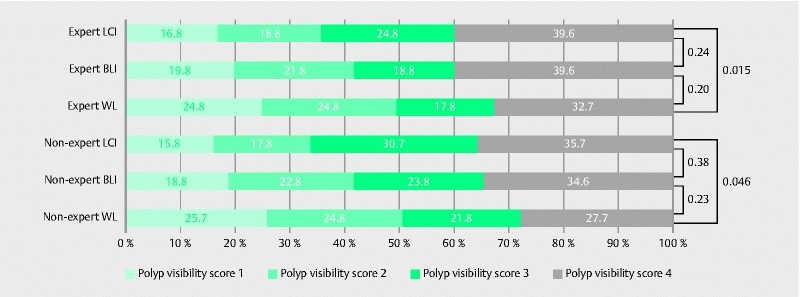
We analyzed 101 colorectal polyps (94 neoplastic) in 66 patients (303 videos). The mean polyp size was 9.0 ± 8.1 mm and 54 polyps were non-polypoid. The mean polyp visibility scores for LCI (2.86 ± 1.08) were significantly higher than for WL and BLI-bright (2.53 ± 1.15, < 0.001; 2.73 ± 1.47, < 0.041). The ratio of poor visibility (score 1 and 2) was significantly lower in LCI for experts and non-experts (35.6 %, 33.6 %) compared with WL (49.6 %, = 0.015, 50.5 %, = 0.046). The polyp visibility scores for LCI were significantly higher than those for WL for all of the factors. With respect to the comparison between BLI-bright and WL, the polyp visibility scores for BLI-bright were not higher than WL for right-sided location, < 10 mm size, sessile serrated adenoma and polyp histology, and poor preparation. For those characteristics, LCI improved the lesions with right-sided location, SSA/P histology, and poor preparation significantly better than BLI.
LCI improved polyp visibility compared to WL for both expert and non-expert endoscopists. It is useful for improving polyp visibility in any location, any size, any morphology, any histology, and any preparation level.
背景/研究目的:使用激光内镜(日本东京富士胶片公司)进行的联动成像(LCI)是一种新型窄带光观察技术。在本研究中,我们旨在通过内镜视频研究LCI是否能提高大肠息肉的可视性。
我们前瞻性地记录了连续诊断为肿瘤性息肉、大小在2 - 20毫米之间的息肉视频。由一位专家为每个息肉录制三段视频,分别为白光(WL)、蓝光成像(BLI)-明亮模式以及LCI。在排除不合适的视频后,两位专家和两位非专家按照已发表的从四分(可视性极佳)到一分(可视性差)的息肉可视性评分标准,对所有视频进行随机评估。此外,将LCI与WL和BLI-明亮模式下的息肉可视性评分与包括位置、大小、组织学、形态以及准备情况等各种临床特征之间的关系进行了分析比较。
我们分析了66例患者的101个大肠息肉(94个肿瘤性息肉)(共303段视频)。息肉平均大小为9.0 ± 8.1毫米,54个息肉为非息肉样。LCI的息肉平均可视性评分为(2.86 ± 1.08),显著高于WL和BLI-明亮模式(分别为2.53 ± 1.15,P < 0.001;2.73 ± 1.47,P < 0.041)。对于专家和非专家而言,LCI中可视性差(评分1和2)的比例显著低于WL(分别为35.6%、33.6%,与WL的49.6%相比,P = 0.015;50.5%,P = 0.046)。对于所有因素,LCI的息肉可视性评分均显著高于WL。关于BLI-明亮模式与WL的比较,在右侧位置、<10毫米大小、无蒂锯齿状腺瘤和息肉组织学以及准备不佳的情况下,BLI-明亮模式的息肉可视性评分不高于WL。对于这些特征,LCI对右侧位置、锯齿状腺瘤/息肉(SSA/P)组织学以及准备不佳的病变的改善明显优于BLI。
与WL相比,LCI对专家和非专家内镜医师均提高了息肉可视性。它有助于提高任何位置、任何大小、任何形态、任何组织学以及任何准备水平下息肉的可视性。