Global and Tropical Health Division, Menzies School of Health Research, Charles Darwin University, Darwin, Northern Territory, Australia.
School of Psychological and Clinical Sciences, Charles Darwin University, Darwin, Northern Territory, Australia.
Sex Transm Infect. 2018 Feb;94(1):32-36. doi: 10.1136/sextrans-2016-053081. Epub 2017 Jun 9.
The detection of an STI agent in a urogenital tract (UGT) specimen from a young child is regarded as being indicative of sexual abuse. However, the probabilities of contamination events that could conceivably lead to STI positive specimens in the absence of sexual contact are unclear. The objective was to estimate the potential for fingers that have come in contact with positive urine to detectably contaminate negative urine.
The study design was based on self-experimentation. Dilutions of elementary bodies (EBs) were prepared. A participant contacted an EB dilution then a urine surrogate specimen. The experiment was performed by three participants using three isolates, of genotype E, F and B. Two surrogate urine contact methods were used to mimic contamination of a carer assisting with a child's urine collection. All EB dilutions and urine surrogate specimens were subjected to assay and quantification in a real-time PCR-based diagnostic system.
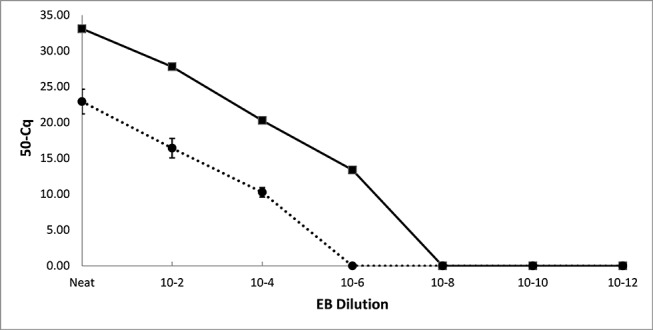
The amplimer crossing point (Cq) for EB dilutions was 10.0±1.6 less than for corresponding finger contacted urine specimens, which corresponds to ~10 µL of EB suspension transferred. This was largely independent of participant identity, strain or EB dilution. Hand decontamination led to large reductions in EBs transferred, but transfer remained consistently detectable. Recent Cq data from positive clinical urine specimens were collated, and 20% clearly contained sufficient to detectably contaminate another specimen by finger-mediated transfer, as in this experiment.
This study directly demonstrated the potential for urine contaminated fingers to convert a negative urine specimen to positive as a result of contact. Accordingly, procedures for urine specimen collection, particularly from children, need to be designed to prevent contamination.
从儿童泌尿生殖道(UGT)标本中检测到性传播感染(STI)病原体被认为提示存在性虐待。然而,在没有性接触的情况下,可能导致 STI 阳性标本的污染事件的概率尚不清楚。本研究旨在估计接触过阳性尿液的手指是否有可能污染阴性尿液而被检测到。
研究设计基于自我实验。制备了原体(EBs)的稀释液。参与者接触 EB 稀释液后,再接触尿液替代样本。该实验由三名参与者使用三种基因型 E、F 和 B 的分离株进行。采用两种替代尿液接触方法模拟照顾者在帮助儿童采集尿液时的污染情况。所有 EB 稀释液和尿液替代样本均采用基于实时 PCR 的诊断系统进行检测和定量。
EB 稀释液的扩增子交叉点(Cq)比相应手指接触的尿液样本低 10.0±1.6,这对应于约 10µL 的 EB 悬浮液转移。这在很大程度上独立于参与者身份、菌株或 EB 稀释度。手部去污处理导致转移的 EB 大量减少,但转移仍持续可检测。收集了来自阳性临床尿液样本的最近 Cq 数据,其中 20%显然含有足够的病原体,可通过手指介导的转移,如本实验中那样,检测到可使另一个样本变为阳性。
本研究直接证明了污染尿液的手指有可能将阴性尿液标本转化为阳性。因此,需要设计尿液标本采集程序,特别是对于儿童,以防止污染。