Cognitive Systems Lab, School of Electrical and Computer Engineering, College of Engineering, University of Tehran, Tehran, Iran.
Cognition and Perception, Department of Psychology, University of Tübingen, Tübingen, Germany.
Sci Rep. 2017 Jun 9;7(1):3167. doi: 10.1038/s41598-017-03521-2.
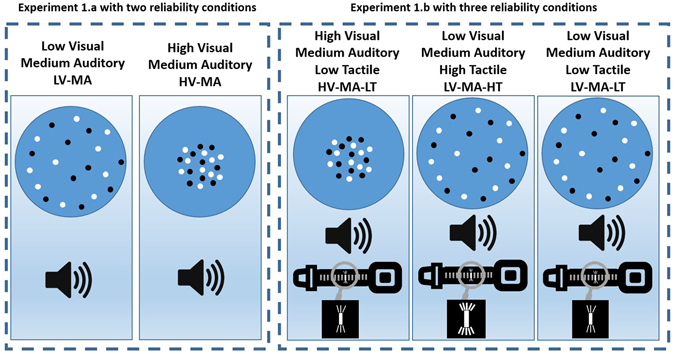
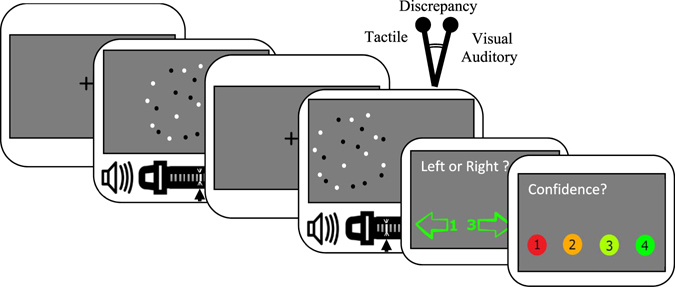
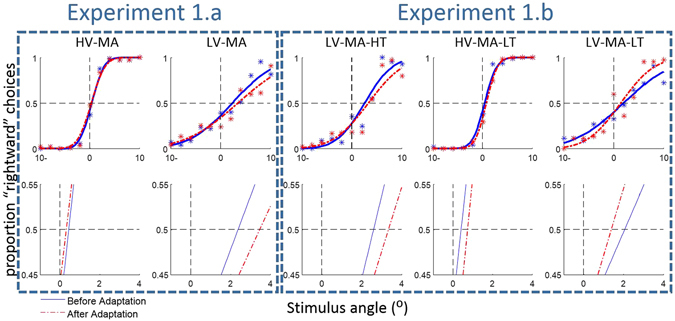
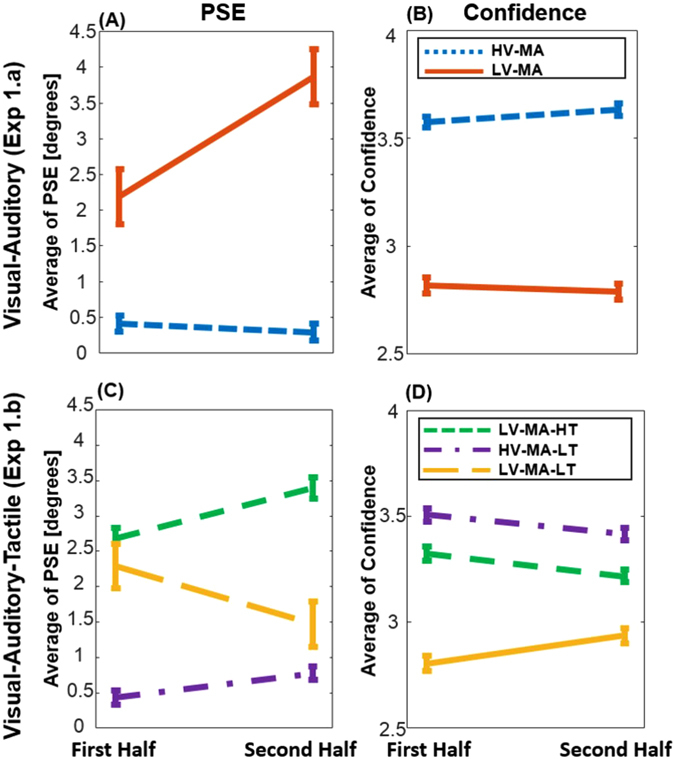
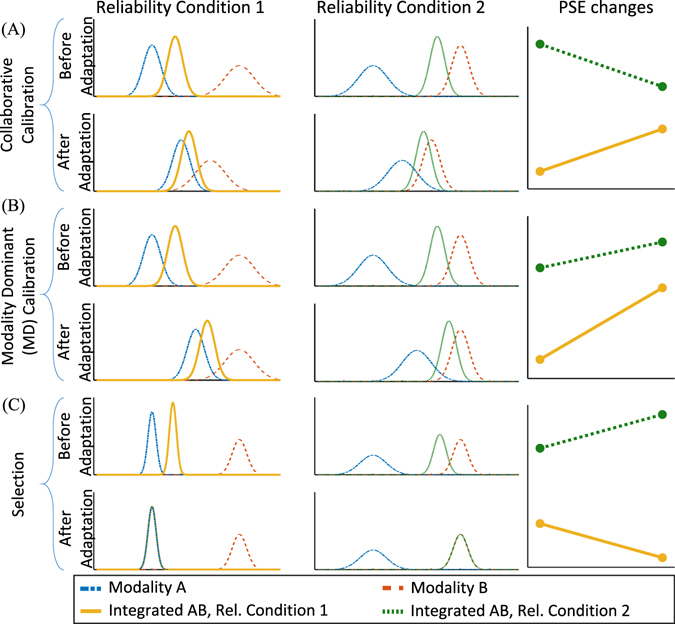
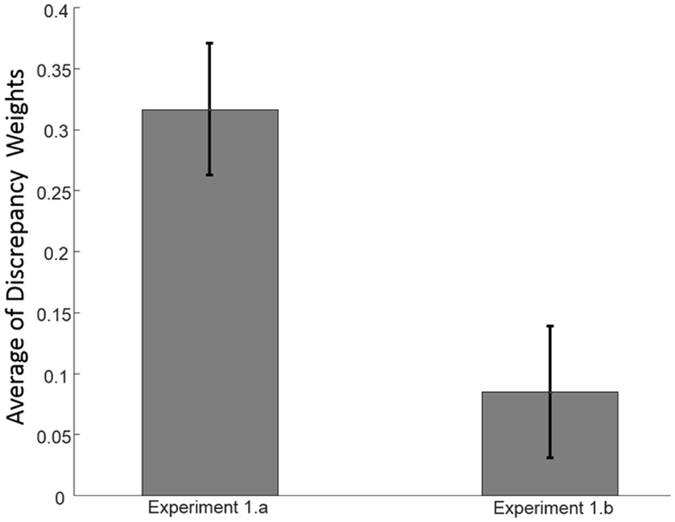
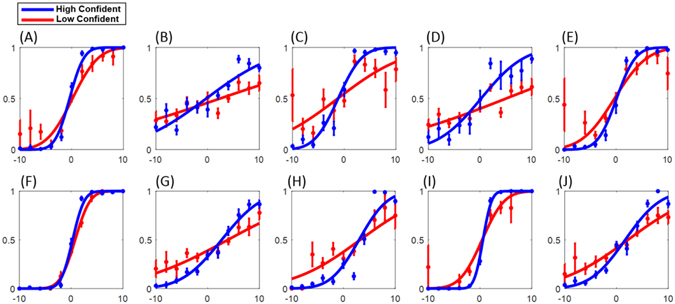
Two psychophysical experiments examined multisensory integration of visual-auditory (Experiment 1) and visual-tactile-auditory (Experiment 2) signals. Participants judged the location of these multimodal signals relative to a standard presented at the median plane of the body. A cue conflict was induced by presenting the visual signals with a constant spatial discrepancy to the other modalities. Extending previous studies, the reliability of certain modalities (visual in Experiment 1, visual and tactile in Experiment 2) was varied from trial to trial by presenting signals with either strong or weak location information (e.g., a relatively dense or dispersed dot cloud as visual stimulus). We investigated how participants would adapt to the cue conflict from the contradictory information under these varying reliability conditions and whether participants had insight to their performance. During the course of both experiments, participants switched from an integration strategy to a selection strategy in Experiment 1 and to a calibration strategy in Experiment 2. Simulations of various multisensory perception strategies proposed that optimal causal inference in a varying reliability environment not only depends on the amount of multimodal discrepancy, but also on the relative reliability of stimuli across the reliability conditions.
两项心理物理学实验研究了视觉-听觉(实验 1)和视觉-触觉-听觉(实验 2)信号的多感觉整合。参与者根据呈现在身体中线上的标准,判断这些多模态信号的位置。通过向其他模态呈现具有恒定空间差异的视觉信号来产生线索冲突。通过呈现具有强或弱位置信息(例如,相对密集或分散的点云作为视觉刺激)的信号,实验从试次到试次扩展了先前的研究,从而改变了某些模态(实验 1 中的视觉,实验 2 中的视觉和触觉)的可靠性。我们研究了在这些变化的可靠性条件下,参与者如何适应来自矛盾信息的线索冲突,以及参与者是否对自己的表现有洞察力。在两个实验过程中,参与者在实验 1 中从整合策略切换到选择策略,在实验 2 中切换到校准策略。对各种多感觉感知策略的模拟表明,在变化的可靠性环境中进行最优因果推理不仅取决于多模态差异的数量,还取决于跨可靠性条件的刺激的相对可靠性。