Royal Holloway University of London, Egham, UK.
Royal Botanic Gardens, Kew, UK.
J Invertebr Pathol. 2017 Sep;148:81-85. doi: 10.1016/j.jip.2017.06.001. Epub 2017 Jun 7.
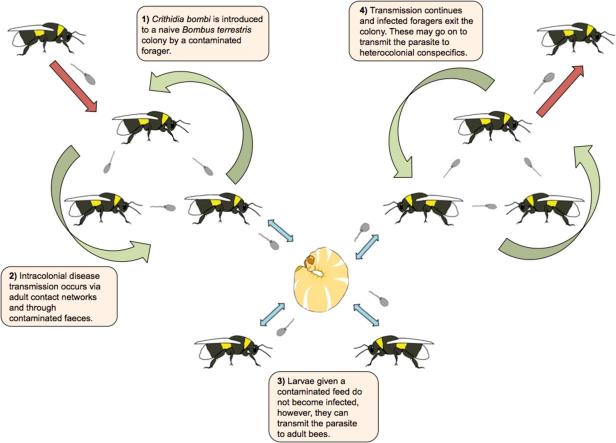
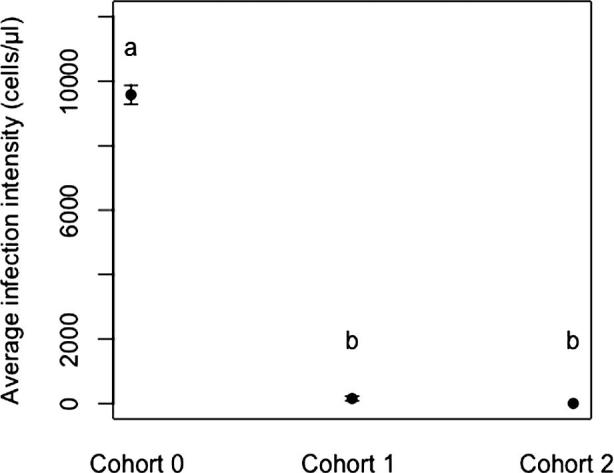
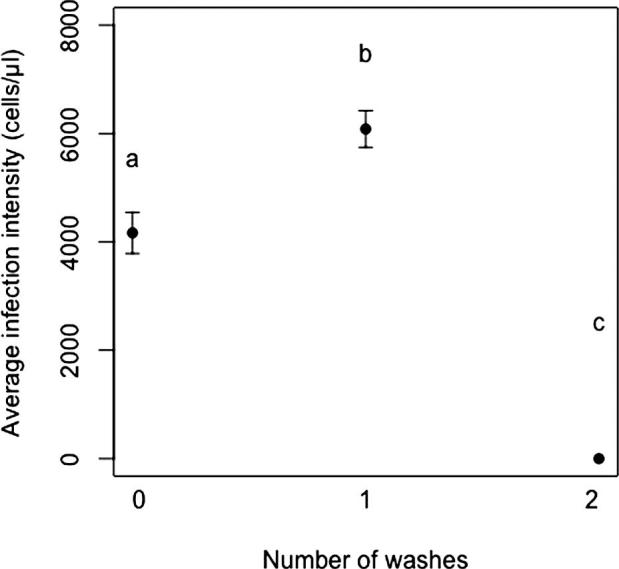
Disease transmission networks are key for understanding parasite epidemiology. Within the social insects, structured contact networks have been suggested to limit the spread of diseases to vulnerable members of their society, such as the queen or brood. However, even these complex social structures do not provide complete protection, as some diseases, which are transmitted by workers during brood care, can still infect the brood. Given the high rate of feeding interactions that occur in a social insect colony, larvae may act as disease transmission hubs. Here we use the bumblebee Bombus terrestris and its parasite Crithidia bombi to determine the role of brood in bumblebee disease transmission networks. Larvae that were artificially inoculated with C. bombi showed no signs of infection seven days after inoculation. However, larvae that received either an artificial inoculation or a contaminated feed from brood-caring workers were able to transmit the parasite to naive workers. These results suggest that the developing brood is a potential route of intracolonial disease transmission and should be included when considering social insect disease transmission networks.
疾病传播网络是理解寄生虫流行病学的关键。在社会性昆虫中,结构化的接触网络被认为可以限制疾病传播到其社会中的脆弱成员,例如蜂王或幼虫。然而,即使是这些复杂的社会结构也不能提供完全的保护,因为有些疾病是由工蜂在照顾幼虫时传播的,仍然会感染幼虫。鉴于在社会性昆虫群体中发生的高频率的喂养相互作用,幼虫可能充当疾病传播的枢纽。在这里,我们使用熊蜂 Bombus terrestris 及其寄生虫 Crithidia bombi 来确定幼虫在熊蜂疾病传播网络中的作用。在接种 C. bombi 后七天,人工接种的幼虫没有感染迹象。然而,接受过育雏工蜂的人工接种或受污染饲料的幼虫能够将寄生虫传播给未感染的工蜂。这些结果表明,发育中的幼虫是一种潜在的殖民地内疾病传播途径,在考虑社会性昆虫疾病传播网络时应将其包括在内。