Ali Faraz Mahmood, Kay Richard, Finlay Andrew Y, Piguet Vincent, Kupfer Joerg, Dalgard Florence, Salek M Sam
Department of Dermatology and Academic Wound Healing, Division of Infection and Immunity, School of Medicine, Cardiff University, Cardiff, CF14 4XN, UK.
School of Pharmacy and Pharmaceutical Sciences, Cardiff University, Cardiff, UK.
Qual Life Res. 2017 Nov;26(11):3025-3034. doi: 10.1007/s11136-017-1607-4. Epub 2017 Jun 10.
The Dermatology Life Quality Index (DLQI) and the European Quality of Life-5 Dimension (EQ-5D) are separate measures that may be used to gather health-related quality of life (HRQoL) information from patients. The EQ-5D is a generic measure from which health utility estimates can be derived, whereas the DLQI is a specialty-specific measure to assess HRQoL. To reduce the burden of multiple measures being administered and to enable a more disease-specific calculation of health utility estimates, we explored an established mathematical technique known as ordinal logistic regression (OLR) to develop an appropriate model to map DLQI data to EQ-5D-based health utility estimates.
Retrospective data from 4010 patients were randomly divided five times into two groups for the derivation and testing of the mapping model. Split-half cross-validation was utilized resulting in a total of ten ordinal logistic regression models for each of the five EQ-5D dimensions against age, sex, and all ten items of the DLQI. Using Monte Carlo simulation, predicted health utility estimates were derived and compared against those observed. This method was repeated for both OLR and a previously tested mapping methodology based on linear regression.
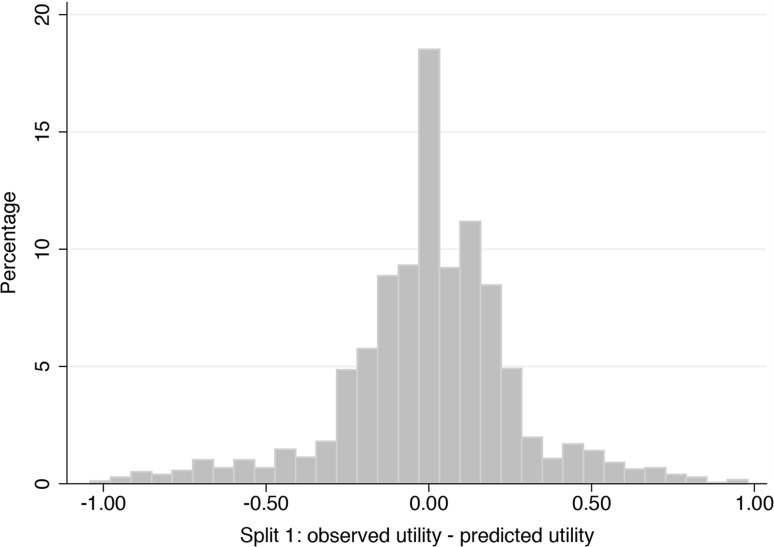
The model was shown to be highly predictive and its repeated fitting demonstrated a stable model using OLR as well as linear regression. The mean differences between OLR-predicted health utility estimates and observed health utility estimates ranged from 0.0024 to 0.0239 across the ten modeling exercises, with an average overall difference of 0.0120 (a 1.6% underestimate, not of clinical importance).
This modeling framework developed in this study will enable researchers to calculate EQ-5D health utility estimates from a specialty-specific study population, reducing patient and economic burden.
皮肤病生活质量指数(DLQI)和欧洲五维健康量表(EQ - 5D)是两种不同的测量方法,可用于收集患者与健康相关的生活质量(HRQoL)信息。EQ - 5D是一种通用测量方法,可从中得出健康效用估计值,而DLQI是一种用于评估HRQoL的特定专科测量方法。为了减轻多种测量方法带来的负担,并能够针对疾病进行更具体的健康效用估计计算,我们探索了一种既定的数学技术,即有序逻辑回归(OLR),以开发一个合适的模型,将DLQI数据映射到基于EQ - 5D的健康效用估计值。
将来自4010名患者的回顾性数据随机分五次分为两组,用于映射模型的推导和测试。采用折半交叉验证,针对年龄、性别以及DLQI的所有十个项目,为五个EQ - 5D维度中的每一个维度总共生成十个有序逻辑回归模型。使用蒙特卡罗模拟得出预测的健康效用估计值,并与观察到的估计值进行比较。对OLR和先前基于线性回归测试的映射方法都重复了此方法。
该模型显示出高度预测性,其重复拟合表明使用OLR以及线性回归的模型都很稳定。在十次建模练习中,OLR预测的健康效用估计值与观察到的健康效用估计值之间的平均差异范围为0.0024至0.0239,总体平均差异为0.0120(低估1.6%,无临床意义)。
本研究中开发的这个建模框架将使研究人员能够从特定专科的研究人群中计算EQ - 5D健康效用估计值,减轻患者负担和经济负担。