Tunstall Brendan J, Carmack Stephanie A, Koob George F, Vendruscolo Leandro F
National Institute on Drug Abuse, National Institutes of Health, Baltimore, MD 21224, USA.
National Institute on Alcohol Abuse and Alcoholism, National Institutes of Health, Rockville, MD 20852, USA.
Curr Opin Behav Sci. 2017 Feb;13:85-90. doi: 10.1016/j.cobeha.2016.10.006. Epub 2016 Nov 19.
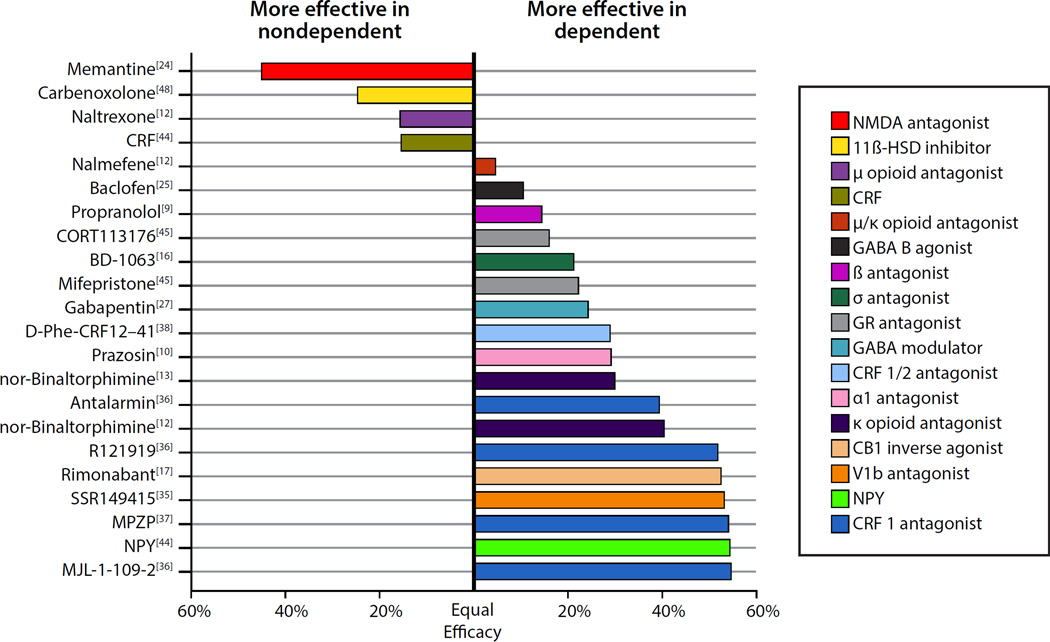
The transition from moderate to compulsive alcohol drinking is driven by increasingly dysfunctional reward and stress systems. We review behavioral and pharmacological studies of alcohol self-administration in rats that were mainly conducted within the framework of the alcohol vapor model of dependence. We discuss neurotransmitter systems that are implicated in alcohol drinking, with a focus on contrasting those neurotransmitter systems that drive behavior in the dependent . nondependent states. We hypothesize that the identification of systems that become increasingly dysfunctional in alcohol dependence will reveal possible targets for successful interventions to reduce the motivation that drives compulsive alcohol drinking. In our opinion, drugs that (1) normalize, rather than block, a hypofunctional reward system via restoration of the function of hypothalamic stress systems, and (2) desensitize extrahypothalamic stress systems have the potential to selectively and effectively curb compulsive alcohol drinking.
从适度饮酒到强迫性饮酒的转变是由功能日益失调的奖赏和应激系统驱动的。我们回顾了主要在酒精依赖的酒精蒸汽模型框架内进行的大鼠酒精自我给药行为和药理学研究。我们讨论了与饮酒有关的神经递质系统,重点是对比那些在依赖和非依赖状态下驱动行为的神经递质系统。我们假设,识别出在酒精依赖中功能日益失调的系统将揭示成功干预的可能靶点,以减少驱动强迫性饮酒的动机。我们认为,(1)通过恢复下丘脑应激系统的功能来使功能减退的奖赏系统正常化而非阻断的药物,以及(2)使下丘脑外应激系统脱敏的药物,有可能选择性且有效地抑制强迫性饮酒。