Knudsen Nikoline N, Schullehner Jörg, Hansen Birgitte, Jørgensen Lisbeth F, Kristiansen Søren M, Voutchkova Denitza D, Gerds Thomas A, Andersen Per K, Bihrmann Kristine, Grønbæk Morten, Kessing Lars V, Ersbøll Annette K
National Institute of Public Health, University of Southern Denmark, Øster Farimagsgade 5A, 2nd Floor, 1353 Copenhagen, Denmark.
Geological Survey of Denmark and Greenland (GEUS), Department of Groundwater and Quaternary Geology Mapping, C.F. Møllers Allé 8, Aarhus, 8000 Aarhus, Denmark.
Int J Environ Res Public Health. 2017 Jun 10;14(6):627. doi: 10.3390/ijerph14060627.
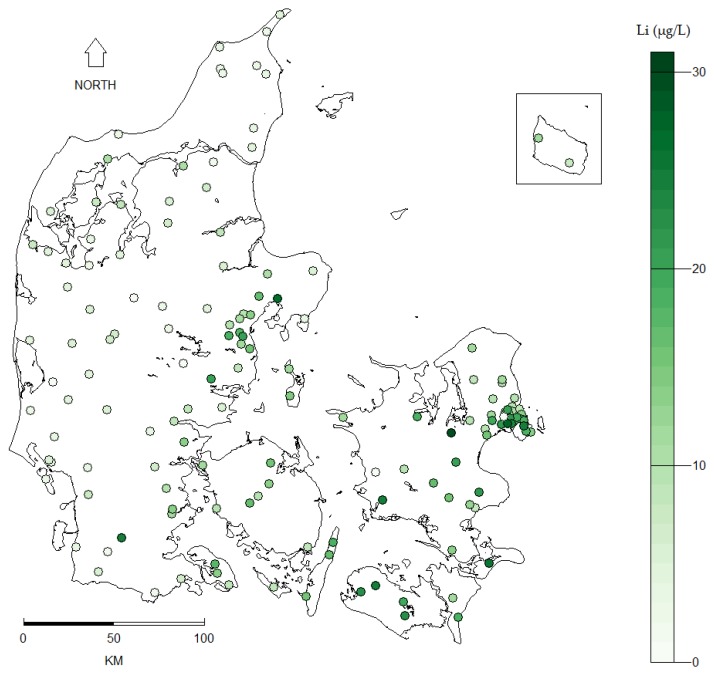
Suicide is a major public health concern. High-dose lithium is used to stabilize mood and prevent suicide in patients with affective disorders. Lithium occurs naturally in drinking water worldwide in much lower doses, but with large geographical variation. Several studies conducted at an aggregate level have suggested an association between lithium in drinking water and a reduced risk of suicide; however, a causal relation is uncertain. Individual-level register-based data on the entire Danish adult population (3.7 million individuals) from 1991 to 2012 were linked with a moving five-year time-weighted average (TWA) lithium exposure level from drinking water hypothesizing an inverse relationship. The mean lithium level was 11.6 μg/L ranging from 0.6 to 30.7 μg/L. The suicide rate decreased from 29.7 per 100,000 person-years at risk in 1991 to 18.4 per 100,000 person-years in 2012. We found no significant indication of an association between increasing five-year TWA lithium exposure level and decreasing suicide rate. The comprehensiveness of using individual-level data and spatial analyses with 22 years of follow-up makes a pronounced contribution to previous findings. Our findings demonstrate that there does not seem to be a protective effect of exposure to lithium on the incidence of suicide with levels below 31 μg/L in drinking water.
自杀是一个重大的公共卫生问题。高剂量锂用于稳定情感障碍患者的情绪并预防自杀。锂以低得多的剂量天然存在于全球各地的饮用水中,但存在很大的地域差异。在总体层面进行的几项研究表明,饮用水中的锂与自杀风险降低之间存在关联;然而,因果关系尚不确定。基于个体登记的数据将1991年至2012年丹麦全体成年人口(370万人)与假设存在反比关系的饮用水中锂的移动五年时间加权平均(TWA)暴露水平相关联。锂的平均水平为11.6μg/L,范围在0.6至30.7μg/L之间。自杀率从1991年每10万人年29.7例降至2012年每10万人年18.4例。我们没有发现五年TWA锂暴露水平增加与自杀率下降之间存在关联的显著迹象。使用个体层面数据和进行22年随访的空间分析的全面性对先前的研究结果做出了显著贡献。我们的研究结果表明,饮用水中锂含量低于31μg/L时,接触锂似乎对自杀发生率没有保护作用。