Horodyska Justyna, Hamill Ruth M, Varley Patrick F, Reyer Henry, Wimmers Klaus
Teagasc, Food Research Centre, Ashtown, Dublin, Ireland.
Leibniz Institute for Farm Animal Biology (FBN), Institute for Genome Biology, Dummerstorf, Germany.
PLoS One. 2017 Jun 12;12(6):e0173482. doi: 10.1371/journal.pone.0173482. eCollection 2017.
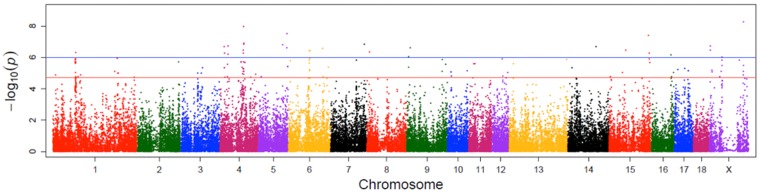
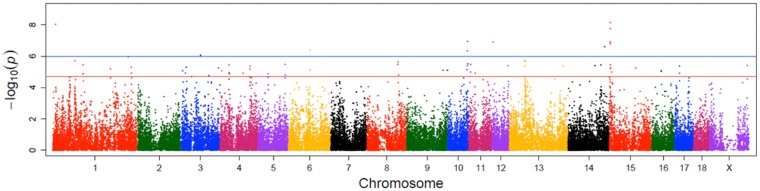
Feed conversion efficiency is a measure of how well an animal converts feed into live weight and it is typically expressed as feed conversion ratio (FCR). FCR and related traits like growth rate (e.g. days to 110 kg-D110) are of high interest for animal breeders, farmers and society due to implications on animal performance, feeding costs and environmental sustainability. The objective of this study was to identify genomic regions associated with FCR and D110 in pigs. A total of 952 terminal line boars, showing an individual variation in FCR, were genotyped using 60K SNP-Chips. Markers were tested for associations with estimated breeding values (EBV) for FCR and D110. For FCR, the largest number of associated SNPs was located on chromosomes 4 (30 SNPs), 1 (25 SNPs), X (15 SNPs) and 6 (12 SNPs). The most prominent genomic regions for D110 were identified on chromosomes 15 (10 SNPs), 1 and 4 (both 9 SNPs). The most significantly associated SNPs for FCR and D110 mapped 129.8 Kb from METTL11B (chromosome 4) and 32Kb from MBD5 (chromosome 15), respectively. A list of positional genes, closest to significantly associated SNPs, was used to identify enriched pathways and biological functions related to the QTL for both traits. A number of candidate genes were significantly overrepresented in pathways of immune cell trafficking, lymphoid tissue structure, organ morphology, endocrine system function, lipid metabolism, and energy production. After resequencing the coding region of selected positional and functional candidate genes, six SNPs were genotyped in a subset of boars. SNPs in PRKDC, SELL, NR2E1 and AKRIC3 showed significant associations with EBVs for FCR/D110. The study revealed a number of chromosomal regions and candidate genes affecting FCR/D110 and pointed to corresponding biological pathways related to lipid metabolism, olfactory reception, and also immunological status.
饲料转化效率是衡量动物将饲料转化为活体重能力的指标,通常用饲料转化率(FCR)来表示。由于对动物生产性能、饲养成本和环境可持续性有影响,FCR以及生长速度(如达到110千克体重所需天数-D110)等相关性状受到动物育种者、养殖户和社会的高度关注。本研究的目的是确定猪中与FCR和D110相关的基因组区域。使用60K SNP芯片对总共952头终端系公猪进行基因分型,这些公猪在FCR方面表现出个体差异。对标记进行了与FCR和D110的估计育种值(EBV)的关联测试。对于FCR,关联SNP数量最多的位于4号染色体(30个SNP)、1号染色体(25个SNP)、X染色体(15个SNP)和6号染色体(12个SNP)上。D110最显著的基因组区域在15号染色体(10个SNP)、1号和4号染色体(均为9个SNP)上被确定。FCR和D110最显著关联的SNP分别距离METTL11B(4号染色体)129.8 Kb和距离MBD5(15号染色体)32Kb。使用最接近显著关联SNP的位置基因列表来确定与这两个性状的QTL相关的富集途径和生物学功能。许多候选基因在免疫细胞运输、淋巴组织结构、器官形态、内分泌系统功能、脂质代谢和能量产生的途径中显著富集。在对选定的位置和功能候选基因的编码区进行重测序后,在一部分公猪中对6个SNP进行了基因分型。PRKDC、SELL、NR2E1和AKRIC3中的SNP与FCR/D110的EBV显示出显著关联。该研究揭示了一些影响FCR/D110的染色体区域和候选基因,并指出了与脂质代谢、嗅觉接收以及免疫状态相关的相应生物学途径。