Research Unit of Medical Imaging, Physics and Technology, Faculty of Medicine, University of Oulu, Oulu, Finland; Department of Laboratory Medicine and Pathobiology, University of Toronto, Toronto, Canada; Department of Physics, University of Helsinki, Helsinki, Finland; Department of Neuroscience and Biomedical Engineering, Aalto University, Espoo, Finland.
Orthopedic Science Consulting Services, Oakville, Ontario, Canada.
Osteoarthritis Cartilage. 2017 Oct;25(10):1680-1689. doi: 10.1016/j.joca.2017.05.021. Epub 2017 Jun 9.
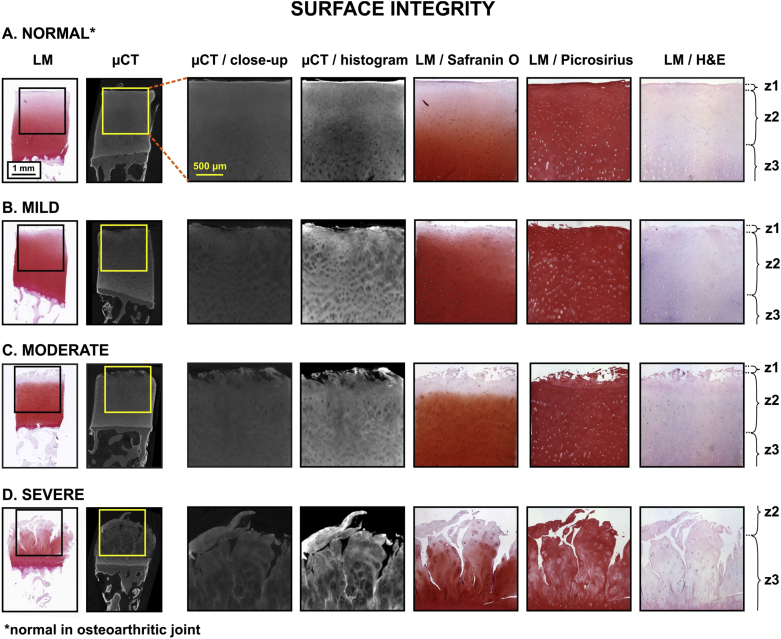
Histopathological grading of osteochondral (OC) tissue is widely used in osteoarthritis (OA) research, and it is relatively common in post-surgery in vitro diagnostics. However, relying on thin tissue section, this approach includes a number of limitations, such as: (1) destructiveness, (2) sample processing artefacts, (3) 2D section does not represent spatial 3D structure and composition of the tissue, and (4) the final outcome is subjective. To overcome these limitations, we recently developed a contrast-enhanced μCT (CEμCT) imaging technique to visualize the collagenous extracellular matrix (ECM) of articular cartilage (AC). In the present study, we demonstrate that histopathological scoring of OC tissue from CEμCT is feasible. Moreover, we establish a new, semi-quantitative OA μCT grading system for OC tissue.
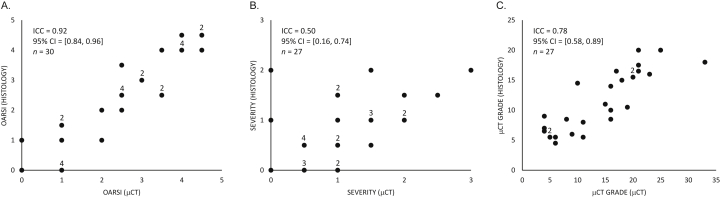
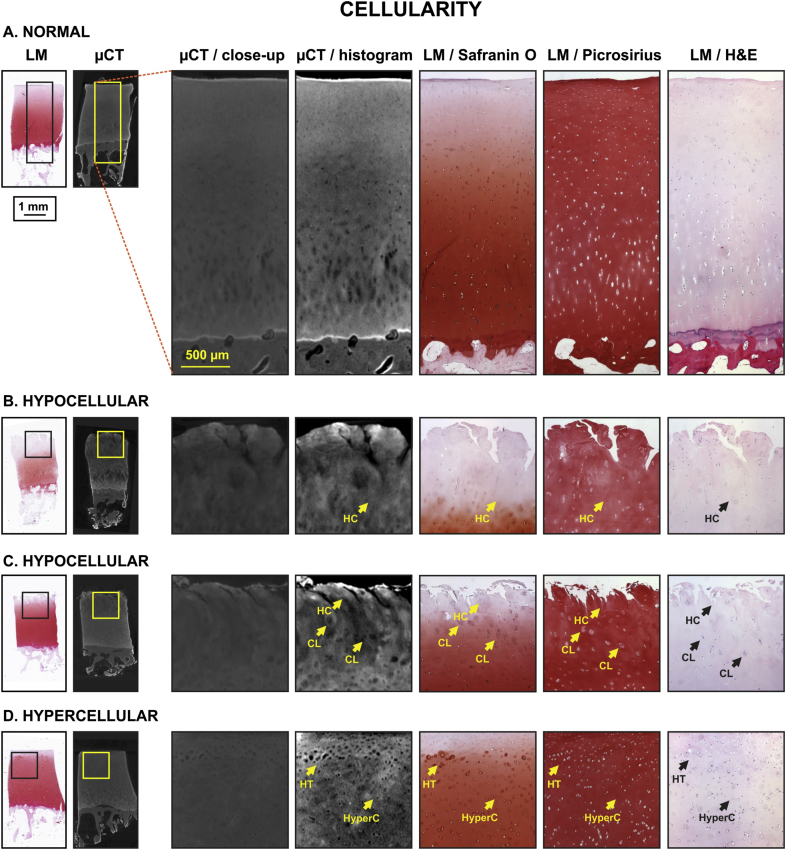
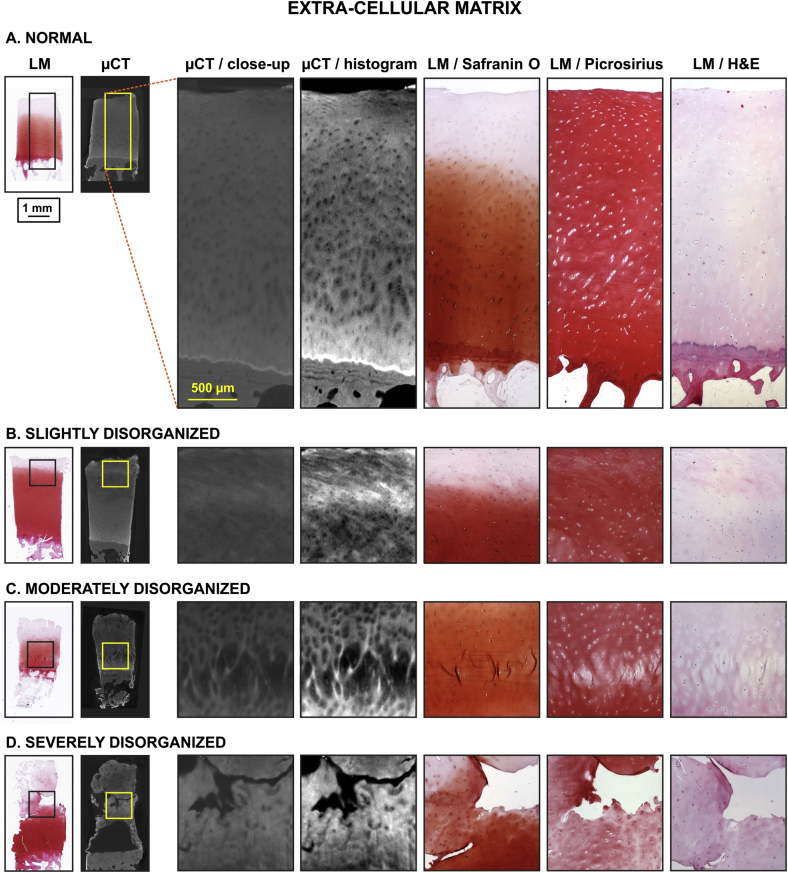
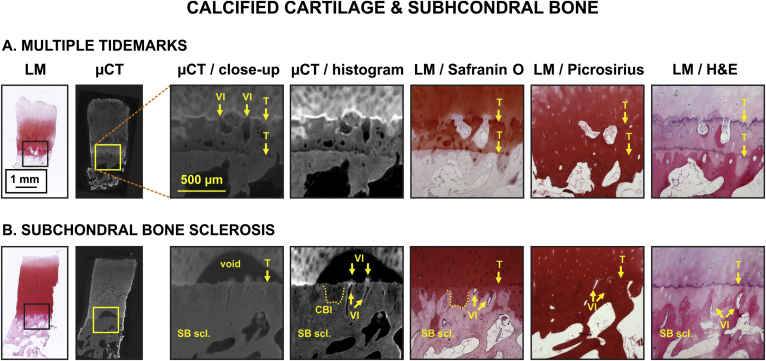
Pathological features were clearly visualized in AC and subchondral bone (SB) with μCT and verified with histology, as demonstrated with image atlases. Comparison of histopathological grades (OARSI or severity (0-3)) across the characterization approaches, CEμCT and histology, excellent (0.92, 95% CI = [0.84, 0.96], n = 30) or fair (0.50, 95% CI = [0.16, 0.74], n = 27) intra-class correlations (ICC), respectively. A new μCT grading system was successfully established which achieved an excellent cross-method (μCT vs histology) reader-to-reader intra-class correlation (0.78, 95% CI = [0.58, 0.89], n = 27).
We demonstrated that histopathological information relevant to OA can reliably be obtained from CEμCT images. This new grading system could be used as a reference for 3D imaging and analysis techniques intended for volumetric evaluation of OA pathology in research and clinical applications.
骨软骨(OC)组织的组织病理学分级在骨关节炎(OA)研究中被广泛应用,并且在术后体外诊断中也较为常见。然而,这种方法依赖于薄的组织切片,存在许多局限性,例如:(1)破坏性,(2)样本处理伪影,(3)2D 切片不能代表组织的空间 3D 结构和组成,以及(4)最终结果是主观的。为了克服这些局限性,我们最近开发了一种对比增强 μCT(CEμCT)成像技术来可视化关节软骨(AC)的胶原细胞外基质(ECM)。在本研究中,我们证明了从 CEμCT 对 OC 组织进行组织病理学评分是可行的。此外,我们建立了一种新的、半定量的 OC 组织 OA μCT 分级系统。
通过 μCT 和组织学验证,使用图像图谱清楚地观察到 AC 和软骨下骨(SB)的病理特征,与组织学一致。在组织学和 CEμCT 两种方法中,OC 组织的组织病理学分级(OARSI 或严重程度(0-3))之间具有极好(0.92,95%CI[0.84,0.96],n=30)或良好(0.50,95%CI[0.16,0.74],n=27)的一致性(ICC)。成功建立了新的 μCT 分级系统,其在跨方法(μCT 与组织学)读者间的一致性极好(0.78,95%CI[0.58,0.89],n=27)。
我们证明了与 OA 相关的组织病理学信息可以从 CEμCT 图像中可靠地获得。这种新的分级系统可作为用于 OA 病理学体积评估的 3D 成像和分析技术的参考。