Darabi Fatemeh, Kaveh Mohammad Hossein, Majlessi Fereshteh, Farahani Farideh Khalaj Abadi, Yaseri Mehdi, Shojaeizadeh Davoud
Ph.D. Student of Health Education and Health Promotion, Department of Health Education and Health Promotion, School of Public Health, Tehran University of Medical Sciences, Tehran, Iran.
Department of Public Health, Asadabad Sciences Faculty, Hamadan University of Medical Sciences, Hamadan, Iran.
Electron Physician. 2017 Apr 25;9(4):4238-4247. doi: 10.19082/4238. eCollection 2017 Apr.
Physical activity (PA) rates decline among most high school female students, and due to cultural restrictions, the reduction of physical activity might be exacerbated in female Iranian adolescents.
To determine the effects of the physical activity education theory-based intervention to promote activity among adolescent girls.
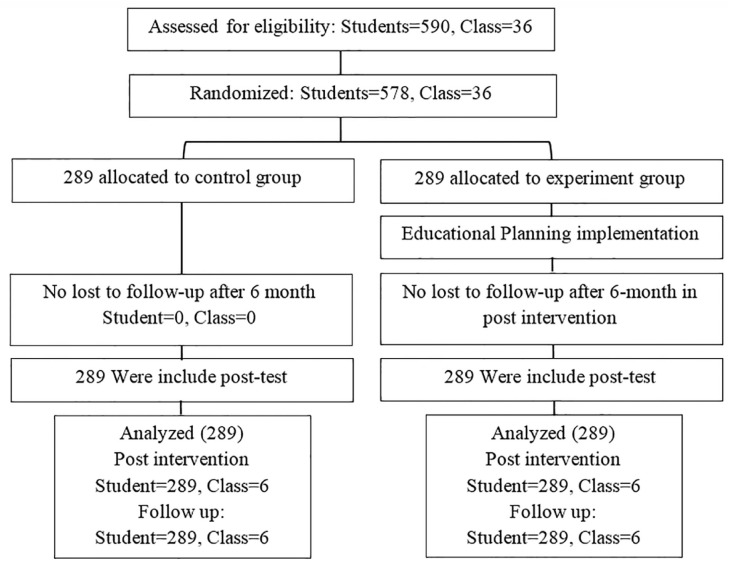
This randomized clinical trial was conducted at public high schools in Tehran, Iran, from September 2015 to July 2016 on 578 girls. The subjects were assigned randomly to two groups of experiment and control (n=289 per group). All participants in the experimental group received an educational program based on a modified TPB. Measures were assessed before and 6 months after the experiment. The data were analyzed using SPSS version 23. We used descriptive statistics, multilevel analysis, Likelihood Ratio (LR) test, P-value less than 0.05 were considered statistically significant.
Five hundred and seventy-eight participants with a mean age of 14.26±0.96 years were studied in two groups of experiment (n=289) and control (n=289). Moreover, adjusted for the baseline values, the mean of the scores of the knowledge (84.1±13.6), attitude (31.2±13.6), subjective norm (40.4±11.1), behavioral intention (34.3±14.7), perceived behavioral control (38.4±11.6), perceived parental control (42.9±14.2), behavioral (42.6±17.1) was significantly higher in the experiment group compared with the control group (p<0.001).
The results of this study implicate that theory based educational intervention is considered to be more effective in improving physical activity in adolescents. This result can be used to increase adolescent's health promotion.
The trial was registered at the Iranian Registry of Clinical Trials (IRST) with the identification number: IRCT2015070623089N2.
The authors received no financial support for the research from Kermanshah University of Medical Sciences.
大多数高中女生的体育活动(PA)率下降,并且由于文化限制,伊朗女性青少年体育活动的减少可能会加剧。
确定基于体育活动教育理论的干预措施对促进青春期女孩体育活动的效果。
这项随机临床试验于2015年9月至2016年7月在伊朗德黑兰的公立高中对578名女孩进行。受试者被随机分为实验组和对照组两组(每组n = 289)。实验组的所有参与者都接受了基于改良的计划行为理论(TPB)的教育计划。在实验前和实验后6个月进行测量。使用SPSS 23版对数据进行分析。我们使用描述性统计、多层次分析、似然比(LR)检验,P值小于0.05被认为具有统计学意义。
在实验组(n = 289)和对照组(n = 289)两组中研究了578名平均年龄为14.26±0.96岁的参与者。此外,在对基线值进行调整后,实验组的知识得分(84.1±13.6)、态度得分(31.2±13.6)、主观规范得分(40.4±11.1)、行为意图得分(34.3±14.7)、感知行为控制得分(38.4±11.6)、感知父母控制得分(42.9±14.2)、行为得分(42.6±17.1)均显著高于对照组(p<0.001)。
本研究结果表明,基于理论的教育干预被认为在改善青少年体育活动方面更有效。这一结果可用于促进青少年的健康。
该试验已在伊朗临床试验注册中心(IRST)注册,识别号为:IRCT2015070623089N2。
作者未获得克尔曼沙赫医科大学对该研究的资金支持。