Hasanzadeh Fereshteh, Faeghi Fariborz, Valizadeh Abdollah, Bayani Leyla
Radiology Technology Department, School of Allied Medical Sciences, Shahid Beheshti University of Medical Sciences, Tehran, Iran. Email:
Asian Pac J Cancer Prev. 2017 May 1;18(5):1265-1270. doi: 10.22034/APJCP.2017.18.5.1265.
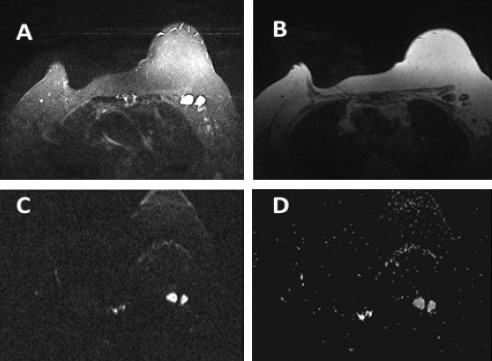
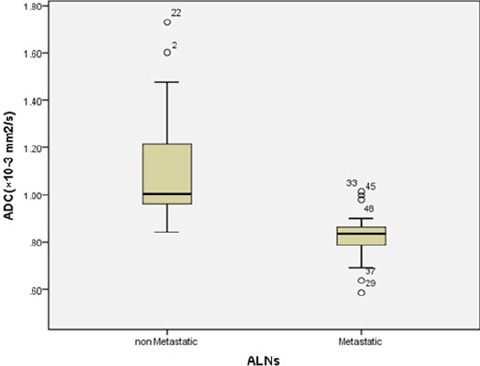
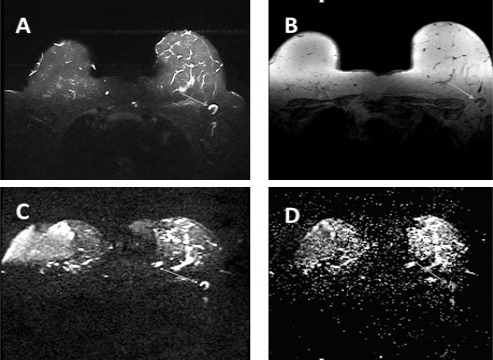
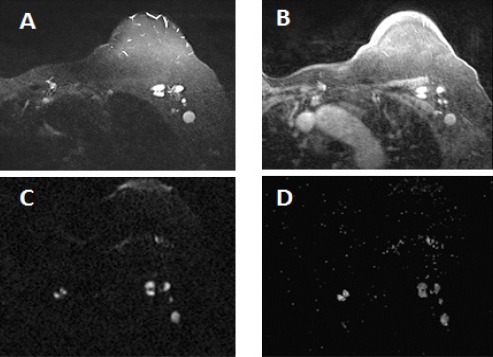
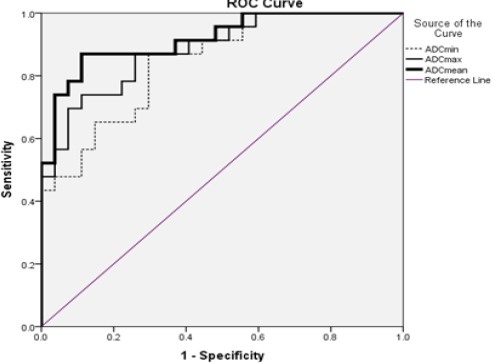
Objective: To evaluate the diagnostic value of diffusion weighted magnetic resonance imaging (DW-MRI) in assessment of metastases in axillary lymph nodes (ALNs) in a sample of Iranian women with breast cancer. Methods: A total of 50 axillary lymph nodes from 30 female patients with histologically verified breast cancer were assessed by 1.5 T MRI. DWI was implemented at b-values of 50, 400 and 800 s/mm2. Short axis diameter, presence of fatty hilum and apparent diffusion coefficient (ADC) values (min, max and mean) of metastatic and non-metastatic ALNs was compared. Cutoff ADC values to discriminate between benign and malignant axillary lymph nodes were analyzed with receiver coefficient characteristic (ROC) curves. Result: The final histopathological examination revealed 46% (n=23) metastatic and 54% (n=27) non-metastatic ALNs. There was no statistically significant difference in short axis diameter between the two groups (p = 0.537). However there was significantly correlation between loss of fatty hilum and presence of metastases (p < 0.001) and ADC values (0.255 ± 0.19×10⁻³ mm2/s vs 0.616 ±0.3×10⁻³ mm2/s (ADC min), 1.088 ± 0.22×10⁻³ mm2/s vs 1.497 ± 0.24×10⁻³ mm2/s (ADC max) and 0.824 ± 0.103 ×10⁻³ mm2/s vs 1.098 ± 0.23 ×10⁻³ mm2/s (ADC mean)) of metastatic ALNs were significantly lower than those of non-metastatic ALNs (p < 0.001). The optimal mean ADC cut-off value for differentiation between metastatic and non-metastatic ALNs was 0.904×10⁻³ mm2/s which had a higher specificity (88.9%) and accuracy (91.8%) as compared with ADC min and ADC max. Conclusion: DWI-MRI and ADC values are promising imaging methods which can assess metastatic ALNs in breast cancer with high sensitivity, specificity and accuracy.
评估扩散加权磁共振成像(DW-MRI)在评估伊朗乳腺癌女性样本腋窝淋巴结(ALNs)转移中的诊断价值。方法:对30例经组织学证实为乳腺癌的女性患者的50个腋窝淋巴结进行1.5 T MRI评估。在b值为50、400和800 s/mm²时进行DWI。比较转移性和非转移性ALNs的短轴直径、脂肪门的存在情况以及表观扩散系数(ADC)值(最小值、最大值和平均值)。用受试者工作特征(ROC)曲线分析区分良性和恶性腋窝淋巴结的ADC临界值。结果:最终组织病理学检查显示46%(n = 23)为转移性ALNs,54%(n = 27)为非转移性ALNs。两组间短轴直径无统计学显著差异(p = 0.537)。然而,脂肪门缺失与转移的存在之间存在显著相关性(p < 0.001),转移性ALNs的ADC值(ADC最小值:0.255±0.19×10⁻³ mm²/s对0.616±0.3×10⁻³ mm²/s,ADC最大值:1.088±0.22×10⁻³ mm²/s对1.497±0.24×10⁻³ mm²/s,ADC平均值:0.824±0.103×10⁻³ mm²/s对1.098±0.23×10⁻³ mm²/s)显著低于非转移性ALNs(p < 0.001)。转移性和非转移性ALNs鉴别的最佳平均ADC临界值为0.904×10⁻³ mm²/s,与ADC最小值和ADC最大值相比,其具有更高的特异性(88.9%)和准确性(91.8%)。结论:DWI-MRI和ADC值是有前景的成像方法,可高灵敏度、特异性和准确性地评估乳腺癌中的转移性ALNs。