Mueller Julia, Jay Caroline, Harper Simon, Davies Alan, Vega Julio, Todd Chris
School of Health Sciences, University of Manchester, Manchester, United Kingdom.
Manchester Academic Health Science Centre, Manchester, United Kingdom.
J Med Internet Res. 2017 Jun 13;19(6):e202. doi: 10.2196/jmir.6755.
The Web has become an important information source for appraising symptoms. We need to understand the role it currently plays in help seeking and symptom evaluation to leverage its potential to support health care delivery.
The aim was to systematically review the literature currently available on Web use for symptom appraisal.
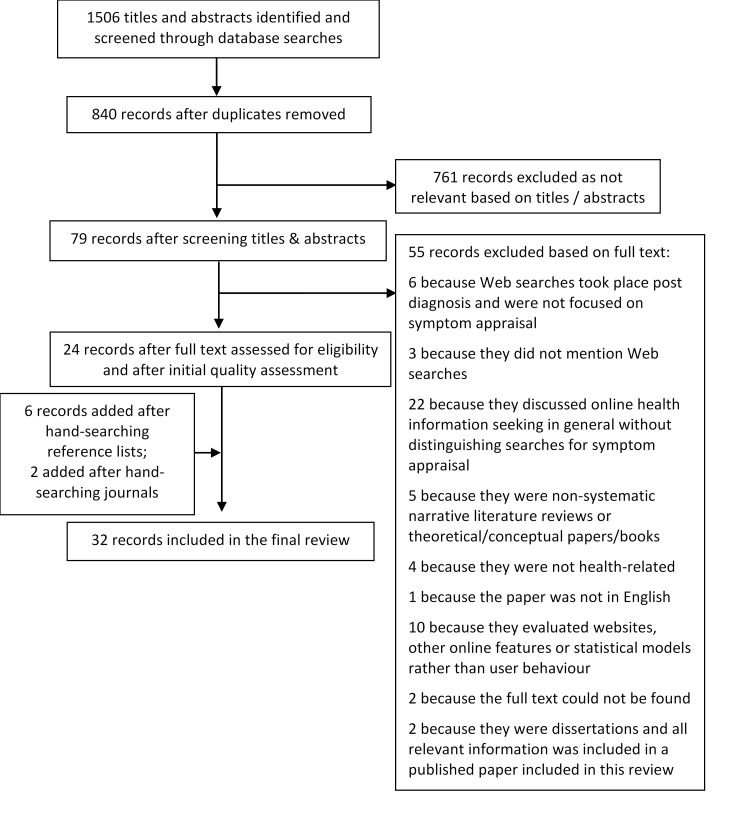
We searched PubMed, EMBASE, PsycINFO, ACM Digital Library, SCOPUS, and Web of Science for any empirical studies that addressed the use of the Web by lay people to evaluate symptoms for physical conditions. Articles were excluded if they did not meet minimum quality criteria. Study findings were synthesized using a thematic approach.
A total of 32 studies were included. Study designs included cross-sectional surveys, qualitative studies, experimental studies, and studies involving website/search engine usage data. Approximately 35% of adults engage in Web use for symptom appraisal, but this proportion varies between 23% and 75% depending on sociodemographic and disease-related factors. Most searches were symptom-based rather than condition-based. Users viewed only the top search results and interacted more with results that mentioned serious conditions. Web use for symptom appraisal appears to impact on the decision to present to health services, communication with health professionals, and anxiety.
Web use for symptom appraisal has the potential to influence the timing of help seeking for symptoms and the communication between patients and health care professionals during consultations. However, studies lack suitable comparison groups as well as follow-up of participants over time to determine whether Web use results in health care utilization and diagnosis. Future research should involve longitudinal follow-up so that we can weigh the benefits of Web use for symptom appraisal (eg, reductions in delays to diagnosis) against the disadvantages (eg, unnecessary anxiety and health care use) and relate these to health care costs.
网络已成为评估症状的重要信息来源。我们需要了解它目前在寻求帮助和症状评估中所起的作用,以充分利用其潜力来支持医疗服务的提供。
旨在系统回顾目前关于网络用于症状评估的现有文献。
我们在PubMed、EMBASE、PsycINFO、ACM数字图书馆、SCOPUS和科学引文索引中搜索了任何关于外行人员使用网络评估身体状况症状的实证研究。不符合最低质量标准的文章被排除。研究结果采用主题分析法进行综合。
共纳入32项研究。研究设计包括横断面调查、定性研究、实验研究以及涉及网站/搜索引擎使用数据的研究。约35%的成年人使用网络进行症状评估,但这一比例因社会人口统计学和疾病相关因素在23%至75%之间有所不同。大多数搜索是基于症状而非基于疾病的。用户仅查看搜索结果的前几项,并且与提及严重疾病的结果互动更多。使用网络进行症状评估似乎会影响寻求医疗服务的决定、与医疗专业人员的沟通以及焦虑情绪。
使用网络进行症状评估有可能影响寻求症状帮助的时机以及患者与医疗专业人员在咨询过程中的沟通。然而,研究缺乏合适的对照组以及对参与者的长期随访,以确定网络使用是否会导致医疗服务利用和诊断。未来的研究应包括纵向随访,以便我们能够权衡使用网络进行症状评估的益处(如减少诊断延迟)与弊端(如不必要的焦虑和医疗服务使用),并将这些与医疗成本联系起来。