Anita Afzali, Division of Gastroenterology, University of Washington, Harborview Medical Center, Seattle, Washington, WA 98104, United States.
World J Gastroenterol. 2017 May 28;23(20):3624-3631. doi: 10.3748/wjg.v23.i20.3624.
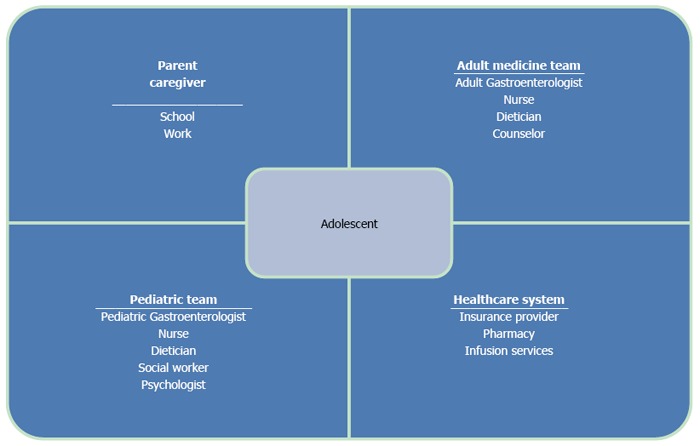
Inflammatory bowel disease (IBD) is a heterogeneous group of chronic diseases with a rising prevalence in the pediatric population, and up to 25% of IBD patients are diagnosed before 18 years of age. Adolescents with IBD tend to have more severe and extensive disease and eventually require graduation from pediatric care toadult services. The transition of patients from pediatric to adult gastroenterologists requires careful preparation and coordination, with involvement of all key players to ensure proper collaboration of care and avoid interruption in care. This can be challenging and associated with gaps in delivery of care. The pediatric and adult health paradigms have inherent differences between health care models, as well as health care priorities in IBD. The readiness of the young adult also influences this transition of care, with often times other overlaps in life events, such as school, financial independence and moving away from home. These patients are therefore at higher risk for poorer clinical disease outcomes. The aim of this paper is to review concepts pertinent to transition of care of young adults with IBD to adult care, and provides resources appropriate for an IBD pediatric to adult transition of care model.
炎症性肠病(IBD)是一组具有异质性的慢性疾病,在儿科人群中的发病率呈上升趋势,多达 25%的 IBD 患者在 18 岁之前被诊断出来。患有 IBD 的青少年往往病情更严重、更广泛,最终需要从儿科护理过渡到成人服务。患者从儿科到成人胃肠病学家的过渡需要精心准备和协调,所有关键参与者都参与其中,以确保护理的妥善合作,避免护理中断。这可能具有挑战性,并伴随着护理提供方面的差距。儿科和成人健康模式在 IBD 的医疗模式以及医疗优先事项方面存在固有差异。年轻成年人的准备情况也会影响这种护理的过渡,他们通常还会遇到其他生活事件的重叠,例如上学、经济独立和搬离家庭。因此,这些患者的临床疾病结局更差的风险更高。本文的目的是回顾与将患有 IBD 的年轻成年人的护理过渡到成人护理相关的概念,并提供适合 IBD 儿科到成人护理过渡模式的资源。