Norise Catherine, Sacchetti Daniela, Hamilton Roy
Laboratory for Cognition and Neural Stimulation, Department of Neurology, University of PennsylvaniaPhiladelphia, PA, United States.
Front Hum Neurosci. 2017 May 29;11:260. doi: 10.3389/fnhum.2017.00260. eCollection 2017.
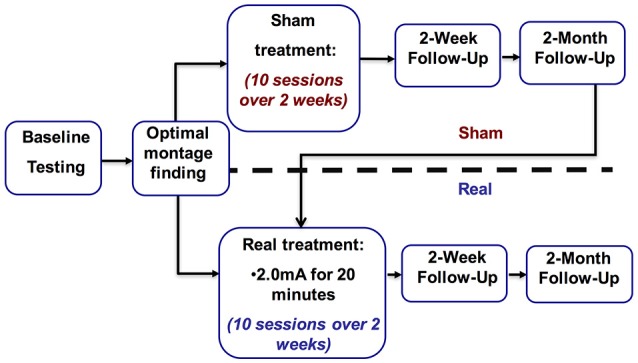
Emerging evidence suggests that transcranial direct current stimulation (tDCS) can improve aspects of language production in persons with chronic non-fluent aphasia due to left hemisphere stroke. However, to date, studies exploring factors that predict response to tDCS in this or any patient population remain sparse, as are studies that investigate the specific aspects of language performance that are most responsive to stimulation. The current study explored factors that could predict recovery of language fluency and which aspects of language fluency could be expected to improve with the identified factor(s). We report nine patients who demonstrated deficits in fluency as assessed using the Cookie Theft picture description task of the Boston Diagnostic Aphasia Examination. In the treatment condition, subjects received a 2.0 mA current through 5 cm × 5 cm electrodes for 20 min at a site previously shown to elicit a patient-dependent optimal response to tDCS. They were then tested 2-weeks and 2-months after treatment. In the sham condition, a subset of these subjects were tested on the same protocol with sham instead of real tDCS. The current study assessed language fluency improvements in measures of production at the word-level and sentence level, grammatical accuracy, and lexical selection as a function of baseline aphasia severity. A more severe baseline language profile was associated with larger improvements in fluency at the word-level after real tDCS but not sham stimulation. These improvements were maintained at the 2-week follow-up. The results suggest that for at least some outcome measures, baseline severity may be an important factor in predicting the response to tDCS in patients with chronic non-fluent aphasia. Moving forward, the ability to identify patient factors that can predict response could help refine strategies for the administration of therapeutic tDCS, focusing attention on those patients most likely to benefit from stimulation.
新出现的证据表明,经颅直流电刺激(tDCS)可以改善因左半球中风导致的慢性非流利性失语症患者的语言表达能力。然而,迄今为止,探索预测该患者群体或任何患者群体对tDCS反应的因素的研究仍然很少,研究哪些语言表现的具体方面对刺激最敏感的研究也很少。本研究探讨了可以预测语言流利性恢复的因素,以及语言流利性的哪些方面有望随着已确定的因素而改善。我们报告了9名患者,他们在使用波士顿诊断性失语症检查的“画饼充饥”图片描述任务进行评估时表现出流利性缺陷。在治疗条件下,受试者通过5厘米×5厘米的电极接受2.0毫安的电流,持续20分钟,该部位先前已被证明能引发患者依赖的tDCS最佳反应。然后在治疗后2周和2个月对他们进行测试。在假刺激条件下,这些受试者中的一部分按照相同的方案接受假刺激而非真正的tDCS测试。本研究评估了在单词层面和句子层面的语言流利性改善情况、语法准确性以及词汇选择,这些都是作为基线失语症严重程度的函数。更严重的基线语言特征与真正的tDCS刺激后单词层面流利性的更大改善相关,但假刺激则不然。这些改善在2周的随访中得以维持。结果表明,至少对于某些结果指标而言,基线严重程度可能是预测慢性非流利性失语症患者对tDCS反应的一个重要因素。展望未来,识别能够预测反应的患者因素的能力有助于完善治疗性tDCS的给药策略,将注意力集中在最有可能从刺激中受益的患者身上。