Kleinlugtenbelt Ydo V, Groen Sylvester R, Ham S John, Kloen Peter, Haverlag Robert, Simons Maarten P, Scholtes Vanessa A B, Bhandari Mohit, Goslings J Carel, Poolman Rudolf W
a Department of Orthopaedic and Trauma Surgery , JointResearch Onze Lieve Vrouwe Gasthuis , Amsterdam.
b Department of Orthopaedic and Trauma Surgery , Deventer Ziekenhuis , Deventer.
Acta Orthop. 2017 Dec;88(6):681-687. doi: 10.1080/17453674.2017.1338066. Epub 2017 Jun 14.
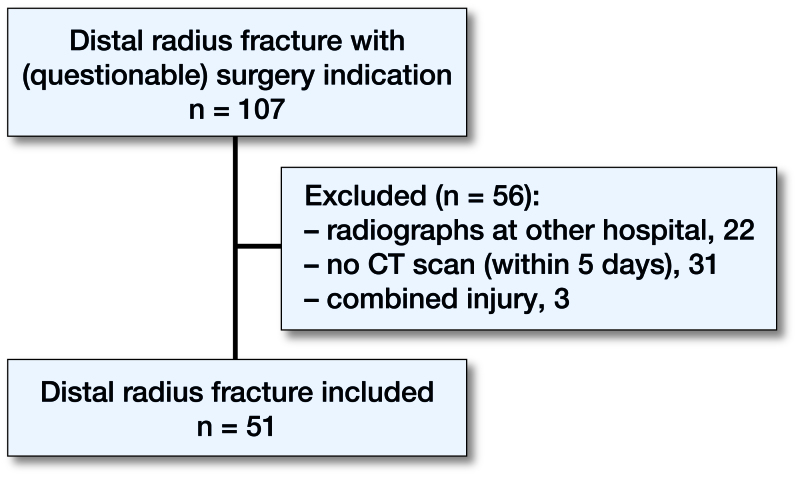
Background and purpose - The reliability of conventional radiography when classifying distal radius fractures (DRF) is fair to moderate. We investigated whether reliability increases when additional computed tomography scans (CT) are used. Patients and methods - In this prospective study, we performed pre- and postreduction posterior-anterior and lateral radiographs of 51 patients presenting with a displaced DRF. The case was included when there was a (questionable) indication for surgical treatment and an additional CT was conducted within 5 days. 4 observers assessed the cases using the Frykman, Fernández, Universal, and AO classification systems. The first 2 assessments were performed using conventional radiography alone; the following 2 assessments were performed with an additional CT. We used the intraclass correlation coefficient (ICC) to evaluate reliability. The CT was used as a reference standard to determine the accuracy. Results - The intraobserver ICC for conventional radiography alone versus radiography and an additional CT was: Frykman 0.57 vs. 0.51; Fernández 0.53 vs. 0.66; Universal 0.57 vs. 0.64; AO 0.59 vs. 0.71. The interobserver ICC was: Frykman: 0.45 vs. 0.28; Fernández: 0.38 vs. 0.44; Universal: 0.32 vs. 0.43; AO: 0.46 vs. 0.40. Interpretation - The intraobserver reliability of the classification systems was fair but improved when an additional CT was used, except for the Frykman classification. The interobserver reliability ranged from poor to fair and did not improve when using an additional CT. Additional CT scanning has implications for the accuracy of scoring the fracture types, especially for simple fracture types.
背景与目的——在对桡骨远端骨折(DRF)进行分类时,传统放射成像的可靠性为中等。我们研究了使用额外的计算机断层扫描(CT)时可靠性是否会提高。患者与方法——在这项前瞻性研究中,我们对51例移位性DRF患者进行了复位前后的正位和侧位X线片检查。当存在(可疑的)手术治疗指征且在5天内进行了额外的CT检查时,该病例被纳入研究。4名观察者使用Frykman、Fernández、通用和AO分类系统对病例进行评估。前两次评估仅使用传统放射成像;随后的两次评估则结合额外的CT进行。我们使用组内相关系数(ICC)来评估可靠性。以CT作为参考标准来确定准确性。结果——仅使用传统放射成像与使用放射成像及额外CT时的观察者内ICC分别为:Frykman分类:0.57对0.51;Fernández分类:0.53对0.66;通用分类:0.57对0.64;AO分类:0.59对0.71。观察者间ICC分别为:Frykman分类:0.45对0.28;Fernández分类:0.38对0.44;通用分类:0.32对0.43;AO分类:0.46对0.40。解读——分类系统的观察者内可靠性为中等,但使用额外CT时有所提高,Frykman分类除外。观察者间可靠性从差到中等,使用额外CT时并未改善。额外的CT扫描对骨折类型评分的准确性有影响,尤其是对于简单骨折类型。